As an Amazon Associate, Akermin earns from qualifying purchases. Product links on this page are affiliate links.
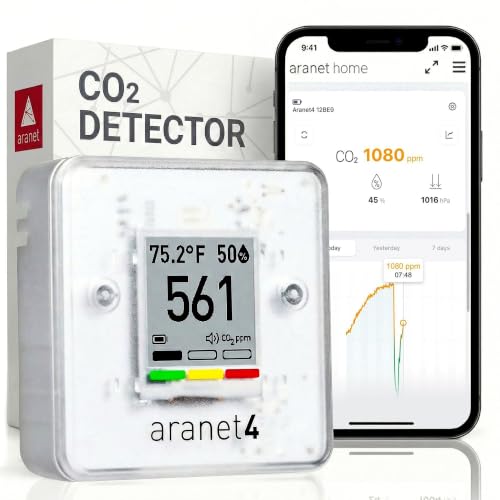
For a bedroom you sleep in every night, the first question is not which monitor is most accurate on paper but which one you will actually leave running. The SAF Aranet4 is the strongest pick here because the listing publishes a battery life of up to four years on an e-ink display, which means no cable across the room and no weekly charging ritual; it also logs up to 90 days of history for a smartphone app. The GOWENIC Wall Mount is the value alternative if you want a wall-mounted unit with an NDIR sensor and audible alarms, though its listing publishes no accuracy figure at all. The Airthings 2960 View Plus is the pick if you also want radon and particulate data from the same device, but it needs WiFi and an account to function, which is a real constraint in a bedroom.
Why a bedroom is the hardest room to ventilate well
A living room gets traffic, doors opening, and people moving through it. A bedroom at night gets none of that. The door is usually shut, the window is usually shut because of noise or cold, and one or two people are breathing in a sealed volume for seven or eight hours. That is the worst combination for CO2 accumulation, and it is why a bedroom monitor needs to be judged differently from one that sits on an office desk.
The mechanism is simple arithmetic. An adult at rest exhales roughly 200 millilitres of CO2 per minute, and in a sealed room with no mechanical ventilation that output accumulates steadily. Outdoor air sits at around 420 parts per million in most populated areas. A small bedroom with the door closed can pass 1,000 ppm within an hour or two of sleep and keep climbing. The monitor is not measuring danger in the acute sense; it is measuring how stale the air has become, which correlates with how much of your exhaled breath you are rebreathing.
That is why the two specifications that matter most for this room are not the ones a spec sheet leads with. They are how long the device runs unattended, and how it behaves when the number crosses a threshold you care about. A monitor that needs charging every few days will end up unplugged. A monitor with no alarm will be ignored. The picks below are judged on those two things first, then on sensor type and data access.
The comparison table, built from listing facts only
| Pick | Sensor type stated | Parameters stated | Power / connectivity stated | Alarm stated | Calibration stated |
|---|---|---|---|---|---|
| SAF Aranet4 | Not stated in the listing bullets | CO2, temperature, relative humidity, atmospheric pressure | Battery up to 4 years; e-ink display; wireless | Optional buzzer; colour coding on display | Not stated in the listing bullets |
| Airthings 2960 View Plus | Electrochemical (stated for the sensor group) | Radon, PM2.5, CO2, VOCs, humidity, temperature, air pressure | Battery powered; WiFi required; app and account required; cloud storage | Air quality notifications via app | Not stated in the listing bullets |
| Sainlogic 16-in-1 | Not stated in the listing bullets | CO2, PM2.5, PM10, PM1.0, AQI, HCHO, TVOC, temperature, humidity | No app or WiFi required; mains or battery not stated | 7 user-defined thresholds; tri-colour LED; audible alarm can be muted | One-touch reset button for sensor recalibration |
| INKBIRDPLUS 6-in-1 | Not stated in the listing bullets | CO2, PM2.5, PM10, AQI, temperature, humidity | Not stated; colour backlit display | Sound when AQI exceeds 100 | 200 second automatic CO2 calibration routine |
| GOWENIC Wall Mount | NDIR | CO2, temperature, humidity | Wall mount; ABS housing; power source not stated | Audible and visual alarms on threshold breach | Automatic and manual modes |
The table exposes the biggest gap in this category: only two of the five listings name the CO2 sensor technology at all. NDIR, non-dispersive infrared, is the standard method for measuring CO2 in air, because it works by absorbing infrared light at the wavelength CO2 absorbs and does not drift the way chemical sensors do. If a listing does not say NDIR, you cannot assume it. That is not a reason to reject a monitor, but it is a reason to treat its absolute number with more caution and its trend with more confidence.
What the number on the screen actually means at 3am
Most people who buy a bedroom monitor are looking for a single answer: is this room fresh or stale. The number gives you that, but only if you know what it is doing. CO2 readings are not instantaneous truth. NDIR sensors sample the air in a small chamber, and the reading you see is a smoothed value from the last few seconds. The Sainlogic 16-in-1 states a 1.5 second sampling interval with a display refresh every one to two seconds, which is fast. The SAF Aranet4, the Airthings 2960 View Plus, the INKBIRDPLUS 6-in-1 and the GOWENIC Wall Mount do not publish a sampling interval, so you cannot compare them on response speed.
The more useful habit is to watch the trend across a night rather than the peak. A bedroom that reaches 1,400 ppm and then falls when the door opens is behaving differently from one that reaches 1,400 ppm and stays there until morning. The SAF Aranet4 addresses this directly with an app that shows up to 90 days of historical data, which is the feature that turns a single reading into a pattern. If you want to understand how a room behaves over weeks, that history matters more than a tenth of a percentage point of accuracy. There is a separate comparison of monitors that let you get that data out of the app, which is worth reading if you plan to keep records.
The common mistake is to treat the absolute number as a pass or fail grade. A reading of 900 ppm is not a health event. It is a signal that ventilation is falling behind occupancy. The monitor is a prompt to act, not a diagnosis.
The five monitors, and who each one suits
SAF Aranet4
Long battery life, e-ink display and 90 days of app history make it the easiest monitor to leave in a bedroom permanently.
Airthings 2960 View Plus
Adds radon, PM2.5 and VOC sensing to CO2, but requires WiFi, an account and cloud connectivity to work at all.
Sainlogic 16-in-1
A large 7.2 inch display with nine parameters and seven user-defined alert thresholds, with no app or WiFi needed.
INKBIRDPLUS 6-in-1
A simple CO2, PM2.5, PM10, AQI, temperature and humidity monitor with a 200 second manual CO2 calibration routine.
GOWENIC Wall Mount
A wall-mounted NDIR CO2 monitor with audible and visual alarms and switchable automatic or manual calibration.
Calibration, drift and the maintenance nobody mentions
Every CO2 sensor drifts, and the cheaper the sensor the faster it drifts. The standard fix is automatic baseline calibration, which assumes that at some point in a rolling window the room will see fresh outdoor air at roughly 400 ppm and resets the sensor to match. That assumption fails in a bedroom that is never ventilated. If the room genuinely never drops to outdoor levels, the monitor slowly recalibrates itself to a wrong baseline and starts under-reporting.
Three of the five listings address calibration explicitly. The INKBIRDPLUS 6-in-1 describes a 200 second manual routine: power the unit off, take it to a ventilated place, and hold three keys simultaneously. The GOWENIC Wall Mount offers switchable automatic and manual modes. The Sainlogic 16-in-1 has a one-touch reset button. The SAF Aranet4 and the Airthings 2960 View Plus do not publish a calibration method at all, which is a gap you should know about before buying either. For a bedroom, the practical advice is to open the window fully for ten minutes at least once a week, which gives any automatic baseline routine the fresh-air reference it needs and also happens to be good for the room.
The maintenance nobody mentions is the sensor’s exposure to the room. A monitor sitting directly beside a pillow will read the air you are breathing out, not the air in the room. A monitor on a windowsill in winter will read cold air pooling against the glass. Mount it at breathing height, a metre or more from the bed, away from direct sun and away from the door draught. The GOWENIC Wall Mount’s wall mount design makes this placement decision easier because it is designed to sit flush on a wall rather than on a surface.
Where a bedroom CO2 monitor stops being the right answer
A CO2 monitor tells you about ventilation. It does not tell you about combustion. If your bedroom contains a gas appliance, a flue, or an attached garage, the instrument you need is a carbon monoxide alarm, and a CO2 monitor is not a substitute for one. Carbon monoxide is a different molecule, it is produced by incomplete combustion rather than by breathing, and it is dangerous at concentrations far below anything a CO2 sensor is designed to resolve. No monitor on this page should be relied on for that job.
Similarly, a CO2 reading does not tell you about particulates. If the reason you are worried about the bedroom is wildfire smoke, traffic pollution or a nearby renovation, you need a particle monitor, and the CO2 number will be largely irrelevant to that question. The two measurements answer different questions and the instruments are not interchangeable. If your concern is smoke ingress, look at the dedicated comparison of particle monitors for smoke tracking rather than a CO2 device.
Finally, a monitor is not an alarm system in the life-safety sense. The Airthings 2960 View Plus includes radon sensing, which is genuinely useful because radon is a long-term exposure risk, but a radon sensor in a consumer monitor is a screening tool, not a certified measurement. If it reads high, the correct next step is a proper radon test, not a decision based on the monitor alone. Where a device is a safety device, know what it does not do.
How to choose between these five for a bedroom
Start with power. If you will not run a cable, the SAF Aranet4’s stated four-year battery life on an e-ink display is the only figure in this group that makes cordless operation genuinely maintenance-free. The Airthings 2960 View Plus is battery powered but needs WiFi and an account, which means it is not really a standalone device. The Sainlogic 16-in-1, the INKBIRDPLUS 6-in-1 and the GOWENIC Wall Mount do not publish a power source in their bullets, so you would need to confirm that before buying.
Then decide whether you want a screen or an app. The Sainlogic 16-in-1’s 7.2 inch display is the largest here and is designed to be read across a room, with three brightness levels and automatic brightening on alert. The SAF Aranet4 and the Airthings 2960 View Plus push data to a phone instead. For a bedroom, a screen on the wall can be more useful than an app, because you will see the number without unlocking anything.
Then decide whether you need more than CO2. The Airthings 2960 View Plus is the only pick that adds radon, PM2.5 and VOC sensing, which makes it the broadest instrument here, at the cost of connectivity requirements. The INKBIRDPLUS 6-in-1 and the GOWENIC Wall Mount are the narrowest, with CO2, temperature and humidity, which is often exactly enough for a bedroom. If you want to compare the wider field of CO2 monitors, including office and studio use cases, there is a broader roundup worth reading before you commit.
Recommended Tools


Products shown because their documented specifications fit this guide. Price and availability are on Amazon and can change.
Frequently Asked Questions
Do I actually need a CO2 monitor in a bedroom, or is opening a window enough?
Opening a window is enough to fix the problem, but the monitor is what tells you when to do it and whether it worked. In a sealed bedroom, CO2 can climb past 1,000 ppm within a couple of hours of sleep, and you cannot feel that reliably. The monitor turns an invisible condition into a number you can act on.
Is a CO2 monitor the same as a carbon monoxide alarm?
No. Carbon dioxide is what you exhale; carbon monoxide is a product of incomplete combustion and is dangerous at much lower concentrations. A CO2 monitor will not detect carbon monoxide and must never be used as a substitute for a CO alarm. If your bedroom has any combustion appliance or attached garage, you need a separate CO alarm.
What CO2 level should I aim for in a bedroom?
Outdoor air is around 420 ppm. Many guides treat 1,000 ppm as the point where ventilation is clearly falling behind, and 1,400 ppm or higher as a sign the room needs air soon. The listings here do not all publish the same thresholds, so set your own alert level based on what you want to know.
Why do some listings not say NDIR?
Because the manufacturer did not publish it in the bullets. NDIR is the standard infrared method for CO2 measurement and is more stable than chemical sensing, but if a listing is silent you cannot assume it is used. The GOWENIC Wall Mount is the only pick here that names NDIR explicitly. For the others, treat the trend as more reliable than the absolute figure.
Will these monitors work without WiFi?
the Sainlogic 16-in-1 states it works with no app or WiFi, and the SAF Aranet4, the INKBIRDPLUS 6-in-1 and the GOWENIC Wall Mount do not require an account in their listings. The Airthings 2960 View Plus is the exception: it requires WiFi, the Airthings app, and an account to function at all, with data stored in the cloud. That is a real consideration if your bedroom has weak signal.
How often do these need calibrating?
The listings do not publish a calibration interval. The INKBIRDPLUS 6-in-1 describes a 200 second manual routine, the GOWENIC Wall Mount offers automatic and manual modes, and the Sainlogic 16-in-1 has a one-touch reset. The SAF Aranet4 and the Airthings 2960 View Plus do not state a method. The practical approach is to fully air the room at least weekly so any automatic baseline routine has a fresh-air reference.
Affiliate disclosure: Akermin earns a commission from qualifying Amazon purchases made through links on this page. Our editorial picks are based on documented specifications and owner feedback, not commissions.