
Best Gas Detectors for Confined Spaces: 9 Trusted Picks for Serious Safety
Nine detectors judged against confined space entry, starting with oxygen, and honest about which listings publish an alarm threshold and which publish nothing.
Read Guide→Gas leak detectors, CO, methane, refrigerants and multi-gas meters.

Nine detectors judged against confined space entry, starting with oxygen, and honest about which listings publish an alarm threshold and which publish nothing.
Read Guide→
Ten detectors an HVAC technician can actually use, split into portable instruments for the van and fixed monitors for plant rooms, with stated ranges.
Read Guide→Nine portable sniffers sorted by the gas each listing actually names, with the stated range and resolution where a manufacturer publishes one.
Read Guide→
Nine workplace monitors compared on gases covered, pump sampling and stated calibration, including two single-gas units for gases a quad misses.
Read Guide→
Ten methane and natural gas detectors compared on what the listings actually state: ppm range, probe length, alarm type and power.
Read Guide→
A comparison of the three rugged field gas detectors in this set, plus why two household and RV alarms were excluded.
Read Guide→A comparison of four rechargeable gas detection instruments, separating multigas safety monitors, fixed hydrogen monitors and handheld sniffers by the job each one does.
Read Guide→Four gas monitors with vibration alarms, compared on detection capability, alarm channels, battery life and the maintenance their listings imply.
Read Guide→
A comparison of five methane-capable detectors for professional leak location, separating trace sniffers from multigas safety monitors.
Read Guide→A comparison of four combustible and ammonia gas detectors, separating true ppm instruments from leak-intensity sniffers.
Read Guide→
A comparison of four boat cabin gas alarm options, from a fixed propane control system to a clip-on hydrogen sulfide monitor, with the gaps in each listing stated plainly.
Read Guide→A comparison of five combustible gas detectors for propane heater service, sorted by whether they locate leaks or only alarm.
Read Guide→
Plug-in combustible gas monitor with a color screen showing live ppm, temperature and humidity and an alarm of 85 dB or more. No UL listing or threshold stated.
Read Review→
Compact flush-mount 12-volt RV alarm for propane and CO, 108 mA draw, mute with rapid recovery, UL 2034 RV and UL 1484 RV. Replaces Atwood 31013 and 31014.
Read Review→
Flush-mount 12-volt RV propane alarm: alarms below 25 percent LEL, 85 dB, mute button, self-cleaning sensor, 90 mA draw. Replaces most CCI Controls units.
Read Review→
Methane and propane sniffer with five LED thresholds above 40, 80, 160, 320 and 640 ppm, a beep rate that tracks concentration and an earphone jack with mute.
Read Review→
Trade-grade sniffer with a 16-inch flexible probe, adjustable sensitivity, visual, audible and vibration alerts and a field-replaceable sensor. No stated range.
Read Review→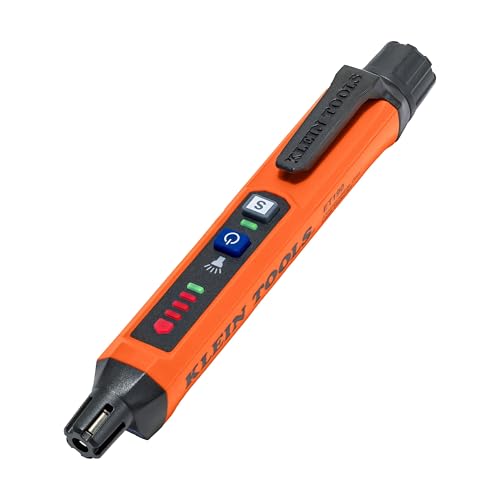
Pen-sized Klein sniffer covering 50 to 2,000 ppm with LED and tone alerts, High and Low sensitivity modes and a 30-second auto-zero. No probe, no readout.
Read Review→
Rechargeable gas sniffer with a 12-inch telescoping steel probe, percent LEL display from 1 to 20 percent, built-in flashlight and Type-C charging.
Read Review→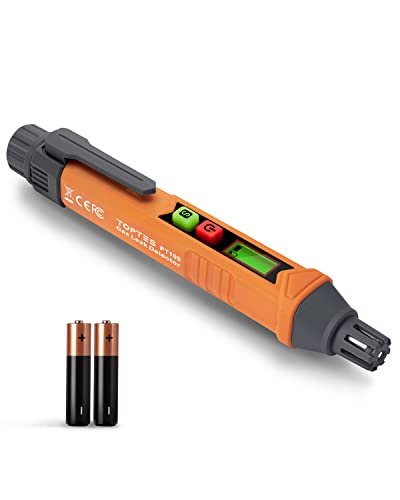
Pocket gas sniffer covering 50 to 1,000 ppm of methane, with a red-screen alarm, 30-second warm-up, 5-minute auto-off and two AAA cells. No number shown.
Read Review→
A technician-grade sniffer with an 18-inch gooseneck, a tip light, a 10 second warm-up and a tic-rate alert that speeds up as you approach the leak.
Read Review→
A pocket sniffer with a 4-inch probe that shows a two-digit percent LEL reading from 1 to 10 percent, with a red-screen alarm, 75 dB buzzer and two AAA cells.
Read Review→
A 17-inch gooseneck sniffer with a seven-bar display, 75 dB alarm, mute and auto power-off, covering about 50 to 10,000 ppm of methane on three AAA batteries.
Read Review→A gooseneck gas sniffer with two sensitivity ranges, five LEDs and an 85 dB alert. No numeric readout, but simple and sturdy for occasional home use.
Read Review→A gooseneck finds leaks faster on fittings you cannot reach: behind ranges, above water heaters, inside RV cabinets. A fixed probe deploys faster in the open.
Read Article→Warm-up brings a sniffer sensor to working temperature and sets its clean-air baseline. Skip it, or run it next to the leak, and the tool under-reads.
Read Article→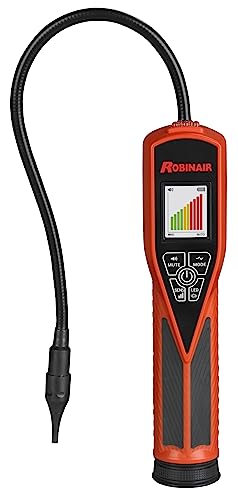
Tracer gas testing fills an empty system with 5 percent hydrogen in 95 percent nitrogen and sweeps with a hydrogen detector. No refrigerant is vented.
Read Article→PPM is parts per million: gas molecules per million molecules of air. 10,000 ppm is 1 percent by volume, and 50,000 ppm of methane is its explosive limit.
Read Article→
A single-gas monitor watches one known hazard; a four-gas monitor watches O2, LEL, CO and H2S in unassessed spaces. Confined-space entry needs four-gas.
Read Article→
Refrigerant detectors sense halogenated refrigerants; combustible gas detectors sense methane and propane. Only a dual-chemistry unit like the DRX3 does both.
Read Article→The PT520A adds a 17-inch gooseneck, a 50 to 10,000 ppm range, a mute and a case. The PT199 is pocket-sized, tops out at 1,000 ppm and costs less shelf space.
Read Article→Both cover 50 to 10,000 ppm of methane on a gooseneck. The ET120 wins on volume and two switchable ranges; the PT520A on mute, auto power-off and finer bars.
Read Article→
A laundry room with a gas dryer gets its own alarm, high for natural gas or low for propane, clear of exhaust, lint and steam. Sweep the connector after moves.
Read Article→A room with a gas fireplace gets its own gas alarm, high on a side wall for natural gas or low for propane, never on the mantel, plus a CO alarm per its manual.
Read Article→
A plug-in gas alarm needs no permission or drilling and leaves with you. Put it in the kitchen outlet farthest from the stove; add a pocket sniffer for move-in.
Read Article→For any home with gas piped in and people sleeping there, yes. A fixed alarm covers the hours your nose is off duty; a sniffer finds the bad connector.
Read Article→