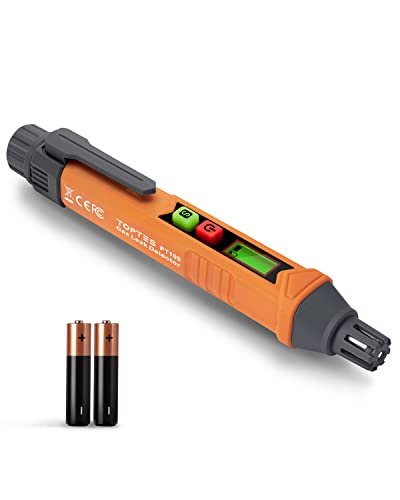
TOPTES · PT199 Natural Gas Leak Detector with Audible & Visual Alarm, Portable Gas Sniffer to Locate Combustible Sources Like Methane, Propane for Home(Includes Battery x2)-Orange
View on AmazonPrice and availability are shown on Amazon and can change at any time.
Verdict
The TopTes PT199 is the sniffer to keep in a kitchen drawer or an RV glovebox if all you need is a fast answer to “is this fitting leaking?” The manufacturer specifies a 50 to 1,000 ppm detection range based on methane, an alarm that triggers within 0.5 seconds and grows stronger with concentration, an LCD that turns red at high levels, a 30-second warm-up, automatic power-off after 5 minutes of inactivity and two included AAA cells. It does not show a number, does not read percent LEL and stops at a concentration that is a small fraction of the level at which methane can ignite. Within those limits, the listing and owner reports agree that it does the one job of locating small leaks.
Who It Is For
- Homeowners who want a quicker check than soapy water after reconnecting a range or dryer.
- RV and camper owners who check the regulator, hoses and appliance connections at the start of each trip.
- Anyone who owns a fixed alarm and wants a small tool to find which fitting set it off.
It is the wrong tool for anyone who wants a reading they can write down, who needs to reach fittings deep behind an appliance, or who expects it to watch a room. The handheld versus fixed comparison explains why a sniffer and a fixed alarm are different purchases.
Documented Specifications
| Item | Manufacturer or listing statement |
|---|---|
| Gases | Natural gas, methane, propane, butane, LPG and other combustible gases |
| Detection range | 50 to 1,000 ppm, based on methane |
| Response | Visual and audible alarm within 0.5 seconds; intensity rises with concentration |
| Display | LCD; screen turns red at high gas levels |
| Warm-up | 30 seconds after power-on |
| Auto power-off | After 5 minutes with no operation and no gas detected |
| Low battery | Indicator activates below 2.4 volts |
| Power | Two AAA cells, included |
| Detection distance | 1 to 5 cm from the suspected source |
| Alarm volume | Not stated on the listing |
| Sensor type | Not stated on the listing |
The listing gives no decibel figure for the buzzer, unlike the PT210S and PT520A listings, and does not name the sensor. A 30-second warm-up is typical of heated semiconductor sensors, but that is an inference, not a manufacturer statement; how MOS gas sensors work explains what it would mean for interferents such as alcohol and solvents.
What 50 to 1,000 ppm Means in Practice
Methane reaches its lower explosive limit at about 5 percent by volume, or 50,000 ppm. The PT199 tops out at 1,000 ppm, so its entire range sits below 2 percent of the LEL. That is not a weakness for a locator; small leaks at a flare fitting or a flexible connector live in exactly this band, and a tool that saturates at 1,000 ppm still points you to the right joint. What it cannot do is tell you whether a space is safe to be in. If the alarm is at full intensity as soon as it warms up, you are not looking at a small leak, and the answer is to leave rather than keep sweeping. The article on whether gas detectors find small leaks puts the 50 ppm floor in context.
Warm-Up, Distance and Sweep Speed
Three habits get the most out of a sniffer in this class. Switch it on in clean air and let the 30-second warm-up finish before you approach the fitting; a unit powered up next to a leak treats that air as normal. Hold the tip within the 1 to 5 cm the manufacturer specifies, because the sensor responds to gas that actually reaches it. And move slowly; owners who sweep a connector in two seconds and report “it found nothing” are usually outrunning the sensor. A minute per fitting is not excessive. Replace both AAA cells when the low battery light appears below 2.4 volts; sensors respond more slowly on weak cells. Using a combustible gas detector safely covers the full routine, including keeping ignition sources out of the room while you work.
Strengths
- Genuinely pocket-sized, with a bag for storage.
- Documented 50 ppm floor and 0.5 second response.
- Batteries included; no charging cable to lose.
- Red-screen alert that is easy to read while watching the probe tip.
Limitations
- No numeric or percent LEL readout.
- Range stops at 1,000 ppm; it cannot judge room safety.
- No probe or gooseneck; the sensor is in the body, so tight fittings are hard to reach.
- Alarm volume and sensor type are not published.
How It Compares
TopTes sells several pocket sniffers that are easy to confuse. The PT177 is the simplest, with five red LEDs and a 75 dB alarm in place of the PT199 screen, plus a shirt-pocket clip. The PT210S adds a 4-inch probe and a two-digit percent LEL readout from 1 to 10 percent, which is the upgrade for anyone who wants a number. The Klein ET190 is the closest pen-style rival, with a stated 50 to 2,000 ppm range, High and Low sensitivity modes and a pen clip. For fittings you cannot reach with a pocket unit, a gooseneck model such as the PT520A or a telescoping probe such as the PT760 is the better buy. The handheld gas leak detector roundup ranks the field, the combustible gas detector roundup covers the fixed alarms a sniffer should be paired with, and the gas leak detector guide covers both.
The Rule the Sniffer Does Not Change
A PT199 is for checking fittings in a room that does not smell of gas. If you walk into a strong gas odor or a fixed alarm is sounding, the sniffer stays in your pocket: get everyone out, leave switches and phones alone until you are outside, and call the gas utility or 911. A locator supplements that procedure; it never replaces it.
How We Research
This review is based on the manufacturer listing and documentation and on patterns in owner reports. We did not run laboratory tests. Where the listing does not give a figure, such as alarm volume and sensor type, we say so rather than fill one in.
Recommended Tools

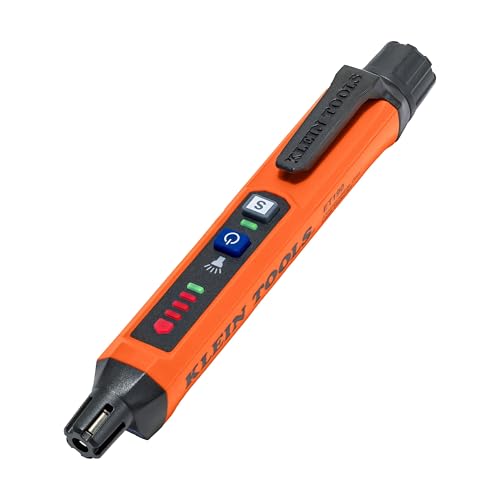

Products shown because their documented specifications fit this guide. Price and availability are on Amazon and can change.
Frequently Asked Questions
Why does the PT199 range stop at 1,000 ppm?
The manufacturer publishes 50 to 1,000 ppm based on methane, which is the low-concentration band where connector and valve leaks are found. Above that the alarm simply stays at full intensity. The tool is designed to say where a leak is rather than how large it is; the PT210S or PT760 shows a number if you need one.
Does the PT199 switch itself off in the middle of a long check?
The listing states that it powers off after 5 minutes without any button press or gas detection. On a slow sweep of a whole RV, press a button now and then to keep it awake. If it detects gas the timer resets on its own.
Can the PT199 be used on a propane grill or an RV?
Yes. The manufacturer lists propane, butane and LPG among the gases it detects and names RV owners as an intended user. Because propane sinks, sweep the low points: hose ends, the regulator, the cylinder valve and the floor of appliance cabinets. The published range is methane-based, so the alarm intensity will not map exactly to propane ppm.
What does the red screen on the PT199 mean?
The listing states that the LCD turns red when gas levels are high and that the alarm intensifies with concentration. It does not give a ppm figure for the color change, so treat red as confirmation of a leak that needs the leave-and-call procedure, not as a measurement.
Affiliate disclosure: Akermin earns a commission from qualifying Amazon purchases made through links on this page. Our editorial picks are based on documented specifications and owner feedback, not commissions.
Related Guides

Orabal 4-in-1 Plug-In Gas Detector Review: Live ppm Without a Listing
Plug-in combustible gas monitor with a color screen showing live ppm, temperature and humidity and an alarm of 85 dB or more. No UL listing or threshold stated.
Read More→
Kidde COPDLG Review: Plug-In Explosive Gas and CO Alarm With AA Backup
Plug-in CO and explosive gas alarm with two AA backup cells, a display that shows CO ppm or GAS, low-level CO alerts at 30 to 70 ppm, 85 dB, 7-year warranty.
Read More→
Safe-T-Alert 25-742 Review: Dual Propane and CO Alarm for RVs
Compact flush-mount 12-volt RV alarm for propane and CO, 108 mA draw, mute with rapid recovery, UL 2034 RV and UL 1484 RV. Replaces Atwood 31013 and 31014.
Read More→