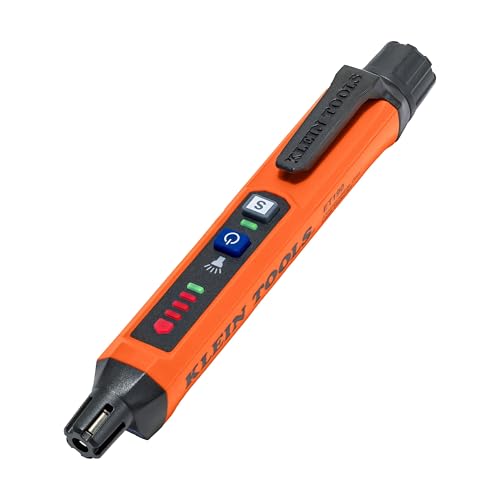
KLEIN TOOLS · Klein Tools ET190 Gas Leak Detector, Wide Detection Range, Audible and LED Alerts, Slim and Lightweight
View on AmazonPrice and availability are shown on Amazon and can change at any time.
Verdict
The Klein Tools ET190 is a combustible gas sniffer shrunk to the size of a marker pen, and that is both its reason to exist and its main limit. The manufacturer specifies a 50 to 2,000 ppm detection range, LED indicators with escalating audible tones, High and Low sensitivity modes, a 30-second automatic zeroing at start-up, a slim body with a sturdy pen clip and construction described as rugged. It has no gooseneck, no numeric display and no percent LEL scale. For a technician who wants a leak check tool in a shirt pocket, or a homeowner who wants a Klein-branded alternative to the TopTes pocket models, it is a sound choice. For anyone whose fittings are hard to reach, the ET120 with its 18-inch gooseneck is the better Klein.
Who It Is For
- Service technicians who carry a pen sniffer for quick checks and use a larger instrument for real diagnosis.
- Homeowners checking a range connector, a dryer hookup or a grill regulator a few times a year.
It suits none of these people if the fitting is behind a slide-in range or deep in a furnace cabinet; the sensor is in the body and has to be brought to the joint. The handheld versus fixed comparison also matters here: the ET190 does not monitor a room while you sleep.
Documented Specifications
| Item | Manufacturer or listing statement |
|---|---|
| Detection range | 50 to 2,000 ppm (reference gas not stated on the listing) |
| Sensitivity modes | High and Low, toggled by the user |
| Alerts | LED indicators and escalating audible tones |
| Start-up | 30-second automatic zeroing |
| Form | Slim, lightweight, pocket-sized, with a pen clip |
| Intended use | Residential, commercial and industrial environments (listing wording) |
| Alarm volume, battery type, number of LEDs, sensor type | Not stated on the listing |
The gaps matter more on this listing than on most. The ET120 listing specifies methane as the basis for its ppm figures and quotes an 85 dB alarm; the ET190 listing quotes neither. We report the range as Klein states it and do not assume the rest carries over.
The 50 to 2,000 ppm Range in Context
A 50 ppm floor is where consumer sniffers cluster, and it is low enough to find the slow leak at a flare nut that soapy water misses. The 2,000 ppm ceiling is where the ET190 parts company with the ET120 (10,000 ppm) and with the percent LEL units from TopTes. Against the roughly 50,000 ppm at which methane reaches its lower explosive limit, 2,000 ppm is 4 percent of the way there, so the ET190 saturates long before a room becomes dangerous. Full scale therefore means “at least this much, stop and follow the leak procedure,” not a measurement. The article on what LEL means sets out the scale, and can gas detectors detect small leaks covers the low end.
Two Sensitivity Modes
High and Low do the same job on the ET190 as on the ET120: High is for searching, Low is for pinpointing. The ET190 listing does not give the ppm span of each mode, whereas the ET120 listing does (50 to 1,000 and 1,000 to 10,000 ppm). In use the method is the same. Sweep in High until the alerts peg, switch to Low, and sweep the same area again; the fitting that still lights the LEDs in Low is the leak. Owners who search in Low from the start report missing small leaks, which is the mode working as designed.
The 30-Second Auto-Zero
At power-up the ET190 samples the surrounding air for 30 seconds and treats it as the baseline. This is convenient and it is also the most common reason owners think a sniffer is broken: switched on beside the leak, it zeroes on the leak. Start it in a hallway or outdoors, wait out the countdown, then walk to the suspect fitting. Zeroing is not calibration; the sensor still ages and drifts, as explained in why gas detectors need bump tests and calibration, and how to test a gas leak detector gives a safe way to confirm the ET190 responds before you rely on it.
Strengths
- Genuinely pocketable, with a clip that holds it in a shirt pocket.
- Stated 50 ppm floor, matching larger sniffers.
- Two sensitivity modes and automatic zeroing, like the ET120.
- Established tool brand with wide availability of owner feedback.
Limitations
- No gooseneck or probe; reach is limited to where the body fits.
- No numeric or percent LEL readout.
- 2,000 ppm ceiling, the lowest of the sniffers we cover.
- Alarm volume, battery type and reference gas are not published.
How It Compares
The natural comparison is Klein’s own ET120: same two-mode idea and auto-zero, but an 18-inch gooseneck, a documented methane-based range to 10,000 ppm, five LEDs and an 85 dB alarm, at the cost of pocketability. Among pen-style rivals, the TopTes PT199 quotes 50 to 1,000 ppm with a red-screen alarm, 5-minute auto-off and included AAA cells, and the TopTes PT177 uses five red LEDs, a 75 dB alarm and a pocket clip. If you want a pen sniffer that shows a number, the TopTes PT210S with its percent LEL display is the answer. The handheld gas leak detector roundup ranks them all, fixed alarms are in the combustible gas detector roundup, and the gas leak detector guide covers the category.
One Thing a Pocket Sniffer Cannot Do
It cannot make a gas-filled room safe to search. If you notice a strong gas smell or an alarm is sounding, leave the ET190 in your pocket, get everyone outside without touching switches or phones, and call the gas utility or 911. Use the sniffer afterward, once the utility has cleared the building, to find what leaked.
How We Research
This review is based on the manufacturer listing and published product information and on patterns in owner reports. We did not run laboratory tests. Where the ET190 listing does not state a figure, we have not borrowed one from the ET120.
Recommended Tools

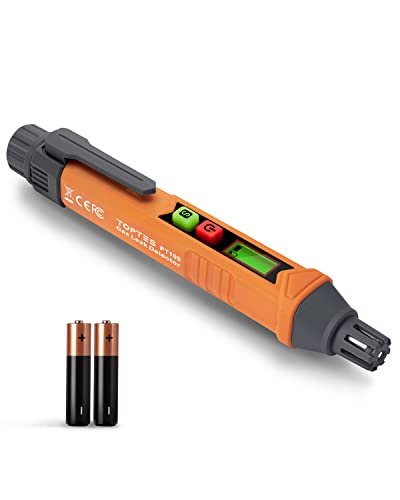

Products shown because their documented specifications fit this guide. Price and availability are on Amazon and can change.
Frequently Asked Questions
Does the ET190 use the same sensor as the ET120?
The listings do not say. The two share the High and Low sensitivity idea and automatic zeroing, but the published ranges differ, 50 to 2,000 ppm for the ET190 against 50 to 10,000 ppm for the ET120, so treat them as separate instruments rather than one sensor in two cases.
Which gas is the ET190 range based on?
The ET190 listing does not name a reference gas. Klein quotes the ET120 range on methane, and it is reasonable to read the ET190 the same way, but the manufacturer has not stated it on this listing. Expect the alerts to respond to propane and butane as well, at thresholds that will not match the methane figures.
Can I skip the 30-second zeroing on the ET190?
No, and you would not want to. The zeroing runs automatically at power-up and sets the baseline from the surrounding air. Start the unit in clean air away from the suspected leak; starting it beside a leak makes that leak the baseline and hides it.
Which sensitivity mode should I start in?
High. It is the search setting for small leaks. Switch to Low once the alerts are at full intensity and you want the LEDs and tone to become useful again for narrowing the leak to a single fitting.
Affiliate disclosure: Akermin earns a commission from qualifying Amazon purchases made through links on this page. Our editorial picks are based on documented specifications and owner feedback, not commissions.
Related Guides

Orabal 4-in-1 Plug-In Gas Detector Review: Live ppm Without a Listing
Plug-in combustible gas monitor with a color screen showing live ppm, temperature and humidity and an alarm of 85 dB or more. No UL listing or threshold stated.
Read More→
Kidde COPDLG Review: Plug-In Explosive Gas and CO Alarm With AA Backup
Plug-in CO and explosive gas alarm with two AA backup cells, a display that shows CO ppm or GAS, low-level CO alerts at 30 to 70 ppm, 85 dB, 7-year warranty.
Read More→
Safe-T-Alert 25-742 Review: Dual Propane and CO Alarm for RVs
Compact flush-mount 12-volt RV alarm for propane and CO, 108 mA draw, mute with rapid recovery, UL 2034 RV and UL 1484 RV. Replaces Atwood 31013 and 31014.
Read More→