As an Amazon Associate, Akermin earns from qualifying purchases. Product links on this page are affiliate links.

KLEIN TOOLS · Klein Tools ET120 Gas Leak Detector
View on AmazonPrice and availability are shown on Amazon and can change at any time.
Verdict
The Klein Tools ET120 is the right handheld sniffer for someone who wants to check a range connector, a water heater union or a grill regulator a few times a year without learning an instrument. It has an 18-inch flexible gooseneck, two sensitivity ranges that together span roughly 50 to 10,000 ppm of methane, five red LEDs and an 85 dB tone that both escalate as concentration rises, and an automatic zeroing routine at power-up. It does not display a number, does not read percent LEL and is not a substitute for a fixed alarm that runs while you sleep. Within those limits the manufacturer documentation and owner reports agree that it does its one job well.
Who It Is For
- Homeowners who install or reconnect gas appliances and want a faster check than soapy water.
- Anyone who has a fixed alarm and wants a tool to find which fitting set it off.
- RV and grill owners checking regulators, hoses and cylinder connections each season.
It is a poor fit for someone who wants to document a concentration, who needs a compact pocket unit, or who expects one device to monitor a room continuously. The handheld versus fixed detector comparison explains that last point.
Documented Specifications
| Item | Manufacturer or listing statement |
|---|---|
| Detection range | Approximately 50 to 10,000 ppm, based on methane |
| Sensitivity settings | High (50 to 1,000 ppm) and Low (1,000 to 10,000 ppm) |
| Visual alert | Five red LEDs that light progressively with concentration |
| Audible alert | 85 dB, intensifies as concentration increases |
| Probe | 18-inch flexible gooseneck, clips to the meter body for storage |
| Calibration | Automatic zero-point calibration at power-up; LEDs flash during self-calibration |
| Readout | LED bar only; no numeric or percent LEL display |
The listing does not name the sensor technology. Handheld sniffers in this class typically use a heated semiconductor sensor, which is consistent with the warm-up and zeroing behavior described, but treat that as an inference rather than a specification.
Sensitivity Ranges in Practice
The two ranges are the most useful feature and the one owners most often misunderstand. In High, the five LEDs cover roughly 50 to 1,000 ppm, which is the range where a small connector leak lives; this is the setting for searching. In Low, the same five LEDs cover 1,000 to 10,000 ppm. Switch to Low once you have found a leak that lights every LED in High and you want to narrow it to a single fitting; the bar becomes meaningful again instead of sitting at full scale. Neither range reaches the lower explosive limit of methane, which is about 50,000 ppm, so the ET120 is a locator for small leaks, not an instrument for judging whether a room is safe to enter. For that distinction, see what LEL means on a gas detector.
Gooseneck and Handling
The 18-inch gooseneck is what separates this from pocket sniffers. It reaches behind a range without pulling the appliance out, follows a flex connector around a corner and gets to the union on top of a water heater in a tight closet. Sweep slowly; sensors of this type take a moment to respond and a moment longer to recover, so a fast pass can miss a small leak entirely. The gooseneck clips to the body for storage, which owners describe as convenient though the clip is a plastic part to treat with some care.
Alerts
Five LEDs and an escalating tone suit a sniffer, because in use you are watching the probe tip, not a screen. The tone rising as you approach a fitting locates the leak without looking. At 85 dB it is loud in a quiet basement; owners occasionally wish for a mute, which this model does not list.
Warm-Up and Zeroing
The ET120 zeroes itself at power-up, taking the surrounding air as clean. That is convenient but has one consequence: if you switch it on in a room that already contains gas, it will treat that concentration as baseline and under-report. Power it on in clean air, wait for the flashing to stop, then move to the suspected leak. Owners who report “it does not detect anything” have often started it right at the leak. Zeroing is not calibration in the instrument sense; why gas detectors need bump tests and calibration covers the difference, and how to test a gas leak detector shows a safe way to confirm the ET120 responds before you rely on it.
Strengths
- Two documented sensitivity ranges that make both search and pinpointing practical.
- Long flexible gooseneck that reaches real appliance fittings.
- Simple LED and tone interface; nothing to configure.
- Established tool brand with a broad range of owner reports to draw on.
Limitations
- No numeric or percent LEL readout.
- Upper range stops at 10,000 ppm, well below the explosive limit; it cannot judge room safety.
- No mute or headphone option listed.
- Bulkier than pen-style units, so it lives in a toolbox rather than a pocket.
How It Compares
Klein’s own ET190 is the pocket version: 50 to 2,000 ppm, a pen clip, the same two-mode idea, but no gooseneck. The TopTes PT520A matches the ET120 on range and gooseneck length, adds a mute button and auto power-off, and uses a seven-bar display at a lower 75 dB volume. The UEi CD100A is the technician’s pick with a tip light and a tic-rate alert that many HVAC owners prefer. The ET120 sits between them as the plain, sturdy homeowner option. The full field is ranked in the handheld gas leak detector roundup, with fixed alarms in the combustible gas detector roundup and everything together in the gas leak detector guide.
One Rule the Tool Does Not Change
A sniffer is for checking fittings in a room that does not smell of gas. If you walk into a strong gas odor, the ET120 stays in the toolbox: leave, do not operate switches, and call the gas utility or 911 from outside.
How We Research
This review is based on Klein Tools’ published specifications, the Amazon product listing and patterns in owner reports. We did not run laboratory tests, and the sensor-type comment above is an inference, not a manufacturer statement.
Recommended Tools
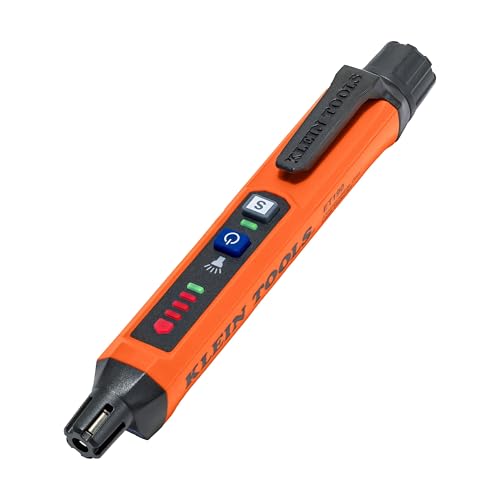


Products shown because their documented specifications fit this guide. Price and availability are on Amazon and can change.
Frequently Asked Questions
Does the Klein ET120 show a ppm number?
No. It indicates concentration with five red LEDs and a tone that intensify as the level rises. If you want a numeric or percent LEL readout, look at the TopTes PT210S or PT760 instead.
What is the difference between the High and Low sensitivity settings?
The manufacturer specifies High as covering roughly 50 to 1,000 ppm and Low as 1,000 to 10,000 ppm, based on methane. High finds small leaks; Low keeps the LEDs meaningful when you are close to a large leak that would peg the High range.
Does the ET120 detect propane as well as natural gas?
The manufacturer describes it as a combustible gas detector and quotes its ranges based on methane. Sensors of this type respond to propane, butane and other combustible gases as well, but the LED thresholds will not correspond exactly to the methane figures for those gases.
Why does it flash when I turn it on?
That is the automatic zero-point calibration. The unit samples the air it is switched on in and treats that as zero, so power it up in clean air away from the suspected leak, wait for the flashing to stop, and then start sweeping.
Affiliate disclosure: Akermin earns a commission from qualifying Amazon purchases made through links on this page. Our editorial picks are based on documented specifications and owner feedback, not commissions.
Related Guides

WiFi Natural Gas Alarm Review: One Unit Reveals the Whole Design
A WiFi natural gas alarm with an LCD showing gas concentration status and temperature, a stated response within 30 seconds, an alarm of at least 85 decibels and notifications to a phone app.
Read More→
Forensics Detectors Cl2 Review: 5 Percent of Full Scale Is 2.5 ppm
A rechargeable chlorine detector with an electrochemical sensor reading 0 to 50 ppm at 0.1 ppm resolution, a response time under 30 seconds, adjustable audible, visual and vibrating alarms and a supplied calibration certificate.
Read More→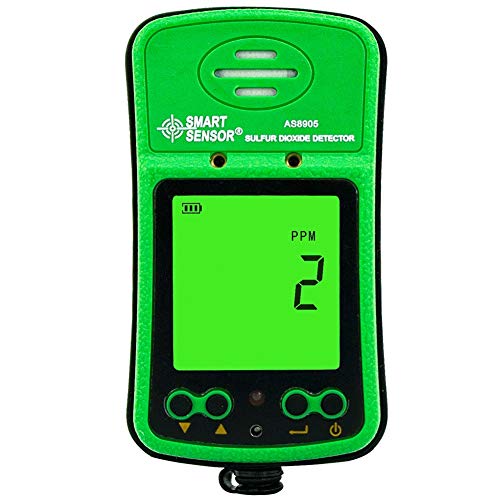
Smart Sensor SO2 Detector Review: 0.1 ppm Steps, No Accuracy Figure
A clip on sulfur dioxide monitor built on an electrochemical sensor, reading 0 to 20 ppm in 0.1 ppm steps, with adjustable high and low alarms signalled by sound, flash and vibration and a rechargeable cell quoted at 8 to 9 hours.
Read More→