As an Amazon Associate, Akermin earns from qualifying purchases. Product links on this page are affiliate links.
Three Tests, Three Different Answers
A gas leak detector can be tested three ways, and each one proves something different. Pressing the test button on a fixed alarm proves the unit has power and the horn works. Exposing a handheld sniffer to a puff of butane from an unlit lighter proves the sensor responds to fuel gas. Applying a known concentration of calibration gas, a bump test, proves that an instrument with a numeric display reads accurately. Most homeowners need the first two. The third applies to meters that show a number and to anyone using a detector for work.
| Test | Applies to | How often | What it proves |
|---|---|---|---|
| Test button | Plug-in and hardwired alarms | Per the manual, commonly monthly | Power, circuit and horn |
| Butane check | Handheld sniffers; fixed alarms only where the manual permits | Before use, or when in doubt | The sensor responds to fuel gas |
| Bump test | Meters with a percent LEL display; professional instruments | Per the manual, often before each working day | The reading is accurate at a known concentration |
The Test Button on a Fixed Alarm
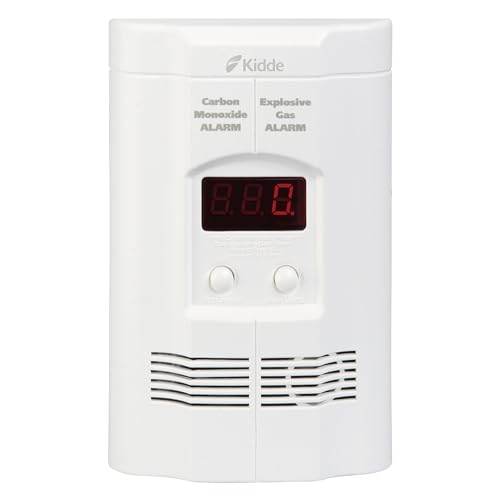
Every listed plug-in or hardwired gas alarm has a test button. Press and hold it, and the unit runs a self-check and sounds the horn. Do this on the manufacturer’s schedule, after power outages, and after the unit has been unplugged or moved. On the Kidde combination alarm with 9V backup, the listing states that peak-level memory records the last time the unit was tested, which is a convenient way to see whether anyone has actually done it. The Kidde COPDLG lists the same test-and-reset button and a backlit display.
Understand what the button does not do. It does not push gas at the sensor. A sensor that has drifted, been poisoned by solvents or reached the end of its service life will pass the button test and still miss a leak. That is why the sensor has a stated service life and why gas detectors do not last forever. The button is a health check for everything except the one part that matters most.
The Butane Check on a Handheld Sniffer
The practical way to confirm that a sniffer senses gas is to give it a small dose of butane from a disposable lighter without lighting it. Butane is a fuel gas of the same family as propane, and every combustible sensor responds to it.
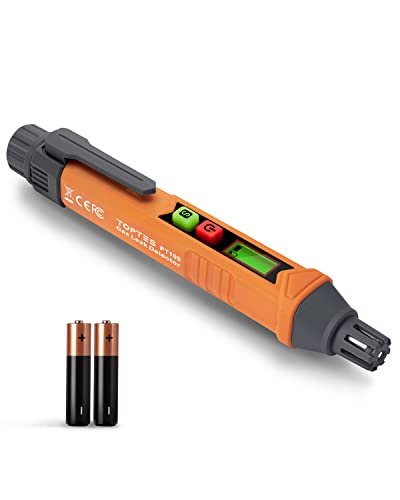
- Switch the sniffer on in clean air and let it complete its warm-up. The TopTes PT199 and PT520A listings state 30 seconds; the unit zeros itself during this time, so do not do it near the lighter.
- Move to a spot with no pilot light, candle, stove or other ignition source nearby, and with some air movement.
- Hold the lighter an inch or so from the probe tip, press the gas valve without striking the wheel, and release after about a second.
- Watch for the response: the LEDs, bars or beep rate should climb immediately. The PT520A listing states a response within 0.5 seconds.
- Move the probe away and confirm the reading falls back toward zero. A sensor that responds but is slow to recover is aging.
A one-second puff of butane is a tiny amount of gas in a ventilated space and cannot approach an ignitable concentration. Keep it that way: do not test in a closed cabinet, near a running appliance, or repeatedly in the same spot. The full safe-handling routine is in how to use a combustible gas detector safely.
Fixed alarms are a different matter. Some manufacturers permit a brief exposure to butane to confirm the sensor; others state that only the test button should be used and that flammable gas or aerosol near the unit can damage it or void the warranty. Read the manual for the model you own before trying it, and never spray anything at a mounted alarm.
When a Bump Test Applies
A bump test applies a known concentration of gas from a calibration cylinder and checks that the instrument alarms or reads within tolerance. It is the standard routine for professional multi-gas monitors and it applies to any consumer meter whose numeric reading you intend to rely on, such as the percent LEL display on a TopTes PT210S. For a relative-scale sniffer that is only used to find leaks, a bump test is more than the instrument can use; the butane check is sufficient. The reasons the routine exists, and the difference between a bump test and a full calibration, are covered in why gas detectors need bump tests and calibration.
What Not to Use
- The gas stove. Do not turn on a burner unlit to release natural gas at a detector. It is a real leak in a real kitchen, and it is the situation the detector exists to prevent.
- Aerosols at a fixed alarm. Hairspray, deodorant and cleaning sprays can set off a semiconductor sensor and leave residue on the element.
- Gasoline or solvent. Liquid fuels give an uncontrolled vapor dose and contaminate the probe.
- Testing during a suspected leak. If you already smell gas, the time for testing is over. Leave, do not operate switches, and call the gas utility or 911 from outside; the detector can be checked afterwards.
What a Failed Test Means
A fixed alarm that does not sound on the test button has a power or circuit fault: check the outlet, the backup battery and the end-of-life indicator, then replace it if those are fine. A sniffer that does not respond to butane after a proper warm-up with a good battery has a spent sensor. Some professional units, such as the RIDGID CD-100, list a field-replaceable sensor; consumer sniffers are generally replaced as a unit. The models in the best handheld gas leak detectors roundup and the best gas leak detectors guide all support the checks above, and how gas leak detectors work explains why warm-up and zeroing decide whether a test is valid in the first place. The Klein ET120, which zeros itself at power-up, is walked through in the Klein Tools ET120 review.
Recommended Tools


Products shown because their documented specifications fit this guide. Price and availability are on Amazon and can change.
Frequently Asked Questions
How often should I test a gas alarm?
Follow the schedule in the manual. Monthly use of the test button is the common manufacturer guidance for plug-in alarms, and after any power outage or move. Handheld sniffers should get a butane check before each use that matters.
Does the test button check the sensor?
No. It checks the power supply, the circuit and the horn. The sensor can be dead and the test button will still sound the alarm. Only exposure to gas checks the sensor.
Can I test with hairspray, a marker or rubbing alcohol?
A semiconductor sensor may respond to them, but that proves only that it reacts to solvents, and the residue can foul the element. Use butane, which is a fuel gas the detector is meant to sense.
My sniffer did not react to the lighter. Is it broken?
Check that it warmed up in clean air, that the battery is not low, and that it is in high-sensitivity mode. Hold the lighter closer and press the valve longer. If it still shows nothing, the sensor has reached end of life and the unit should be replaced.
Affiliate disclosure: Akermin earns a commission from qualifying Amazon purchases made through links on this page. Our editorial picks are based on documented specifications and owner feedback, not commissions.
Related Guides

WiFi Natural Gas Alarm Review: One Unit Reveals the Whole Design
A WiFi natural gas alarm with an LCD showing gas concentration status and temperature, a stated response within 30 seconds, an alarm of at least 85 decibels and notifications to a phone app.
Read More→
Forensics Detectors Cl2 Review: 5 Percent of Full Scale Is 2.5 ppm
A rechargeable chlorine detector with an electrochemical sensor reading 0 to 50 ppm at 0.1 ppm resolution, a response time under 30 seconds, adjustable audible, visual and vibrating alarms and a supplied calibration certificate.
Read More→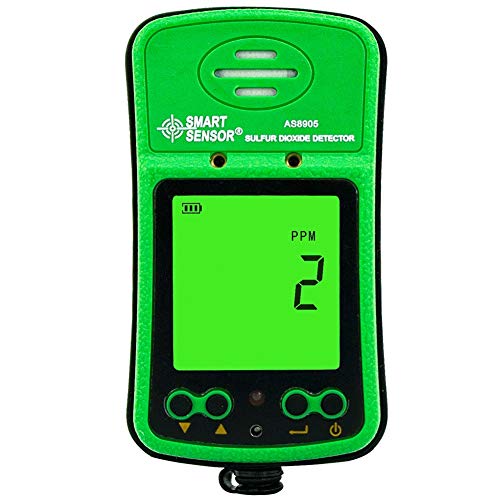
Smart Sensor SO2 Detector Review: 0.1 ppm Steps, No Accuracy Figure
A clip on sulfur dioxide monitor built on an electrochemical sensor, reading 0 to 20 ppm in 0.1 ppm steps, with adjustable high and low alarms signalled by sound, flash and vibration and a rechargeable cell quoted at 8 to 9 hours.
Read More→