As an Amazon Associate, Akermin earns from qualifying purchases. Product links on this page are affiliate links.
The Core Idea
Every consumer gas leak detector works the same way at its core. Air reaches a small sensing element that is kept hot by a built-in heater. When flammable gas touches the element, its electrical behavior changes: on a semiconductor sensor the resistance drops, on a catalytic sensor the element heats further as the gas burns on its surface. The electronics measure that change. In a fixed alarm the measurement is compared with a preset threshold and the horn sounds when it is crossed. In a handheld sniffer the measurement drives a rising scale of lights, bars or beeps so you can follow the gas to its source. The sensor chemistry is covered in detail in gas detector sensor types; this page is about what happens between the leak and the alarm.
How a Fixed Gas Alarm Works
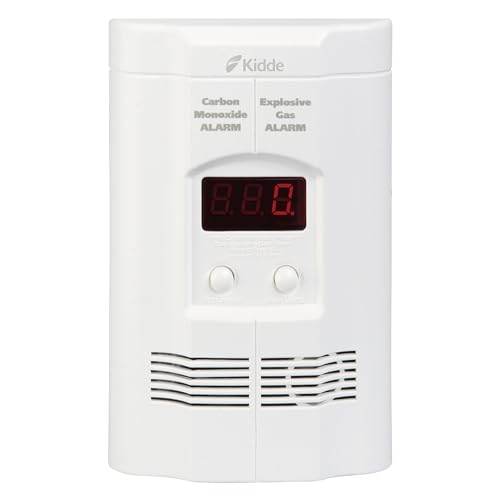
A plug-in or hardwired gas alarm is a monitoring device. It sits in one place with its sensor exposed through vents in the case, and gas reaches the sensor by diffusion and by the air currents in the room. The sensor is powered continuously, which is why most fixed gas alarms run from an outlet or a 12V supply rather than from a battery. The electronics watch the sensor signal and compare it with an alarm setpoint. That setpoint is expressed as a fraction of the lower explosive limit of the gas, commonly in the 10 to 25 percent LEL region depending on the product and the standard it is listed to, so that the alarm sounds well before the room could ignite. Some units show nothing until they alarm; the Kidde combination alarm, for example, displays a CO number in normal operation and the word GAS when the combustible sensor trips. Others, such as the Adorelf plug-in, display a live ppm-style reading alongside temperature and humidity.
Because a fixed alarm depends on gas diffusing to it, where it sits is as important as how it works. Natural gas rises and propane sinks, so the mounting height decides how early the sensor meets the gas. Placement for each fuel is covered in the best gas leak detectors guide and its placement pages.
How a Handheld Sniffer Works
A handheld gas leak detector is a locating tool. The sensor sits at the end of a probe, a rigid tube, a pen tip or a flexible gooseneck, and you move it along pipes, fittings and appliance connections. The display is relative rather than absolute on most consumer units: the Klein ET120 uses five red LEDs and an audible alert that intensify with concentration, the TopTes PT520A uses seven colored bars and a buzzer, and the UEi CD100A signals with a tick rate that speeds up as gas increases. You follow the rising signal to the point where it peaks, and that is the leak. A few models, including the TopTes PT210S and PT760, put a number on the display in percent LEL; those are discussed in what LEL means on a gas detector.
Sniffers are sensitive to low concentrations. The Klein ET120 listing states a range from about 50 to 10,000 ppm of methane with a high-sensitivity mode covering 50 to 1,000 ppm; the TopTes PT199 lists 50 to 1,000 ppm. A fixed alarm, by contrast, is silent at those levels by design. Sensitivity is a feature in a locating tool and a nuisance in an alarm, which is the core of handheld vs fixed gas detector.
Warm-Up and Zeroing
Two things happen when you switch a sniffer on. The heater brings the element to temperature, and the electronics record the sensor’s output in the current air as the zero point. Every later reading is measured relative to that zero. If you switch the unit on next to the suspected leak, it records gas as “clean air” and then under-reads or misses the leak entirely. That is why the listings are insistent: 30 seconds of warm-up in clean air for the TopTes sniffers, automatic zero-point calibration at power-up on the Klein ET120, a 30-second auto-zero on the Klein ET190. Fixed alarms do the same thing at power-up and typically show a warm-up indicator before they begin monitoring.
What the Readings Mean
| Device | What you see | What it tells you |
|---|---|---|
| Fixed alarm, no display | Silence, then a horn | Gas has reached the alarm threshold at the sensor’s position |
| Fixed alarm with display | A number or the word GAS | Live level at the sensor, then the alarm state |
| Sniffer with LEDs or bars | Rising lights and faster beeps | Relative concentration near the probe; follow it to the peak |
| Sniffer with percent LEL display | A one- or two-digit number | Approximate fraction of the explosive limit at the probe, referenced to methane |
What the Method Cannot Do
- It responds to more than fuel gas. Heated sensing elements react to alcohol, solvents, aerosols and gasoline vapor. A rising reading near a freshly cleaned surface is not necessarily a leak. Causes are listed in what can cause false gas detector readings.
- It takes time. Gas must diffuse to the element and the element must respond. Why gas sensor response time matters explains the consequences.
- It ages. The element degrades with heat and exposure, and eventually the unit must be replaced. See why gas detectors do not last forever.
- It does not replace your nose or the utility. The odorant in natural gas and propane is a detector everyone already owns. If you smell gas, leave, keep your hands off switches and phones until you are outside, and call the gas utility or 911. A detector, fixed or handheld, adds to that procedure and never replaces it.
For a walk-through of using a sniffer once you understand how it responds, see how to use a combustible gas detector safely, and for models see the best handheld gas leak detectors.
Recommended Tools


Natural-Gas-Detector with Plug-in Design, Gas-Leak-Detector with High Accuracy Sensor, Portable
View on AmazonProducts shown because their documented specifications fit this guide. Price and availability are on Amazon and can change.
Frequently Asked Questions
Why does a gas detector need a warm-up period?
The sensing element runs hot and needs time to reach operating temperature and settle. Listings state 30 seconds for the TopTes sniffers and 10 seconds for the UEi CD100A. The unit also sets its zero during this period, so it must warm up in clean air.
Does the detector sense the rotten-egg smell or the gas?
The gas. The sensor responds to the fuel itself. The mercaptan odorant is added for human noses and is not what the instrument is measuring.
Why does the reading fall as soon as I move the probe away from the fitting?
Gas dilutes quickly in room air. A leak produces a small plume around the source, and the concentration drops sharply within inches. That is why the TopTes PT520A listing tells you to bring the probe within 1 to 5 cm of the suspected source.
Do gas detectors work in an unheated garage or an RV in winter?
Within the operating temperature the manufacturer states. The Safe T Alert RV alarms list an operating range of minus 40 to plus 158 degrees F; many plug-in home units do not publish a range, so assume indoor conditions.
Affiliate disclosure: Akermin earns a commission from qualifying Amazon purchases made through links on this page. Our editorial picks are based on documented specifications and owner feedback, not commissions.
Related Guides

WiFi Natural Gas Alarm Review: One Unit Reveals the Whole Design
A WiFi natural gas alarm with an LCD showing gas concentration status and temperature, a stated response within 30 seconds, an alarm of at least 85 decibels and notifications to a phone app.
Read More→
Forensics Detectors Cl2 Review: 5 Percent of Full Scale Is 2.5 ppm
A rechargeable chlorine detector with an electrochemical sensor reading 0 to 50 ppm at 0.1 ppm resolution, a response time under 30 seconds, adjustable audible, visual and vibrating alarms and a supplied calibration certificate.
Read More→
Smart Sensor SO2 Detector Review: 0.1 ppm Steps, No Accuracy Figure
A clip on sulfur dioxide monitor built on an electrochemical sensor, reading 0 to 20 ppm in 0.1 ppm steps, with adjustable high and low alarms signalled by sound, flash and vibration and a rechargeable cell quoted at 8 to 9 hours.
Read More→