Best Gas Leak Detectors for Home: Fixed Alarms and Handheld Sniffers
A gas leak detector is two different products. A fixed alarm on the wall warns you when gas builds up; a handheld sniffer tells you which fitting is leaking. This guide picks the strongest of each from manufacturer specifications and explains which one a given home needs first.
As an Amazon Associate, Akermin earns from qualifying purchases. Product links on this page are affiliate links.
Our Top Picks
Fixed alarms and handheld sniffers do different jobs, so this list has both. Picks are based on manufacturer specifications, listing standards (UL 1484 for gas alarms, UL 2034 for CO) and recurring owner feedback; we did not run laboratory tests.
Best Fixed Alarm
Kidde COPDLG Explosive Gas and CO Alarm
Plug-in natural gas, propane and CO alarm with AA backup.
Detects natural gas, propane and low-level CO
Backlit display shows CO ppm or the word GAS
120V plug-in with two AA backup batteries
UL 2034 5th Edition, ETL listed, 7-year limited warranty
Specifications are the manufacturers' published figures at the time of research. Handheld sniffers locate leaks; only the fixed alarms are designed for continuous monitoring.
How to Choose a Gas Leak Detector
Four questions settle most purchases:
Alarm or Locator?
A wall alarm watches the room 24/7. A sniffer finds the fitting. Most homes with gas appliances eventually need both.
Which Gas
Natural gas rises; propane sinks. That decides mounting height, so buy for the gas your home actually uses.
Listing and Standard
For a fixed alarm look for UL 1484 (gas) and UL 2034 (CO). Uncertified plug-ins are a gamble in a safety role.
Power and Backup
Plug-in alarms should have battery backup. Sniffers need a warm-up in clean air, so battery state matters.
Do I need a gas leak detector if I already have a carbon monoxide alarm?
Yes, if you have gas appliances. A CO alarm senses carbon monoxide only; its sensor does not respond to methane or propane. A combination unit such as the Kidde COPDLG covers both, or you can add a dedicated gas alarm next to the CO alarm.
Which is better, a plug-in gas alarm or a handheld detector?
They are not alternatives. The plug-in alarm protects the house while you sleep; the handheld tells you which joint is leaking after the alarm sounds or after you smell gas. Buy the alarm first, the sniffer second.
Where should a gas leak detector go?
Natural gas detectors go high, near the ceiling in the room with the appliance. Propane detectors go low, near the floor. Both stay a few feet from the stove, away from windows, vents and dead-air corners. Manufacturer instructions override general rules.
What should I do if the alarm sounds?
Leave the building without switching anything on or off, including lights and phones, and call the gas utility or 911 from outside. Do not go back in to find the leak with a sniffer until the utility says the building is safe.
Reviews
Kidde COPDLG Explosive Gas and CO Alarm Best Fixed Alarm
The COPDLG is Kidde's current replacement for the long-running KN-COEG-3 and it is the fixed alarm most homes should start with. One unit at an outlet covers the three gases a house with gas appliances can produce: natural gas from a supply leak, propane if the house or a grill line uses LP, and carbon monoxide from a failing burner or flue.
The display is the practical advantage over a plain buzzer. It reads the CO level in ppm and switches to the word GAS when the combustible sensor trips, so you know which hazard you are dealing with before you open the door. Kidde states low-level CO alerts from 30 to 70 ppm with a separate pattern, and the 85 dB alarm is standard for the class.
The outlet decides placement. Wall outlets sit low, which suits propane (it sinks) and CO (it mixes), but is below the ceiling zone where methane collects. Kidde's manual accepts outlet mounting; for a natural-gas-only room with a high ceiling, a ceiling-zone detector is the better choice.
Strengths
Three hazards in one listed device
Digital display distinguishes gas from CO
AA backup keeps it working through an outage
Rotating plug fits vertical and horizontal outlets
A fixed alarm tells you that gas is present. The PT520A tells you where. Its 17-inch gooseneck reaches the flare fitting behind a range, the union on a water heater and the valve on a fireplace log set, and the seven-bar display rises as you move the tip closer to the leak, which is exactly how a leak is located.
TopTes specifies a 50 to 10,000 ppm methane range with a 0.5-second response and a 30-second warm-up in clean air. That range covers both the faint leak you would otherwise find with soapy water and the strong one you can already smell. The 75 dB alarm is quieter than a fixed alarm, which is fine for a tool held at arm's length.
It is not a monitor. Semiconductor sensors drift and react to solvents, so it should be zeroed in clean air each time and never left running as a substitute for a wall alarm.
Strengths
Long gooseneck reaches hidden fittings
Wide stated range from faint to strong leaks
Case and batteries included
Mute and auto power-off
Limitations
Not a certified alarm and not for continuous monitoring
Klein Tools ET120 Gas Leak Detector Best for Repeated Use
The ET120 is the sniffer for someone who will use it more than once a year: a landlord, a plumber or a homeowner who maintains gas appliances. Klein splits its range into a high-sensitivity band (50 to 1,000 ppm) for tracing a faint leak and a low-sensitivity band (1,000 to 10,000 ppm) for narrowing down a strong one without the alarm saturating.
The unit self-zeroes at power-up, which Klein signals with flashing lights, and the 18-inch gooseneck stores clipped to the body so the sensor tip is protected in a tool bag. The 85 dB alert is loud enough to hear over a furnace.
It costs more than a pocket sniffer and adds no numeric readout. If you want a %LEL figure on screen, the TopTes PT210S in our handheld guide is the alternative; if you want a pro-grade tool that will still be in the bag in five years, this is the one.
Short answer: put a Kidde COPDLG plug-in alarm in the room with your gas appliance, and keep a TopTes PT520A sniffer in the drawer for the day you smell something. Together they cover the two things a gas leak detector has to do: warn you that gas is building up, and show you which fitting is leaking. If you only buy one, buy the alarm.
Two products that share one name
Retail listings call both of these a gas leak detector, and that is where most buying mistakes start. A fixed alarm is a listed safety device that sits on a wall or in an outlet, samples the room continuously and sounds at a set fraction of the lower explosive limit. A handheld sniffer is a diagnostic tool with a semiconductor sensor on a gooseneck; it is silent until you hold it near a leak, and it is not designed or certified to guard a room. Our handheld vs fixed gas detector comparison goes through the differences in detail.
Which gas you have decides where the alarm goes
Natural gas is mostly methane, which is lighter than air and collects near the ceiling. Propane and butane are heavier than air and pool near the floor. That single fact decides mounting height, and it is why we keep natural gas detectors and propane detectors on separate pages. A plug-in alarm at outlet height is a compromise: good for propane and CO, low for methane. Kidde’s instructions accept it; for a natural-gas furnace room with a high ceiling, a ceiling-zone unit does the job better.
What the listing standards mean
UL 1484 is the US standard for residential gas detectors; UL 2034 covers CO alarms. A listed device has had its alarm threshold, false-alarm resistance and endurance checked by a laboratory. Several plug-in detectors on Amazon show no listing at all, and their feature bullets talk about sensitivity in vague terms. They may work, but in a safety role we would not rely on one as the only alarm. The Kidde units are listed; the handheld sniffers are tools and are not expected to be.
Handheld sniffers: what the numbers mean
Sniffers quote a methane range such as 50 to 10,000 ppm. The low end is what matters for finding a slow leak at a fitting; the high end matters for narrowing down a strong leak without the display saturating. Adjustable sensitivity, as on the Klein ET120, is the practical way to cover both. A gooseneck of 12 inches or more reaches the fittings behind a range or on top of a water heater, and a warm-up of 30 seconds in clean air before use is normal for the sensor type. Read how gas leak detectors work for the sensor background and what LEL means for the units on the more expensive models.
If you smell gas
None of these products replaces the basic procedure. If you smell the rotten-egg odorant or an alarm sounds, leave the building, do not operate switches, phones or appliances inside, and call the gas utility or 911 from outside. The sniffer is for afterwards, when the utility has confirmed the building is safe and you or a technician are tracing the source.
Products were compared on manufacturer documentation: gases detected, stated detection range, alarm level, power and backup, listing standards and warranty. Owner feedback was reviewed for recurring complaints such as false alarms near cleaning products and early sensor failure. We did not run laboratory tests and publish no measurements of our own. Amazon data supplies images, availability and links only.
A WiFi natural gas alarm with an LCD showing gas concentration status and temperature, a stated response within 30 seconds, an alarm of at least 85 decibels and notifications to a phone app.
A rechargeable chlorine detector with an electrochemical sensor reading 0 to 50 ppm at 0.1 ppm resolution, a response time under 30 seconds, adjustable audible, visual and vibrating alarms and a supplied calibration certificate.
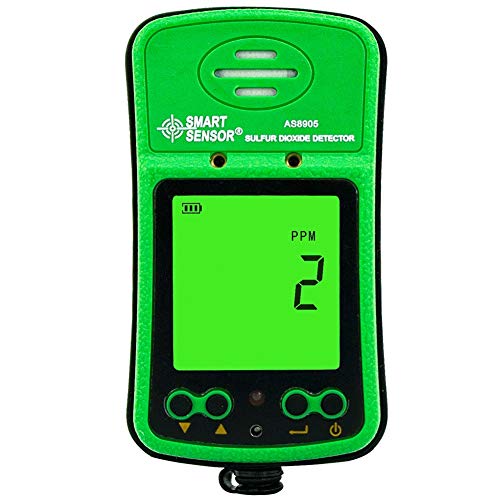
A clip on sulfur dioxide monitor built on an electrochemical sensor, reading 0 to 20 ppm in 0.1 ppm steps, with adjustable high and low alarms signalled by sound, flash and vibration and a rechargeable cell quoted at 8 to 9 hours.