A gas range is the appliance most people worry about and the hardest place to put a detector, because cooking fumes, steam and cleaning sprays all trigger cheap sensors. This guide picks kitchen-suitable alarms from manufacturer specifications and explains placement that avoids the false alarms.
As an Amazon Associate, Akermin earns from qualifying purchases. Product links on this page are affiliate links.
Our Top Picks
Kitchen detectors face cooking fumes, steam and sprays that trigger cheap sensors, so listing, placement and false-alarm resistance mattered more than feature count. Comparison used manufacturer documentation and owner feedback; no laboratory testing was carried out.
Best Overall
Kidde COPDLG Explosive Gas and CO Alarm
Listed plug-in for the outlet across the kitchen from the range.
Detects natural gas, propane and low-level CO
Display shows CO ppm or GAS
120V plug-in, two AA backup batteries
UL 2034 5th Edition, ETL listed, 7-year limited warranty
Manufacturer-published specifications at the time of research. Only the two Kidde units are listed alarms; the others are a supplementary monitor and locating tools.
How to Choose a Kitchen Gas Detector
Kitchens add three constraints to the usual rules:
Distance From the Range
A few feet away, on the far wall or by the door. Directly beside the stove means steam and fumes trip it and you unplug it.
Listed Alarm First
UL 1484 or a UL 2034 combination unit. A live-reading monitor is a useful second device, not the safety alarm.
Expect Sprays and Alcohol
Oven cleaner, degreaser and wine in a pan all trigger semiconductor sensors. Ventilate before you assume a leak.
Check the Connector
The flex line behind the range is the joint that moves. A pocket sniffer in the drawer checks it after every pull-out.
Not beside the range. Put a listed plug-in a few feet away on another wall or near the doorway, out of the path of steam and cooking fumes, and away from the window and the range hood. If the kitchen is on natural gas and has a high ceiling, a dedicated methane alarm near the ceiling on the far wall is the better position; for propane, low is correct.
Why does my kitchen gas detector go off when I cook?
Semiconductor gas sensors respond to alcohol, cooking vapors, aerosol sprays and cleaning products, and a unit placed beside the range gets all of them. Move it further away. If it still alarms with no cooking or sprays, treat it as a leak: leave, and call the gas utility from outside.
Does a gas range need a carbon monoxide alarm too?
Yes. An oven burner that is dirty or misadjusted produces carbon monoxide, and older ranges with pilot lights do it continuously. A combination gas and CO unit such as the Kidde COPDLG covers both; otherwise fit a CO alarm in the adjoining hallway.
How do I check the connector behind the range?
Pull the range forward a few inches, warm up a sniffer in clean air, and sweep the tip slowly around the shut-off valve, the flare nuts and the length of the flexible connector. Soapy water on the joints works too but is slower. Do this after any time the range has been moved.
Reviews
Kidde COPDLG Explosive Gas and CO Alarm Best Overall
A gas range produces the two things a kitchen alarm has to catch: a supply leak at the connector or a burner valve left open, and carbon monoxide from an oven burning badly. The COPDLG covers both from one outlet and the display tells you which sensor tripped, which in a kitchen full of smells is worth having.
Placement is the whole trick. Kidde's instructions, and every listed alarm's, keep the unit a few feet from the range so cooking fumes, steam from a pot and a burst of oven cleaner do not trip it. An outlet on the far wall or beside the doorway is the usual spot; the outlet directly behind the range is the wrong one. The AA backup keeps it running through an outage, and the rotating plug fits horizontal outlets under a counter.
It does not tell you where the leak is. For that, keep a pocket sniffer in the drawer.
Orabal 4-in-1 Plug-In Gas Detector Best Live Reading
The kitchen is the one room where a live reading earns its place. A burner that takes a few seconds to light, an oven with a lazy igniter or a pilot that blows out all release a small amount of gas, and a listed alarm stays silent because the level never approaches its threshold. The Orabal shows the ppm climb and fall, so a habit that is slowly getting worse becomes visible.
The listing states continuous monitoring of natural gas, methane, propane and LPG, a preset alarm at 85+ dB, and a brief warm-up. Temperature and humidity are on the same screen.
It states no UL listing and has no battery backup, and a semiconductor sensor at kitchen distance will react to alcohol in a sauce and to sprays. Use it as the monitor beside a listed alarm, placed where it can see the range but not breathe its steam.
TopTes PT210S Gas Leak Detector Best for the Stove Connector
The connector behind a gas range is the fitting that gets disturbed: the range is pulled out for cleaning or a new floor, pushed back, and the flare nut or the flexible line kinks. A pocket sniffer with a short probe is enough to check it, and the PT210S adds a %LEL number so you can tell the difference between a trace and a problem.
TopTes specifies a 0.5-second response, a screen that turns red as bars rise, a 75 dB buzzer and two sensitivity modes. The four-inch probe reaches the shut-off valve and the connector when the range is pulled forward a few inches, and it checks each burner valve from the top.
It is a check tool, not an alarm, and it needs a 30-second warm-up in clean air away from the stove. Anyone who wants the longer gooseneck for a water heater as well should look at the PT520A in the main guide.
Short answer: plug a Kidde COPDLG into an outlet a few feet from the range, on the far wall or by the kitchen door, and it will catch both a gas leak and carbon monoxide from the oven. Add an Orabal 4-in-1 if you want to see the level move when a burner is slow to light, and keep a TopTes PT210S in the drawer for checking the connector every time the range is pulled out.
Why the kitchen is the hard room
Every other room in a house with gas is simple: one appliance, one detector, mount it at the right height. The kitchen has the appliance you use every day, and everything that appliance does, from boiling pasta to searing a steak to the oven-cleaner cycle, produces vapors that a gas sensor responds to. Put a cheap detector beside the range and it alarms during dinner; owners unplug it, and then it protects nothing. The solution is a listed alarm placed at a distance, plus a check tool for the connector. What causes false gas detector readings lists the culprits.
Where to put it
A few feet from the range, out of the direct path of steam and the range hood, away from the window and the door draft, on a wall outlet at the far side of the room or by the doorway. Natural gas rises, so in a kitchen with a tall ceiling a dedicated methane alarm near the ceiling on that far wall catches a leak sooner than an outlet-height plug-in; Kidde’s plug-ins are designed and listed for outlet height and are acceptable in a standard kitchen. Propane sinks, and an outlet is already in its zone. The full rules, with distances, are in where to place a natural gas detector; how many gas detectors you need covers whether the kitchen alarm also serves the adjoining rooms.
Small releases that never trip an alarm
A listed alarm sounds at a fraction of the explosive limit, which is thousands of ppm. A burner that takes three seconds to light, a pilot that blows out, or an oven igniter on its way out releases a few hundred ppm near the range and never approaches that threshold. That is exactly what a live-reading monitor such as the Orabal shows, and it is the argument for having one in the kitchen even though it is not the safety device. Watch for a reading that climbs at the same time every day; that is a habit or a component, not a leak, and it can be fixed before it becomes one.
The connector behind the range
The flexible connector and its flare fittings are the joint that gets disturbed, every time the range is pulled out for cleaning, a new floor or a delivery. A pocket sniffer with a short probe checks it in a minute: pull the range forward, warm up the tool in clean air, and sweep the valve and both ends of the connector. The handheld detector guide compares the sniffers; for the water heater and furnace elsewhere in the house, a gooseneck model is the better buy.
Carbon monoxide from the oven
Gas ovens are a routine source of carbon monoxide, especially older ones with standing pilots or a burner that has gone yellow. A combination unit covers this from the same outlet; a CO-only alarm in the adjoining hallway is the alternative. Gas leak detector vs carbon monoxide detector explains why a CO alarm alone will not catch a gas leak, and the main gas leak detector guide covers the rest of the house. If you ever smell gas in the kitchen, do not switch anything, including the range hood; leave, and call the utility from outside.
How We Research
Products were compared on manufacturer documentation: gases covered, listing standard, power and backup, readout and alarm level. Owner feedback was reviewed specifically for kitchen false alarms and placement problems. We did not run laboratory tests. Amazon data supplies images, availability and links only.
A WiFi natural gas alarm with an LCD showing gas concentration status and temperature, a stated response within 30 seconds, an alarm of at least 85 decibels and notifications to a phone app.
A rechargeable chlorine detector with an electrochemical sensor reading 0 to 50 ppm at 0.1 ppm resolution, a response time under 30 seconds, adjustable audible, visual and vibrating alarms and a supplied calibration certificate.
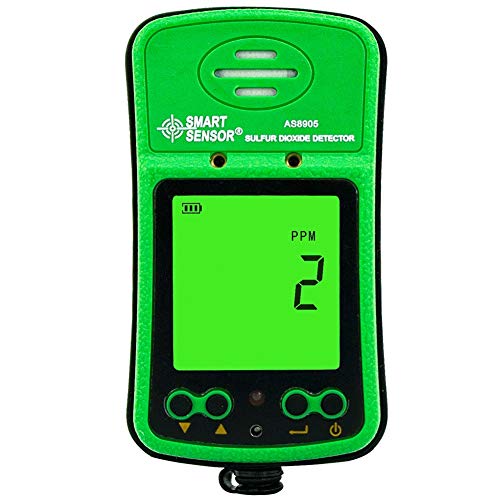
A clip on sulfur dioxide monitor built on an electrochemical sensor, reading 0 to 20 ppm in 0.1 ppm steps, with adjustable high and low alarms signalled by sound, flash and vibration and a rechargeable cell quoted at 8 to 9 hours.