As an Amazon Associate, Akermin earns from qualifying purchases. Product links on this page are affiliate links.
The right number of gas detectors is the number of rooms in which gas can leak, not a figure based on square footage. In practice that means: one combustible gas alarm in every room that contains a gas appliance or the gas meter, carbon monoxide alarms on every level and outside each sleeping area, and no more than one handheld sniffer for the whole household. For a typical gas-heated house with a kitchen range and a basement furnace and water heater, that works out to two combustible gas alarms, two or three CO alarms and one sniffer. The sections below show how to get to your own number.
Why You Count Rooms, Not Square Feet
Smoke and CO alarms carry coverage advice because those hazards spread through a house fairly evenly. A combustible gas leak does not. Natural gas rises and collects under the ceiling of the room it leaked into; propane sinks and pools on that room’s floor. A closed door, a stairwell or simply the distance across a large open plan can keep the gas away from a sensor in the next room until the concentration where it started is already dangerous. So the question for each room is simple: is there a gas pipe, connector or appliance in here? If yes, that room gets its own alarm.
Step 1: Combustible Gas Alarms
Walk the house and list every place gas is present.
- Kitchen with a gas range or cooktop. One alarm, placed for the fuel type and away from the stove itself; the kitchen gas detector roundup covers models built for that room.
- Furnace or water heater room, mechanical closet or basement. One alarm. If the furnace and water heater sit in different rooms, that is two.
- Laundry with a gas dryer. One alarm, unless it shares the mechanical room above.
- Garage with a gas water heater, a gas heater or stored propane cylinders. One alarm.
- Living room or bedroom with a gas fireplace, log set or wall heater. One alarm per room.
- Meter location, if it is indoors, as in some older houses and apartment buildings.
A room with two gas appliances still needs only one alarm, provided it is placed where gas from either could reach it. Long or oddly shaped rooms, and rooms where a large island or partial wall splits the ceiling into two dead-air zones, are the exception; a second alarm at the far end is reasonable there.
Step 2: Carbon Monoxide Alarms
CO alarms are a separate count because they guard against a separate hazard: exhaust from incomplete combustion rather than unburned fuel. The widely recommended minimum is one on every level of the home and one outside each separate sleeping area, and many manufacturers add one in any room with a fuel-burning appliance. A combustible gas alarm does not detect CO, and a CO alarm does not detect natural gas or propane; the article on gas leak detectors versus CO detectors explains why the two sensors cannot substitute for each other. If you want a display that shows the CO level in parts per million rather than a simple alarm, CO meter versus CO alarm covers the difference.
Where Combination Units Change the Count
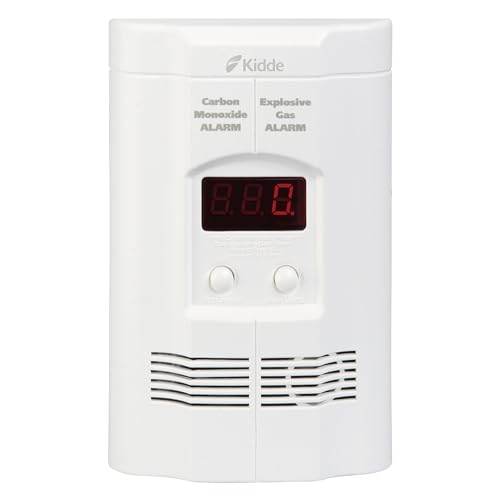
A combination explosive gas and CO alarm, such as the plug-in Kidde models, counts as both an explosive gas alarm and a CO alarm for the room it is in. That lets a kitchen or mechanical room be covered by a single device. It does not reduce the CO count elsewhere in the house, and it does not let one unit cover two rooms.
Step 3: One Handheld Sniffer
A handheld detector is a tool you switch on when you suspect a leak, want to check a new appliance connection or need to confirm what a fixed alarm is reporting. One per household is enough because it is never left running in a room. Models such as the Klein ET120 with its flexible gooseneck are designed for exactly this occasional use. The handheld versus fixed detector comparison explains why a sniffer cannot stand in for a fixed alarm, and vice versa.
Typical Counts by Home Type
| Home | Combustible gas alarms | CO alarms | Sniffer |
|---|---|---|---|
| Studio or one-bedroom apartment, gas range only | 1 (kitchen) | 1 or 2 (near sleeping area, plus one if the range is far from it) | Optional |
| Single-level house, gas range and gas furnace in a utility closet | 2 | 2 (one outside bedrooms, one near the furnace) | 1 |
| Two-story house with basement mechanicals, gas range, gas dryer in basement | 2 (kitchen, basement) | 3 (one per level) | 1 |
| House with gas fireplace in living room in addition to the above | 3 | 3 | 1 |
| Travel trailer or motorhome with LP range, fridge and furnace | 1 low-mounted LP alarm, or 1 combination LP and CO alarm | 1 (often combined) | 1 |
| All-electric house with an attached garage | 0 | 1 or more (vehicle exhaust) | None |
Counting Replacements Too
Every alarm you install has a sensor life, usually stated by the manufacturer as a number of years from activation, after which the unit must be replaced. When you decide on the count, note the install date on each unit so the replacement count is easy later. The reasons behind that limit are in why gas detectors do not last forever.
What the Count Does Not Change
No number of alarms replaces the response to a gas smell: get everyone out, leave switches and phones alone until you are outside, and call the utility or 911. Alarms give you earlier warning and cover the times you are asleep or away from the appliance; the procedure is the same whether one alarm or five are sounding. Models for each room type are compared in the gas leak detector guide.
Recommended Tools


Products shown because their documented specifications fit this guide. Price and availability are on Amazon and can change.
Frequently Asked Questions
Does a gas detector cover a certain number of square feet?
No. A gas alarm responds to gas that physically reaches its sensor. A wall or a closed door blocks it completely, and even in an open room the gas has to drift to the alarm. Think in terms of rooms and appliances, not coverage area.
Do I need a gas detector in the bedroom?
Not for combustible gas unless the bedroom contains a gas appliance such as a wall heater or fireplace. Carbon monoxide alarms, by contrast, are widely recommended outside every sleeping area because CO does not announce itself with a smell.
Can one combination CO and gas alarm replace two separate alarms?
In the room where it is installed, yes, as long as its placement satisfies both jobs. A plug-in combination unit sits at outlet height, which the manufacturer accepts for both hazards. You still need CO coverage on other levels and near bedrooms.
How many handheld sniffers should a household own?
One. A sniffer is a diagnostic tool you carry to the suspected leak, not a device you leave running. Buy a fixed alarm for each room that needs continuous monitoring and one sniffer for the toolbox.
Affiliate disclosure: Akermin earns a commission from qualifying Amazon purchases made through links on this page. Our editorial picks are based on documented specifications and owner feedback, not commissions.
Related Guides

WiFi Natural Gas Alarm Review: One Unit Reveals the Whole Design
A WiFi natural gas alarm with an LCD showing gas concentration status and temperature, a stated response within 30 seconds, an alarm of at least 85 decibels and notifications to a phone app.
Read More→
Forensics Detectors Cl2 Review: 5 Percent of Full Scale Is 2.5 ppm
A rechargeable chlorine detector with an electrochemical sensor reading 0 to 50 ppm at 0.1 ppm resolution, a response time under 30 seconds, adjustable audible, visual and vibrating alarms and a supplied calibration certificate.
Read More→
Smart Sensor SO2 Detector Review: 0.1 ppm Steps, No Accuracy Figure
A clip on sulfur dioxide monitor built on an electrochemical sensor, reading 0 to 20 ppm in 0.1 ppm steps, with adjustable high and low alarms signalled by sound, flash and vibration and a rechargeable cell quoted at 8 to 9 hours.
Read More→