Best Refrigerant Leak Detectors for Heat Pumps: 4 Picks
A comparison of four refrigerant leak detectors suited to heat pump work, with the sensor type, published sensitivity and refrigerant coverage of each.
Read Guide→Gas leak detectors, CO, methane, refrigerants and multi-gas meters.

A comparison of four refrigerant leak detectors suited to heat pump work, with the sensor type, published sensitivity and refrigerant coverage of each.
Read Guide→
Three refrigerant leak detectors with published long-life or field-replaceable sensors, compared on sensor type, refrigerant coverage and what the listings do not say.
Read Guide→A comparison of refrigerant leak detectors with field-replaceable sensing elements, covering heated diode and infrared designs and what each listing actually publishes.
Read Guide→A comparison of the A3-capable leak detectors in the listings, plus one accessory that keeps a heated diode detector working.
Read Guide→A comparison of five refrigerant leak detectors sold for R32 and A2L service work, built from what each listing publishes.
Read Guide→A comparison of five refrigerant leak detectors whose listings state A2L or R454B compatibility, with the sensor, sensitivity and probe facts each one actually publishes.
Read Guide→
A reference leak, a clean-air zero and a warm sensor. Two minutes that tell you the detector can find what you are looking for.
Read Guide→Match the sensor to your refrigerants and workload: infrared for daily HVAC and A2L, heated diode for occasional HFC work, semiconductor for hydrocarbons.
Read Guide→
Sniffers for car and truck air conditioning compared on R-134a and R-1234yf sensitivity, UV dye lights, sweep mode, tracer-gas capability and sensor life.
Read Guide→Infrared refrigerant sniffers with sensors rated in years, compared on stated sensitivity, sensitivity settings, A2L coverage, battery runtime and probe reach.
Read Guide→
Heated-diode sniffers compared on stated sensitivity, sensor hours, refrigerant coverage and how easily the consumable sensor is replaced.
Read Guide→Detectors whose listings name A2L coverage, sorted by sensor type: an infrared Fieldpiece, a replaceable-sensor all-rounder and a certified heated diode unit.
Read Guide→An infrared refrigerant leak detector with four sensitivity settings, automatic and manual zero modes, A2L coverage and a rugged carrying case.
Read Review→A portable infrared refrigerant leak detector that combines area monitoring with pinpoint leak location and shows concentration in ppm.
Read Review→An infrared refrigerant detector with a stated 10-year sensor, under 0.03 oz/yr, IP54, 17-inch probe and 10-plus hours on USB-C. Halogenated refrigerants only.
Read Review→Detectors miss tiny leaks when the sweep is fast, sensitivity is wrong, air is moving, the sensor is tired or the zero is off. Slow and close finds them.
Read Article→R-32 and R-454B are mildly flammable A2L refrigerants. An older detector may sense them, but unless its maker states A2L suitability it was not built for them.
Read Article→An A2L refrigerant leak detector responds to R-32 and R-454B and is rated for use around a mildly flammable gas. Check the listing for the A2L label first.
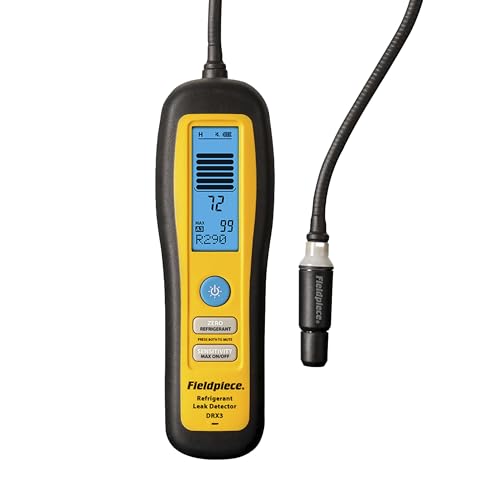
Read Article→Refrigerant detectors sense halogenated refrigerants; combustible gas detectors sense methane and propane. Only a dual-chemistry unit like the DRX3 does both.
Read Article→The DRX3 covers A3, A2L and A1 refrigerants plus combustible gases on a replaceable heated-diode sensor. The DR82 is infrared with a stated 10-year sensor.
Read Article→Heated diode: cheap, sensitive, short-lived, prone to false alarms. Infrared: selective, durable, A2L-ready, pricier.
Read Article→A sniffer for HFC, HFO, CO₂ and hydrocarbon refrigerants. The sensor type decides which it can find and how small.
Read Article→