As an Amazon Associate, Akermin earns from qualifying purchases. Product links on this page are affiliate links.
Refrigerant leak detectors miss tiny leaks mostly because of how they are used, not because of what they are rated to find. A probe moved too quickly never lets the sensor draw in enough gas; a fan or an open door carries the plume away before it reaches the tip; the sensitivity level is set for finding a big leak and ignores the small one; the sensor is near the end of its life; or the tool zeroed itself in air that already contained refrigerant and now treats the leak as background. Technicians who find the small ones sweep slowly in still air, control the zero, step sensitivity up at the right moment and, when the detector has done its best, fall back on pressure holds, dye and tracer gas.
What “Tiny” Means in Ounces per Year
Manufacturers rate sensitivity as the smallest leak the detector responds to, in ounces per year or grams per year, under a test method each manufacturer defines for itself. An ounce is about 28 grams, so the figures on current listings span a wide range: the Fieldpiece DR82 states under 0.03 oz/yr, the Elitech ILD-200 max states a minimum of 1 g/a at its Super setting (roughly 0.035 oz/yr), and the CPS LS790B states better than 0.25 oz/yr, or 7 g/yr. A leak at the bottom of that range takes years to lose an ounce of charge, which is why it produces so little gas at the joint and why technique matters more than the number on the box. The broader topic is covered in gas detector sensitivity.
Why the Detector Passes Over a Small Leak
- The probe moved too fast. A sensor needs a moment to draw in the sample and a moment to respond. A quick wave over a joint spends less time in the plume than the sensor needs.
- The air was moving. A condenser fan, an open door, a running air handler or a technician’s own breath disperses a tiny plume below the detection floor. Refrigerant vapor is heavier than air and pools under a joint in still air; in moving air it is simply gone.
- The sensitivity level was wrong. The ILD-200 max offers Super, High, Medium and Low at 1, 3, 7 and 14 g/a; the LS790B offers ten ranges. A low setting chosen to stop nuisance alarms near a large leak will not respond to a small one across the coil.
- The tool zeroed in a contaminated space. Automatic background adjustment, which the LS790B and many others describe, resets the baseline to whatever the sensor currently sees. Power up next to a leaking coil and the leak becomes zero.
- The sensor is worn. Heated diode sensors are consumed by use and are quoted in hours; infrared sensors are quoted in years and are less affected. A heated diode near the end of its stated hours can still beep at a large leak and stay silent at a small one.
- The leak is intermittent. Some leaks only open at operating pressure and temperature, or when a vibration loads the joint. A system checked cold and off will not show them.
- Oil or dirt is covering the site. A film of oil can slow the escape of gas enough that a fast sweep misses it, while marking the spot for anyone who looks.
Three Detectors, Three Approaches to Small Leaks
| Detector | Sensor | Stated sensitivity | Sensitivity control | Zeroing | Sensor life stated |
|---|---|---|---|---|---|
| Fieldpiece DR82 | Infrared | Under 0.03 oz/yr | Backlit LCD shows size and intensity; LED tip and beep | Not stated | 10 years |
| Elitech ILD-200 max | Infrared | 1 g/a minimum | Four levels: Super 1, High 3, Medium 7, Low 14 g/a; 2.8-inch TFT display | Not stated | 10 years |
| CPS LS790B Leak-Seeker | Ion pump | Better than 0.25 oz/yr (7 g/yr) of HFC | Ten user-selectable ranges; bar graph and over 100 tones | Automatic calibration and background adjustment; water vapor filter | Not stated |
The two infrared tools trade on sensitivity and a decade of sensor life. The LS790B is a different design, an ion pump sensor with a coarser rated sensitivity but ten ranges and automatic balancing that owners describe as steady in humid conditions. Its listing also limits it to non-combustible CFC, HCFC and HFC gases, so it is not a tool for A2L or A3 work. Infrared versus heated diode refrigerant leak detectors explains the sensor choice, and the DR82 review covers the most sensitive of the three.
How Technicians Find the Leak Anyway
- Kill the airflow. Shut off fans, close doors, wait for the air to settle. Outdoors, shield the condenser from wind or come back when it is calm.
- Zero in clean air, deliberately. Walk away from the equipment, let the detector settle, and only then approach. On tools with a manual zero, do not press it while the probe is near a joint.
- Sweep slowly and close. Keep the tip almost touching the joint and move at a crawl. Check the underside of every joint, because refrigerant vapor sinks.
- Step the sensitivity up at the end. Find the general area at a middle level, then switch to the highest level to separate two joints an inch apart.
- Check under running conditions. Run the system to operating pressure and temperature, then re-sweep the suspect joints.
- Confirm with bubbles. Once the detector flags a joint, a bubble solution confirms it and shows exactly where the braze failed.
- Escalate when the detector is done. A nitrogen pressure hold proves a leak exists; hydrogen tracer gas, described in tracer gas leak detection explained, finds leaks too small for a refrigerant sweep; UV dye finds the intermittent ones on the next visit.
Ruling Out the Tool
Before blaming a leak for hiding, prove the detector responds. A quick reference check, described in how to test a refrigerant leak detector before use, takes a minute and settles whether a quiet sweep means no leak or a dead sensor. Heated diode tools with a stated life in hours deserve that check every job; infrared tools less often, but still before any callback where the first visit found nothing.
Detectors Built for Small Leaks
If missed leaks are a recurring problem, the fix is often a more sensitive sensor plus a display that shows intensity rather than a single beep. Infrared models with stated figures below 0.05 oz/yr are compared in the infrared refrigerant leak detector roundup, and the full field including heated diode and ion pump tools is in the refrigerant leak detector guide.
Recommended Tools

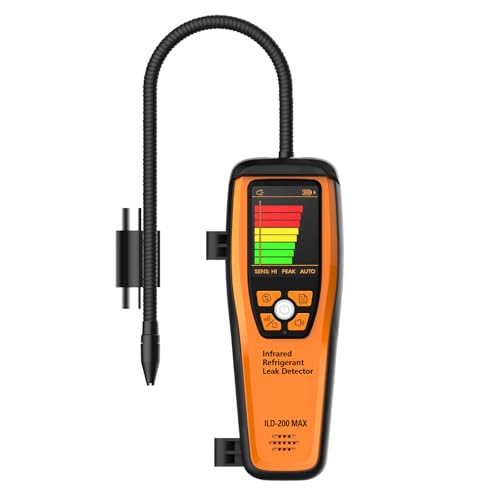

Products shown because their documented specifications fit this guide. Price and availability are on Amazon and can change.
Frequently Asked Questions
Should I always run the detector at its highest sensitivity?
Not for the whole search. On the ILD-200 max the Super level responds at 1 g/a, and on a system with a moderate leak that setting alarms everywhere near the coil and tells you nothing. Start at a middle level to find the general area, then step up to the highest level to pinpoint the joint.
Why does the detector find a leak once and then go quiet?
Usually because the tool auto-zeroed while sitting in the plume, adopting the leak concentration as its new baseline. Move the probe to clean air, let it settle, and approach again. Detectors with a manual zero, such as the Fieldpiece DRX3, let you control when that reset happens.
Are bubbles better than an electronic detector for small leaks?
No. The Fieldpiece DR82 listing describes its infrared sensor as 20 times more sensitive than bubbles, and a leak in the tenths of an ounce per year range may never raise a visible bubble. Bubbles remain useful for confirming a joint the detector has already flagged.
Can a UV dye find a leak the detector missed?
Often, given time. Dye circulates with the oil and marks the leak site as a fluorescent stain that a UV light shows on a later visit, so it catches intermittent leaks and leaks in places the probe cannot reach. It is slower than a detector and requires the dye to be compatible with the system.
Affiliate disclosure: Akermin earns a commission from qualifying Amazon purchases made through links on this page. Our editorial picks are based on documented specifications and owner feedback, not commissions.
Related Guides

WiFi Natural Gas Alarm Review: One Unit Reveals the Whole Design
A WiFi natural gas alarm with an LCD showing gas concentration status and temperature, a stated response within 30 seconds, an alarm of at least 85 decibels and notifications to a phone app.
Read More→
Forensics Detectors Cl2 Review: 5 Percent of Full Scale Is 2.5 ppm
A rechargeable chlorine detector with an electrochemical sensor reading 0 to 50 ppm at 0.1 ppm resolution, a response time under 30 seconds, adjustable audible, visual and vibrating alarms and a supplied calibration certificate.
Read More→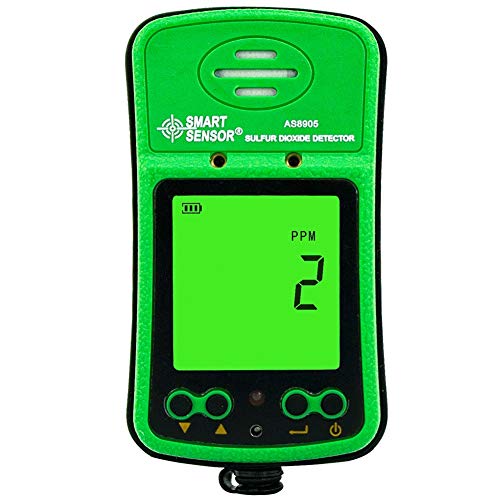
Smart Sensor SO2 Detector Review: 0.1 ppm Steps, No Accuracy Figure
A clip on sulfur dioxide monitor built on an electrochemical sensor, reading 0 to 20 ppm in 0.1 ppm steps, with adjustable high and low alarms signalled by sound, flash and vibration and a rechargeable cell quoted at 8 to 9 hours.
Read More→