Best Infrared Refrigerant Leak Detectors: Ten-Year Sensors for Daily HVAC Service
An infrared refrigerant leak detector reads light absorption instead of burning refrigerant on a diode, so the sensor is rated in years rather than hours. These picks were compared from manufacturer specifications for a technician who sniffs coils every working day and wants the consumable gone.
As an Amazon Associate, Akermin earns from qualifying purchases. Product links on this page are affiliate links.
Our Top Picks
Infrared detectors cost more up front and stop the sensor replacement cycle. These were compared on manufacturer documentation for stated sensitivity, sensitivity settings, sensor life, refrigerant coverage, ingress rating, battery and probe, with owner feedback on false alarms; no laboratory tests were run.
Figures are the manufacturers' published claims and are not comparable test results. The Yellow Jacket listing has no feature bullets, so only its title is used. The CPS unit is not infrared; it is included to show the ion-pump alternative.
How to Choose an Infrared Refrigerant Leak Detector
Four points settle the purchase:
Sensor Rating in Years
The reason to buy infrared is a sensor rated at ten years. Fieldpiece and Elitech state it; a listing that does not may still be infrared but gives you nothing to hold it to.
Stated Sensitivity
Under 0.03 oz/yr on the DR82 and 1 g/yr on the ILD-200 max are top-of-class claims; 0.14 oz/yr still finds a normal service leak. Each is manufacturer-defined.
A2L on the Listing
R-32 and R-454B are mildly flammable. The D-TEK 3 names A2L; check the listing for any other model before using it on new equipment.
Runtime and Ingress
Ten hours on USB-C and an IP54 body, as on the DR82, are what a full day of coils demands. Budget listings often omit both.
Is an infrared refrigerant leak detector less sensitive than a heated diode?
Not on the manufacturers' own figures. Fieldpiece quotes under 0.03 oz/yr for both its infrared DR82 and its heated-diode DR58. Infrared sensors respond a little more slowly to a passing whiff and are less prone to false alarms from oil and humidity, which owners generally count as a fair trade.
Do infrared detectors need calibration?
They zero themselves in clean air at start-up and most offer a manual zero as well. There is no user calibration gas for a refrigerant sniffer; the practical check is a leak-test vial or reference source held near the tip, as described in how to test a refrigerant leak detector before use.
What does the Super setting on the D-TEK 3 do?
It raises the gain to the highest level the instrument offers for micro-leaks on a sealed, evacuated system. In a mechanical room with background refrigerant it will sound continuously, which is why the Low and Medium settings exist: drop the sensitivity until the tone follows the fitting rather than the room.
Will an infrared detector work on tracer gas?
Infrared refrigerant sensors are tuned to halogenated refrigerants; the 5 percent hydrogen, 95 percent nitrogen tracer mix is a different molecule. The Fieldpiece heated-diode models and the Robinair tracer-gas detectors list H2/N2 coverage; none of the infrared listings on this page do.
Reviews
Fieldpiece DR82 Infrared Refrigerant Leak Detector Best Overall
The DR82 is the infrared detector that most technicians moving off heated-diode tools end up with, and the specification explains why. Fieldpiece states the same under 0.03 oz/yr sensitivity it quotes for its heated-diode DR58, paired with a sensor rated at ten years instead of 300 hours. That removes the consumable from a tool that is switched on at every call.
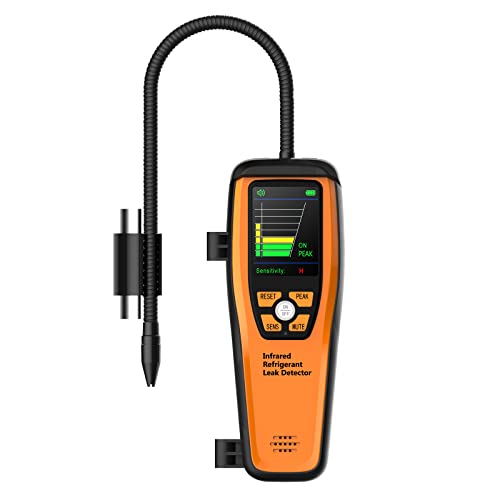
The rest of the listing is built for the truck: IP54 ingress rating with resistance to moisture and oil, a 17-inch flexible probe, replaceable filter tips, and a battery that charges over USB-C and is rated for more than ten hours. The backlit LCD shows leak size and intensity, and the LED at the tip plus the beep rate locate the fitting.
The listing names CFC, HCFC, HFC and HFO coverage and blends but does not use the A2L label; the DRX3 is the Fieldpiece model that does. For everything running R-410A, R-22 and R-134a today, the DR82 is the long-life sniffer to buy once.
Strengths
Ten-year sensor rating ends the replacement cycle
Sensitivity claim matches the heated-diode DR58
IP54 and oil resistant
USB-C battery and long probe
Limitations
Premium cost
A2L not named on the listing
Heavier reliance on the screen than a tone-only sniffer
Inficon D-TEK 3 Refrigerant Leak Detector Best Sensitivity Settings
The D-TEK 3 is Inficon's current infrared detector and the one on this page whose listing explicitly covers A2L refrigerants. For a technician installing R-32 or R-454B equipment, that line matters more than any sensitivity number, because it says the manufacturer built and rated the tool for those gases.
The feature that earns the badge is the four-step sensitivity ladder: Low, Medium, High and Super. Super finds the micro-leak on a sealed system; Low lets you walk a contaminated mechanical room and still pick out the fitting that is actually leaking. Automatic and manual zero modes support both ways of working, and the unit ships in a rugged case.
The listing is short. It gives no oz/yr sensitivity, no sensor life, no probe length and no battery figure, so our table shows not stated in those columns. Inficon publishes those details in its own literature; on the marketplace page you are buying the brand's record and the A2L statement. Our D-TEK 3 review covers what owners report.
Strengths
A2L refrigerants named on the listing
Four sensitivity settings including Super
Auto and manual zero
Case included
Limitations
Listing states no sensitivity or sensor-life figure
Elitech ILD-200 Infrared Refrigerant Leak Detector Best Value
The ILD-200 brings the infrared sensor's ten-year rating down to a cost that a homeowner with a heat pump or a technician wanting a backup can justify. Elitech states 0.14 oz/yr maximum sensitivity, which is less than the Fieldpiece figure but well inside the range that finds an ordinary service leak, with High, Medium and Low settings to narrow the source.
The manufacturer describes the infrared sensor's advantages over a heated diode as stronger resistance to interference, faster response and longer life, and the 2.8-inch screen uses a peak display to show which direction the reading rose. Coverage on paper includes CFCs, HFCs, HCFCs, HCs and HFOs, with R-1234yf, R-410A and R-22 named.
The listing gives no probe length, no battery type or runtime, no ingress rating and no A2L statement. The ILD-200 max in the table adds a 3000 mAh battery, four sensitivity levels and a 1 g/yr claim for a little more.
Short answer: the Fieldpiece DR82 is the infrared refrigerant leak detector to buy for daily service: a ten-year sensor, the same under 0.03 oz/yr sensitivity claim as its heated-diode sibling, and an IP54 body on USB-C. Choose the Inficon D-TEK 3 if A2L equipment is in your work and you want four sensitivity settings. The Elitech ILD-200 gets the ten-year sensor into a homeowner’s or apprentice’s bag for much less.
How infrared detection differs
An infrared refrigerant sensor passes the sampled air through a small cell where a light source and a detector measure how much of a specific wavelength the halogenated molecules absorb. Nothing is burned and nothing is consumed, which is why the manufacturers rate these sensors in years. A heated diode gives the same sort of tone and display but wears out in hours of operation. The infrared vs heated-diode comparison lays out both; the short version is that infrared costs more on day one and nothing after, and heated diode is the reverse. What is a refrigerant leak detector covers the basics if you are new to the tool.
The sensor rating is the reason to buy
Fieldpiece and Elitech both state a ten-year sensor life; Inficon and Yellow Jacket give no figure on their marketplace listings. That rating is the whole argument for the class, so a listing that omits it is asking you to take the technology on trust. For a technician who switches the detector on at every call, ten years without a sensor purchase is the difference between a tool cost and a running cost.
Sensitivity claims and settings
The DR82’s under 0.03 oz/yr and the ILD-200 max’s 1 g/yr Super setting are the strongest claims on the page; the ILD-200’s 0.14 oz/yr is the conservative one; the D-TEK 3 quotes none. All are manufacturer-defined figures with no common test behind them, so they place the tool rather than rank it. Settings matter more in practice. The D-TEK 3’s Low, Medium, High and Super ladder and the ILD-200 max’s four levels (1, 3, 7 and 14 g/yr) let you drop the gain in a contaminated room until the tone follows a fitting, then raise it at the joint to confirm. Auto and manual zero, listed on the D-TEK 3, serve the same purpose.
A2L refrigerants: read the listing
R-32 and R-454B are A2L, mildly flammable, and residential equipment now ships with them. A detector rated for A1 refrigerants such as R-410A may respond to them but was not built or documented for the job. On this page the D-TEK 3 is the model whose listing names A2Ls. The Fieldpiece DR82 lists HFO coverage without the label, and the Elitech listings do not mention it. The A2L refrigerant leak detector guide is the place to go if that is your work.
Battery, probe and ingress rating
A day of coils is ten hours of sniffing, sometimes in a wet condensate pan. The DR82 lists more than ten hours on a USB-C charge, IP54 ingress protection and a 17-inch probe with replaceable filter tips. The ILD-200 max lists a 3000 mAh battery with eight hours of use and a four-hour charge. The ILD-200, D-TEK 3 and Yellow Jacket listings state none of these, which is a reason to read the manufacturer’s own literature before buying rather than a reason to reject them.
The ion-pump alternative
The CPS LS790B in the table is not infrared. It uses an ion-pump sensor with ten selectable sensitivity ranges, automatic calibration and a stated better than 0.25 oz/yr HFC response, plus a water vapor filter for humid work. It is here to show that the long-life alternative to a heated diode is not only infrared, and because technicians who learned on CPS tools ask about it.
Using an infrared sniffer
Power on in clean air and let it zero. Sweep slowly, tip below the joint, pausing at brazed connections, Schrader cores, flare nuts and the coil face. Start on the high setting and step down when the tone is continuous. Keep the tip out of oil and standing water even on an IP54 body, and change the filter tip when the reading becomes sluggish. For A2L systems, ventilate the space before sniffing; the refrigerant is mildly flammable, and the detector is a locating tool, not a safety monitor.
How We Research
Detectors were compared on manufacturer documentation: sensor type and rated life, stated sensitivity, sensitivity settings and zero modes, refrigerant classes and A2L statements, probe length, ingress rating and battery. Owner feedback was reviewed for false alarms near oil and for screen readability. We did not run laboratory tests and publish no sensitivity results of our own. Amazon data supplies images, availability and links only.
A WiFi natural gas alarm with an LCD showing gas concentration status and temperature, a stated response within 30 seconds, an alarm of at least 85 decibels and notifications to a phone app.
A rechargeable chlorine detector with an electrochemical sensor reading 0 to 50 ppm at 0.1 ppm resolution, a response time under 30 seconds, adjustable audible, visual and vibrating alarms and a supplied calibration certificate.
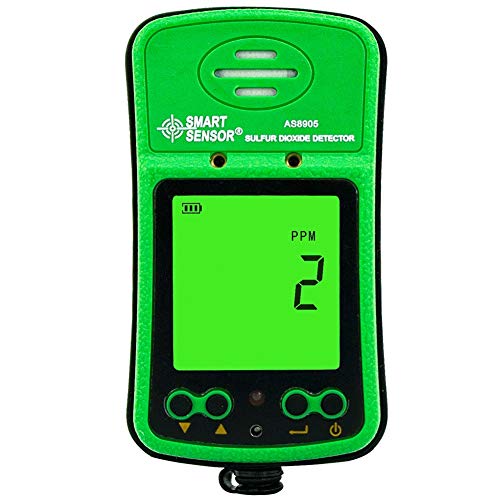
A clip on sulfur dioxide monitor built on an electrochemical sensor, reading 0 to 20 ppm in 0.1 ppm steps, with adjustable high and low alarms signalled by sound, flash and vibration and a rechargeable cell quoted at 8 to 9 hours.