As an Amazon Associate, Akermin earns from qualifying purchases. Product links on this page are affiliate links.

Inficon · Inficon D-TEK 3 Refrigerant Leak Detector
View on AmazonPrice and availability are shown on Amazon and can change at any time.
Verdict
The INFICON D-TEK 3 is a pinpoint refrigerant leak detector built around an infrared sensor. It offers four sensitivity settings from low to super, automatic and manual zero modes, and detection of CFC, HCFC, HFC and HFO refrigerants and their blends including the A2L class, and it ships in a rugged case. The infrared sensor is the reason to choose it over a lower-cost heated-diode detector: it is far less likely to alarm on oil, solvent or cleaning products, and the manufacturer positions its sensor life as long. Owner reports are consistent on that point and on the detector’s response at brazed joints and Schrader cores. It does not show a ppm value and it does not have the room-scale monitor mode of the D-TEK Stratus. For residential and light commercial HVAC service, the documentation supports it as a first-choice detector.
Who It Is For
- Residential and light commercial HVAC technicians who locate leaks on split systems and heat pumps.
- Refrigeration technicians who want an infrared detector without the price of a monitoring instrument.
- Contractors moving to A2L equipment who need a detector rated for it.
Our guide to choosing a refrigerant leak detector explains the sensor types in more detail.
Documented Specifications
| Item | Documentation |
|---|---|
| Sensor | Infrared (manufacturer) |
| Sensitivity settings | Low, medium, high and super |
| Zero modes | Automatic and manual |
| Refrigerants | All CFCs, HCFCs, HFCs, HFOs and blends, including A2Ls |
| Included | Rugged carrying case |
Sensitivity in terms of leak rate, response time, sensor life and battery details are on the manufacturer’s datasheet; consult the current revision.
Using the Sensitivity Settings and Zero Modes
Leak detection is a search for a gradient. With the detector on a high setting, the probe is moved slowly along lines and joints, and the alarm rate rises as the concentration rises. Once the general area is found, dropping to a lower setting stops the detector alarming on background refrigerant and lets it discriminate between neighbouring joints. The super setting is for the smallest leaks on systems that have been evacuated and recharged and still lose charge over months. Automatic zero keeps the detector referenced to the air around it, so a slowly rising background does not produce a continuous alarm; manual zero holds a fixed reference for the case where the background is already contaminated and only a stronger source matters. Owners describe getting comfortable with the two modes as the main learning curve. Before a search, the detector should be confirmed on a reference leak: see testing a refrigerant leak detector before use.
The Infrared Sensor
Heated-diode detectors respond to any halogenated compound and to a number of other chemicals, which is why they alarm on brake cleaner, fresh adhesive and some oils. An infrared sensor measures absorption at wavelengths characteristic of refrigerant molecules. That reduces false alarms, which on a job site is the difference between trusting the detector and second-guessing it. Infrared sensors are also longer lived and are field-replaceable on the D-TEK line. The cost is a higher purchase price, and the sensor remains a consumable that will eventually need replacement.
A2L and Blended Refrigerants
Blends behave differently from single-component refrigerants because the components leak at different rates; a detector that responds to the whole family is needed. New equipment increasingly ships with A2L refrigerants, classed as mildly flammable, and finding those leaks is a safety task as well as a repair task. The listing states coverage of all the current families including A2L, which should be confirmed for any detector bought for new equipment.
Strengths
- Infrared sensor with fewer false alarms than heated-diode designs.
- Four sensitivity settings for search and pinpointing.
- Automatic and manual zero modes.
- Coverage of current refrigerant families including A2L.
Limitations
- No ppm readout; indication is relative.
- No room-scale monitor mode.
- Higher price than heated-diode detectors.
How It Compares
The INFICON D-TEK Stratus adds a portable monitor mode and a ppm display for large systems. The INFICON AST 300 is the automotive detector with a ppm display, an infrared sensor and a UV light for dye inspection. For a technician who also needs electrical measurements on the same call, the Extech EX623A is the HVAC clamp meter that pairs with a detector like this.
How We Research
This review is based on the manufacturer’s published specifications, the Amazon product listing and owner reports. We did not run laboratory tests. See gas detection for related instruments.
Recommended Tools

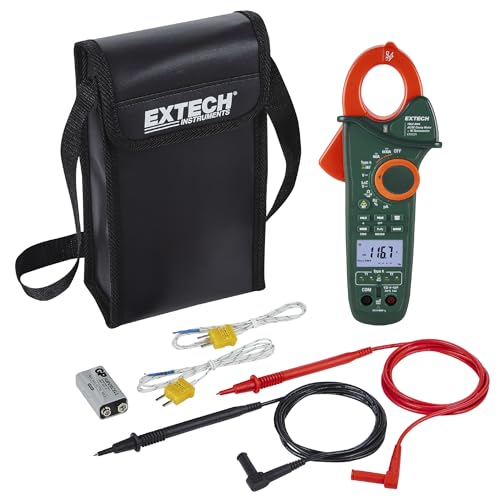
Products shown because their documented specifications fit this guide. Price and availability are on Amazon and can change.
Frequently Asked Questions
What do the four sensitivity settings do?
Low, medium, high and super set how small a leak the detector responds to. Start high to find the general area, then drop the sensitivity to pinpoint the joint without the detector alarming on background refrigerant.
What is the difference between automatic and manual zero?
Automatic zero continuously adjusts to the background so the detector only alarms on a rising concentration. Manual zero holds a reference so a steady leak in a contaminated space can still be found. Both are documented on the listing.
Does it work on A2L refrigerants?
Yes. The listing states detection of all CFCs, HCFCs, HFCs, HFOs and blends, including A2Ls.
How does it differ from the D-TEK Stratus?
The D-TEK 3 is a pinpoint detector. The Stratus adds a portable monitor mode with a ppm readout for finding a refrigerant cloud in a room before pinpointing.
Affiliate disclosure: Akermin earns a commission from qualifying Amazon purchases made through links on this page. Our editorial picks are based on documented specifications and owner feedback, not commissions.
Related Guides

WiFi Natural Gas Alarm Review: One Unit Reveals the Whole Design
A WiFi natural gas alarm with an LCD showing gas concentration status and temperature, a stated response within 30 seconds, an alarm of at least 85 decibels and notifications to a phone app.
Read More→
Forensics Detectors Cl2 Review: 5 Percent of Full Scale Is 2.5 ppm
A rechargeable chlorine detector with an electrochemical sensor reading 0 to 50 ppm at 0.1 ppm resolution, a response time under 30 seconds, adjustable audible, visual and vibrating alarms and a supplied calibration certificate.
Read More→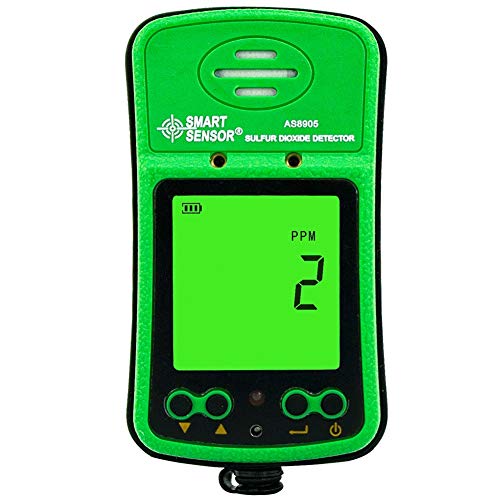
Smart Sensor SO2 Detector Review: 0.1 ppm Steps, No Accuracy Figure
A clip on sulfur dioxide monitor built on an electrochemical sensor, reading 0 to 20 ppm in 0.1 ppm steps, with adjustable high and low alarms signalled by sound, flash and vibration and a rechargeable cell quoted at 8 to 9 hours.
Read More→