
Best Mini Thermal Cameras: 10 Compact Picks with Impressive Performance
Ten pocket and phone-mounted thermal imagers compared on stated detector resolution, sensitivity and what you give up when the body gets smaller.
Read Guide→Thermal cameras, infrared thermometers, borescopes and moisture meters.

Ten pocket and phone-mounted thermal imagers compared on stated detector resolution, sensitivity and what you give up when the body gets smaller.
Read Guide→
Nine thermal imagers judged against under-bonnet work, compared on stated detector resolution and whether a listing separates it from an upscaled figure.
Read Guide→
Nine thermal imagers for panel and motor work compared on stated resolution, temperature range, fusion imaging and report export.
Read Guide→
Four thermal cameras compared on battery arrangement, native resolution and phone compatibility for buyers who need to keep working past one charge.
Read Guide→Four thermal cameras compared on radiometric image files, native resolution, measurement range and what each listing does and does not state.
Read Guide→Four thermal cameras compared on published NETD, resolution and measurement range, with guidance on what low NETD actually buys you.
Read Guide→Four manual focus thermal cameras compared on focus mechanism, native resolution, sensitivity and the jobs each one actually suits.
Read Guide→Four thermal imagers compared for ceiling leak work, from a phone plug-in to a 320 x 240 handheld with cloud image management.
Read Guide→A comparison of four thermal cameras for bearing and motor inspection, explaining resolution, focus distance and the limits of each listing.
Read Guide→A comparison of three thermal cameras for tracing underfloor heating loops, judging flow balance and locating blockages, based only on published listing data.
Read Guide→Wi-Fi cameras sorted by what the link does: FLIR E8 Pro to the Ignite cloud, HSFTOOLS P2W to a phone app and PC software, and the pocket FLIR C5.
Read Guide→Cameras sorted by detector, not headline: the native 320x240 FLIR E8 Pro and C8, the 256x192 Thermal Master Thor002 and the 640x480 super-resolution claims.
Read Guide→
The 872s tops testo's compact handheld range with a 320×240 detector and SuperResolution to 640×480; it is not currently listed on Amazon US.
Read Review→The 871s is the middle testo handheld with a 240×180 detector and SuperResolution to 480×360; it is not currently listed on Amazon US.
Read Review→A handheld thermal imager with a 160×120 detector, SuperResolution to 320×240, NETD under 80 mK, a 5 MP visible camera, ScaleAssist and IFOV warning.
Read Review→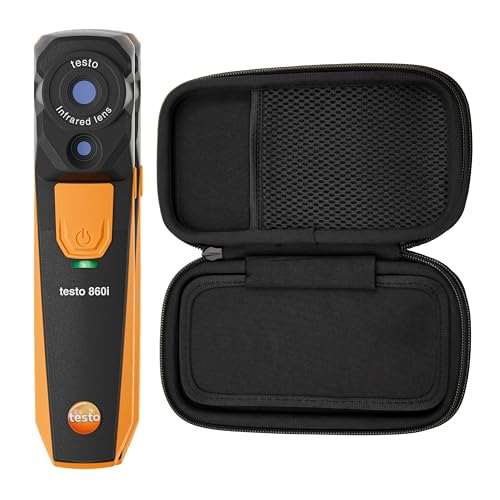
A wireless 256×192 thermal camera that streams to the testo Smart App over Bluetooth and Wi-Fi, with radiometric images, a -20 °C to 350 °C range and IP54.
Read Review→
A 256×192 Android thermal camera with a 9 mm adjustable-focus lens (0.1 m to 500 m), a -20 °C to 550 °C measurement range and a monocular detection mode.
Read Review→
The TC002C Duo is a USB-C thermal camera for iPhone 15 and newer, iPad, Android and Windows with a 256×192 detector, 25 Hz refresh and 40 mK sensitivity.
Read Review→The TC002 is TOPDON's Lightning-connector thermal camera for older iPhones; the current Amazon listing is the USB-C TC002C Duo, used here as the reference.
Read Review→
A 256×192 thermal camera for Android phones with TISR upscaling to 512×384, a -20 °C to 550 °C range, ±2 °C accuracy and no battery of its own.
Read Review→
The TC001 Plus is the USB-C member of TOPDON's 256×192 plug-in family; the current Amazon listing is the dual-lens TC001 Max, with the TC001 also listed.
Read Review→
The K33 is FLIR's mid-range firefighting camera with a larger display and higher resolution than the K2; it is not currently listed on Amazon US.
Read Review→A compact firefighting thermal camera rated IP67, drop-tested to 2 m and operable at 500 °F for three minutes, with single-button gloved controls and MSX.
Read Review→
A handheld 160×120 thermal camera with MSX, a -20 °C to 400 °C measurement range, Wi-Fi and FLIR Ignite cloud upload, backed by FLIR's 2-10 warranty.
Read Review→
One finds where to look from outside; the other looks inside. They are a sequence, not a choice.
Read Article→Right conditions, locked span, square-on framing and a visible reference. The camera is the easy part.
Read Article→Sun, wind, rain and the inside-outside difference all rewrite what a wall looks like in infrared.
Read Article→Often, because wet materials evaporate and cool. But a cold patch needs a moisture meter to prove it.
Read Article→No. It sees the wall's surface. But what is behind the wall changes that surface, and that is the trick.
Read Article→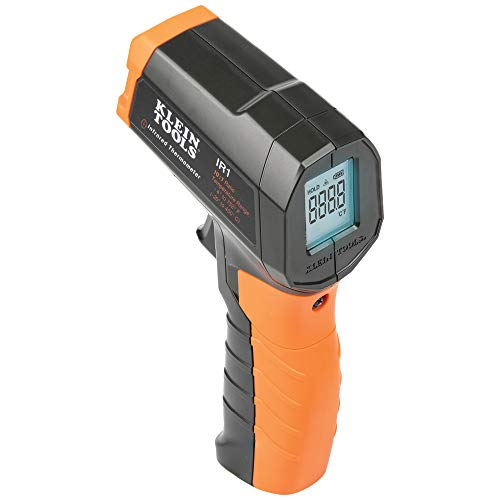
One pixel versus thousands. A spot thermometer reads a temperature; a camera shows where the temperature is.
Read Article→Polished metal is an infrared mirror. The camera sees the room, the lights and you, not the metal.
Read Article→How well a surface radiates heat compared with a perfect emitter. Set it wrong and the temperature is wrong.
Read Article→The smallest temperature difference the camera can distinguish from noise. Lower is better; under 50 mK is good.
Read Article→The native detector array is the real number. Everything else is upscaling or the visible camera.
Read Article→Everything warm glows in infrared. The camera has a sensor that sees that glow and a lens that lets it through.
Read Article→