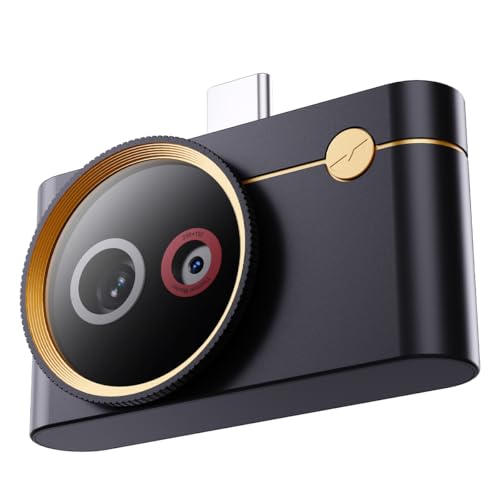
Best Thermal Cameras With Wi-Fi: Picks That Send Images to the Phone and Cloud
Wi-Fi on a thermal camera listing can mean cloud upload for reports, a live view on a phone or tablet, or a link to PC software, and the listings in this group split across all three. This guide sorts them by that workflow first and by native detector resolution second, using only figures the manufacturers state.
As an Amazon Associate, Akermin earns from qualifying purchases. Product links on this page are affiliate links.
Our Top Picks
These cameras were compared on what their listings state the wireless link does (cloud, app or PC software), native detector resolution, stated NETD, refresh rate, range, storage and battery. We did not run laboratory tests or connect the cameras ourselves; every figure is the manufacturer's own and gaps are marked Not stated.
Best Overall
FLIR E8 Pro Thermal Imaging Camera
Native 320x240 with Wi-Fi upload to the FLIR Ignite cloud.
Wi-Fi to FLIR Ignite: automatic storing, editing and sharing of images from the Ignite app
320 x 240 native detector, 76,800 pixels, with MSX edge overlay
All figures come from the manufacturers' Amazon listings at the time of research. Upscaled resolutions are shown in brackets and are not comparable with native counts. Not stated means the listing gives no value; FLIR publishes NETD and battery figures in its datasheets.
How to Choose a Thermal Camera With Wi-Fi
Four questions decide it:
Cloud, App or PC
FLIR listings describe Ignite cloud upload for reports. HSFTOOLS, AccuMEMS and Holdwell describe phone app pairing, and the P2W adds Windows software. Pick the workflow you will actually use.
Native Pixels
320 x 240 is 76,800 points, 256 x 192 is 49,152, 160 x 120 is 19,200. A 640 x 480 output on a 256 x 192 detector is software upscaling.
NETD Where Stated
Under 40 mK on the P2W and TT27D, 50 mK or lower on the Holdwell. The FLIR listings state no figure; check the datasheet.
Battery and Storage
Video over Wi-Fi eats both. The P2W states 16 GB and up to 4 hours; the Holdwell states 8 GB and over 6 hours; FLIR listings state neither.
Does a Wi-Fi thermal camera need an internet connection on site?
It depends on which link the listing describes. FLIR Ignite is a cloud service, so images reach it when the camera has a connection to the internet. The HSFTOOLS, AccuMEMS and Holdwell listings describe Wi-Fi pairing directly between the camera and a phone or tablet, which is a local link. None of the listings spells out offline behavior, so check the manual for how images are held until a connection is available.
Is Wi-Fi the same as a live thermal view on my phone?
No. The FLIR listings describe Wi-Fi as the route to the Ignite cloud for storing, editing and sharing, not as a live feed. The AccuMEMS TT27D listing states real-time streaming and remote control through its app, and the HSFTOOLS P2W states real-time monitoring in its Windows software. If a live view matters, buy from a listing that says so.
Does a 640 x 480 Wi-Fi camera have more detail than a 320 x 240 FLIR?
Not in the detector. The P2W states a 256 x 192 detector upscaled to 640 x 480, and the TT27D describes its 640 x 480 as AI upscaling without stating the native count. The FLIR E8 Pro states a native 320 x 240, which is 76,800 real measurement points against 49,152 on a 256 x 192 detector. Upscaling smooths the picture; it does not add readings.
Why is the FLIR C8 not listed as a Wi-Fi camera when it uploads to Ignite?
Because its Amazon listing names Ignite cloud connectivity and emailed reports but does not use the word Wi-Fi, unlike the C5, E5 Pro, E6 Pro and E8 Pro listings, which all state it. The workflow described is the same. We report what the listing says; the C8 review on this site covers the camera in detail.
Can I put the camera on a tripod and control it from the phone?
The AccuMEMS TT27D listing states remote control through the AccuHeat app and a tripod hole; the HSFTOOLS P2W states a quarter-inch tripod hole and real-time monitoring in its PC software. The FLIR and Holdwell listings do not describe remote control. For a fixed-position scan of a panel under load, those two are the ones to look at.
Reviews
FLIR E8 Pro Thermal Imaging Camera Best Overall
The E8 Pro is the Wi-Fi camera for an inspector whose images end up in a client report. FLIR states Wi-Fi connectivity to the FLIR Ignite cloud, where images are stored, edited and shared automatically through the Ignite app, plus over-the-air updates that keep the camera current without a cable. The detector is a native 320 x 240, which is 76,800 measurement points, and MSX embosses visible edges onto the thermal image so a hot breaker or a cold stud bay can be located in the picture.
The measurement range is stated as -20 to 550 C (-4 to 1022 F), enough for building, HVAC and electrical work, and FLIR covers the camera for 2 years and the detector for 10.
What the listing leaves out is the rest of the wireless story and the imaging figures. It gives no NETD, field of view or battery life, and it does not describe a live phone view or PC software; Ignite is the workflow. A technician who wants a live feed on a tablet will find that on the HSFTOOLS and Holdwell listings.
Strengths
Wi-Fi to Ignite cloud with automatic storing, editing and sharing
HSFTOOLS P2W Wi-Fi Thermal Camera Best Wi-Fi Value
The P2W is the pick for a technician who wants the Wi-Fi link to do more than back up files. HSFTOOLS states Wi-Fi pairing with its app on Google Play and the App Store for accessing, sharing, analyzing and reporting images, and separate HSF Studio software for Windows. The camera is a 3.5-inch touchscreen unit with a 256 x 192 native VOx detector; the manufacturer's Live Super Resolution algorithm raises the output to 640 x 480, and the native count is the one to compare with the FLIR cameras.
The stated figures are strong for the class: NETD under 40 mK, 25 Hz refresh, a -4 to 752 F range, accuracy within plus or minus 3.6 F or 2%, adjustable emissivity and distance, and automatic hot, cold and center tracking with alarms shown on screen, by LED or by buzzer.
Storage is 16 GB for up to 60,000 images or 54 hours of video, battery is stated at up to 4 hours, and the body is IP54 with a 6.6 ft drop test. The intelligent scene features are the manufacturer's description; treat them as aids, not verdicts.
Strengths
Wi-Fi app and Windows software both described
Stated NETD under 40 mK and 25 Hz
Large storage with video and audio recording
Touchscreen with 8 MP visual camera and five image modes
Limitations
Native detector is 256 x 192; 640 x 480 is upscaled
Up to 4 hours battery is shorter than the Holdwell figure
The C5 is the lowest-tier way into the FLIR Ignite workflow. FLIR states Wi-Fi connectivity, direct upload of images to the Ignite cloud and the report step that follows: create professional reports and email them to customers. The camera is pocket-sized, the detector is a native 160 x 120 (19,200 pixels), and MSX embosses visible detail onto the thermal image so a small picture still reads.
The measurement range is stated as -20 to 400 C (-4 to 752 F), which covers building, HVAC and most electrical work, and the 2-year camera, 10-year detector warranty is the same as the E8 Pro's.
The trade is pixels. 19,200 is a quarter of the E8 Pro's count and below the 256 x 192 native detectors on the HSFTOOLS and Holdwell units, so the C5 suits close-range checks rather than surveys from across a room. The listing also gives no NETD, field of view, refresh rate or battery life, and describes no live phone view. For a home inspector who mainly needs the Ignite report path in a pocket, it is enough.
Strengths
Wi-Fi upload to Ignite and emailed reports stated
Pocket size
Same 10-year detector warranty as the E-series
400 C upper limit covers most building and HVAC work
Short answer: the FLIR E8 Pro is the Wi-Fi camera for an inspector whose images go into client reports, with a native 320 x 240 detector and automatic upload to the FLIR Ignite cloud; the HSFTOOLS P2W is the Wi-Fi value pick for a technician who wants the link to feed a phone app and Windows software, with a stated NETD under 40 mK and 25 Hz on a 256 x 192 native detector; and the FLIR C5 is the lowest-tier entry into the Ignite workflow, a 160 x 120 pocket camera that uploads and emails reports.
What Wi-Fi does on a thermal camera, and what it does not
Wi-Fi on a thermal camera listing can mean three different things, and the listings in this group split cleanly between them. On the FLIR E8 Pro, E6 Pro, E5 Pro and C5 the wireless link goes to FLIR Ignite, a cloud service the manufacturer describes as automatically storing, editing and sharing images from the Ignite app, with over-the-air updates for the camera. On the HSFTOOLS P2W, the AccuMEMS TT27D and the Holdwell 256 x 192 the link pairs the camera with a phone or tablet app for live viewing and sharing; the P2W adds separate Windows software over USB. None of the listings states that Wi-Fi changes the thermal image itself. The detector, lens and sensitivity decide what the camera sees; the wireless link decides where the picture goes afterwards. The main thermal camera guide sorts the same cameras by job; this page sorts them by that wireless workflow.
Cloud reporting: the FLIR Ignite path
Four FLIR cameras in the table state Wi-Fi to Ignite, and they differ mainly in detector size and range. The E8 Pro is native 320 x 240 (76,800 pixels) with a stated -20 to 550 C range, the E6 Pro is 240 x 180 (43,200 pixels) with the same range, the E5 Pro is 160 x 120 (19,200 pixels) to 400 C and the C5 is 160 x 120 to 400 C in a pocket body. All four state MSX, which embosses visible edges onto the thermal image, and the same 2-year camera, 10-year detector warranty. The C5 and C8 listings describe the report step explicitly: upload to Ignite, create professional reports and email them to customers. The C8 is the odd one out on wording, because its listing names Ignite cloud connectivity but never uses the word Wi-Fi, so the table marks it that way. The FLIR listings say nothing about live phone viewing, PC software, NETD or battery life; FLIR publishes those in its datasheets.
App and PC workflows: HSFTOOLS, AccuMEMS and Holdwell
The non-FLIR cameras describe a more direct link. HSFTOOLS states that the P2W pairs over Wi-Fi with its app on Google Play and the App Store for accessing, sharing, analyzing and reporting images, and that HSF Studio for Windows adds screen projection, real-time monitoring and 3D plotting. AccuMEMS states Wi-Fi to its AccuHeat app for real-time streaming and remote control. Holdwell states Wi-Fi pairing with mobile devices and a USB connection to a PC for real-time sharing and analysis, without naming the app. For a technician who wants a helper to watch the live thermal feed on a tablet while the camera sits on a tripod, these are the listings that describe it; the P2W and TT27D both state a tripod hole.
Native pixels versus the upscaled figure
Three of the Wi-Fi cameras advertise 640 x 480 output, and none of them states a 640 x 480 detector. HSFTOOLS states that the P2W’s Live Super Resolution algorithm raises a 256 x 192 detector to a 640 x 480 output; AccuMEMS describes the TT27D’s 640 x 480 as AI upscaling and does not state the native count at all; Holdwell states 256 x 192 without an upscaled figure. A 256 x 192 detector has 49,152 measurement points, more than the 160 x 120 FLIR C5 and E5 Pro (19,200) and fewer than the 320 x 240 E8 Pro (76,800). Compare those native numbers; the upscaled image is smoother but carries no extra temperature readings. How to compare thermal camera resolution explains the arithmetic.
Sensitivity, refresh and battery on the listings
The wireless cameras from HSFTOOLS, AccuMEMS and Holdwell state figures the FLIR listings omit. NETD is under 40 mK on the P2W and TT27D and 50 mK or lower on the Holdwell, all with 25 Hz refresh. The P2W states accuracy within plus or minus 3.6 F or 2%, adjustable emissivity, and hot, cold and center tracking with high and low alarms; the Holdwell states plus or minus 2 C, emissivity adjustable from 0.01 to 1.0, a 56 by 42 degree field of view and a 3.11 mm lens; the TT27D states plus or minus 3.6 F and three-point measurement. Battery life is stated as up to 4 hours on the P2W and over 6 hours on the Holdwell, and not at all on the FLIR cameras or the TT27D. What NETD means covers how to read the sensitivity figure.
Emissivity and reflections still apply
A wireless link does not make a temperature reading right. Every camera here measures the infrared energy leaving the surface it faces, and the reading is only correct when emissivity is set for that surface. Painted drywall, wood and brick read close to true; shiny metal such as a copper bus bar, a foil-faced board or a galvanized duct reads low and reflects whatever is opposite it, including the person holding the camera. The P2W and Holdwell listings state adjustable emissivity, and a strip of electrical tape on a shiny surface gives a reliable target where it is safe to apply one. Reflections are the second trap: a cold patch that moves when you step sideways is a reflection, not a defect. A thermal camera also shows surface temperature only; it does not see through walls, and a cool evaporative patch that looks like water needs a moisture meter to confirm.
Related guides
For a compact camera chosen on size rather than the cloud, see the pocket thermal camera guide; the smartphone thermal camera guide covers the phone-powered alternative. Detailed reviews of the FLIR C8 and E5 Pro are also on this site.
How We Research
Cameras were compared on manufacturer listing text: what the wireless link is stated to do, native detector resolution and any upscaled figure, stated NETD, refresh rate, temperature range, accuracy, storage, battery life and warranty. Owner feedback was reviewed for recurring comments on app pairing and cloud reliability. We did not run laboratory tests, did not connect the cameras and publish no measurements of our own. Amazon data supplies images, availability and links only.
A 17 gram USB-C thermal attachment stating 320 by 240 after X3 processing from a 160 by 120 detector, with 0.04 C sensitivity, isotherm mode and adjustable emissivity.
An Android phone attachment with a 256 by 192 detector upscaled to 512 by 384, NETD below 35 mK, a 56 by 42 degree field of view and no battery of its own.
A 1080P borescope with a 4.3 inch screen, a 16.4 foot semi rigid IP67 probe, eight LEDs and an accessory kit. Reviewed from a listing whose own bullets contradict its title.