As an Amazon Associate, Akermin earns from qualifying purchases. Product links on this page are affiliate links.

POWERTEC · POWERTEC 7" Color LCD Rechargeable Air Quality Monitor - Multi-Sensor Detector for CO2, PM2.5, PM10, HCHO, TVOC, AQI Tester with Alarm for Workshop & Garage (AD1001)
View on AmazonPrice and availability are shown on Amazon and can change at any time.
The AD1001 pairs an NDIR CO2 sensor with an electrochemical formaldehyde sensor to 2 mg per m3, a semiconductor TVOC sensor to 5 mg per m3 and laser particle sensing to 999 micrograms per m3 across PM1.0, PM2.5 and PM10, on a seven inch colour display with colour coded alarms. It publishes a complete set of ranges and no accuracy figure at all. Its most creditable line is an admission most listings omit: run it on mains power and its own heat shifts the temperature reading.
The sensor list is the review
Multi sensor air monitors live or die on which element sits behind each number, because the display looks identical either way. This listing names them, which already puts it ahead of most.
For carbon dioxide it states a next generation infrared NDIR sensor. NDIR shines infrared through a small chamber and measures how much the CO2 in it absorbs. The response is to carbon dioxide and very little else. The alternative found in cheap monitors is a metal oxide semiconductor that measures general air chemistry and derives a CO2 estimate from it, which is why those units spike when someone opens a bottle of solvent. Our explainer on NDIR against metal oxide sensing goes through the failure modes.
For particles it states laser sensing for PM1.0, PM2.5 and PM10. Laser scattering counts particles by the light they deflect and sorts them by size. In a woodworking shop this is the number that responds to sanding, and it responds within seconds.
For formaldehyde it states an electrochemical sensor. Electrochemical cells react with the target gas at an electrode and are the more selective option for HCHO. For TVOC it states a semiconductor sensor, which is the broad brush option and should be read as a trend line.
Ranges without accuracy is half a specification
| Measurement | Sensor type stated | Range stated | Accuracy stated |
|---|---|---|---|
| Carbon dioxide | NDIR infrared | Not stated in the listing bullets | Not stated in the listing bullets |
| Formaldehyde | Electrochemical | 0 to 2 mg per m3 | Not stated in the listing bullets |
| TVOC | Semiconductor | 0 to 5 mg per m3 | Not stated in the listing bullets |
| PM1.0, PM2.5, PM10 | Laser scattering | 0 to 999 micrograms per m3 | Not stated in the listing bullets |
| Temperature | Not stated | Minus 40 to 211 F | Not stated in the listing bullets |
| Humidity | Not stated | 0 to 99 percent RH | Not stated in the listing bullets |
A range says what the instrument will try to display. An accuracy figure says how far from the truth the display may be. Without the second, a reading of 0.08 mg per m3 of formaldehyde cannot be compared with any guideline value, because you do not know whether the real figure might be 0.04 or 0.16. For a workshop that wants to know whether extraction is working, relative change over an hour is still useful. For anyone trying to establish compliance with a limit, this is not the instrument.
The admission about mains power
Buried in the power bullet is a sentence that most manufacturers would have deleted. The listing states that the unit can be used while charging, though continuous plugged in use may generate slight extra heat that can minimally affect temperature readings, and that optimal accuracy is achieved during battery operation.
That is a real effect and it is not unique to this monitor. Self heating is the reason a temperature sensor inside a powered enclosure reads high, and it is why fixed installations put the sensor on a stalk away from the electronics. Almost every compact monitor with a mains lead has this problem. This one tells you about it.
The practical consequence is simple. If you want the temperature and humidity figures to mean something, run it on the stated 2500 mAh battery, which the listing says charges in two hours and gives up to six hours of use. If you want it as a permanent bench watcher for particles and CO2, leave it plugged in and treat the temperature reading as indicative.
Built for a shop rather than a living room
The framing throughout the listing is workshop, garage and industrial space: sawdust, paint fumes and airborne pollutants during cutting, sanding and finishing. The seven inch display with three brightness levels and colour coded green, yellow and red bands with audible alarms fits that. You want to glance across a dusty room and read a state, not squint at a number.
That focus has a cost. A shop monitor sized to be seen from across a room is a large object for a bedroom, and the alarm behaviour that is useful over a sander is intrusive at night. If the intended room is a home office or a nursery, the general air quality monitor comparison covers units designed for that setting.
What it does not do
Three absences shape who this suits. There is no stated data logging or export, so this is a live display rather than a record. There is no stated calibration procedure, and NDIR sensors normally rely on either a manual fresh air calibration or an automatic baseline routine, so it matters which. And there is no stated accuracy for anything, which caps how far any single reading can be pushed.
Within those limits it is a well specified instrument for its stated job. NDIR rather than metal oxide for CO2, a selective sensor for formaldehyde, laser sensing for particles, a display you can read across a workshop, and an honest note about self heating. Buy it to see whether your extraction is keeping up. Do not buy it to prove a number to anybody.
Recommended Tools

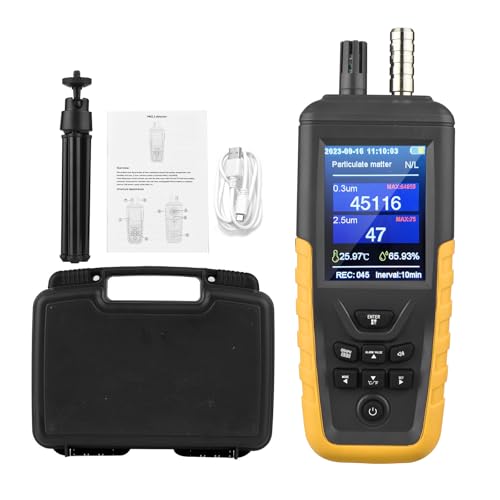
Products shown because their documented specifications fit this guide. Price and availability are on Amazon and can change.
Frequently Asked Questions
Does the sensor type actually matter?
For CO2 it decides whether the reading means anything. The listing states a next generation infrared NDIR sensor. NDIR measures how much infrared light carbon dioxide absorbs, so it responds to CO2 itself. The cheaper alternative is a metal oxide element that infers a number from general air chemistry and will react to a cleaning spray as if the room had filled with people. On this specification the AD1001 is on the right side of the line.
What do the published sensor ranges tell me?
They tell you what the instrument will attempt to read, which is not the same as how well. Formaldehyde is 0 to 2 mg per m3 by an electrochemical sensor, TVOC is 0 to 5 mg per m3 by a semiconductor sensor, and particles are 0 to 999 micrograms per m3 for PM1.0, PM2.5 and PM10 by laser scattering. No accuracy or resolution figure is published for any of them.
Why does the listing warn about using it while plugged in?
Because the electronics generate heat and the temperature sensor sits inside the same case. The listing states that continuous plugged in use may generate slight extra heat which can minimally affect temperature readings, and that optimal accuracy comes on battery. Most listings would leave that out. Taking it at face value, run it on the 2500 mAh battery when the temperature and humidity numbers matter.
Is a semiconductor TVOC reading trustworthy?
Treat it as a trend rather than a measurement. A semiconductor element responds to a broad mix of organic compounds without identifying any of them, so the number rises when solvent is in the air and falls when it clears. That is genuinely useful in a finishing shop. It is not a figure to compare against an exposure limit for a named chemical.
What is missing that a workshop buyer would want?
Any accuracy figure, any statement about calibration or recalibration, and any mention of data logging or export. The listing describes a live display with alarms. It does not describe a record you could review after a week of sanding.
Affiliate disclosure: Akermin earns a commission from qualifying Amazon purchases made through links on this page. Our editorial picks are based on documented specifications and owner feedback, not commissions.