Best Air Quality Monitors: 12 Smart Picks for Healthier Indoor Air
Air quality monitor covers everything from a single-gas alarm to a 16-sensor desktop display, and a long parameter list is not the same as a long list of real sensors. This hub sorts the twelve by what each listing states it measures, how it connects and whether it also functions as a safety alarm.
Independent Research
Verified Specifications
Honest Recommendations
Count the Sensors
Not the Parameters
Then Read the Trend
As an Amazon Associate, Akermin earns from qualifying purchases. Product links on this page are affiliate links.
Our Top Picks
These twelve are compared on what each manufacturer states the device measures, how it is powered, whether it connects to an app or a smart home platform and whether it also acts as a safety alarm. Parameter counts are quoted as the listing gives them, which is worth remembering: a 16-in-1 monitor does not contain sixteen sensors, it derives several readings from fewer. We ran no reference comparisons and publish no measurements of our own.
Best Overall
bonoch AirSentry 16 in 1 Air Quality Monitor
A seven inch high-definition display and the widest stated parameter list here.
Parameter counts are quoted from the listings and should not be read as sensor counts: PM1, PM2.5 and PM10 typically come from one optical sensor, and an air quality index is calculated rather than measured. No listing on this page publishes a measurement accuracy figure for carbon dioxide or particles, which is why that column does not exist. Two of these devices are primarily carbon monoxide safety alarms with air quality added.
How to Choose an Air Quality Monitor
Decide what you are trying to find out before you compare feature lists:
Sensors, Not Parameters
A 16-in-1 figure counts displayed values, not sensing elements. Ask which physical sensors are inside: an optical particle sensor, a gas sensor and a temperature and humidity sensor cover most of any parameter list.
Real CO2 or Estimated
True carbon dioxide measurement uses an optical sensor. Some devices estimate it from a volatile organic compound reading instead, which tracks occupancy loosely and fails whenever cleaning products or cooking are involved.
Monitor or Alarm
An air quality monitor is an information device. A carbon monoxide alarm is a life safety device with certification behind it. If you need the second, buy a certified alarm and do not rely on a monitor with a CO reading.
What Happens to the Data
A reading you have to notice changes nothing. Connectivity that drives a fan, sends a notification or keeps a log is what turns a display into a decision.
Does a 16-in-1 monitor really have sixteen sensors?
Almost certainly not. One optical particle sensor produces PM1, PM2.5 and PM10 from a single measurement. A temperature and humidity sensor produces both plus dew point. An air quality index is calculated from the other readings. A realistic count for a 16-in-1 device is three or four physical sensors, which is not a criticism, but it means comparing parameter counts compares marketing rather than hardware.
Which reading should I actually watch?
In an occupied room, carbon dioxide, because it tracks ventilation directly and rises predictably with people in a closed space. Outdoor air is around 420 ppm, a well ventilated room sits somewhere in the hundreds above that, and readings above roughly 1000 ppm indicate the air is being recirculated rather than replaced. Particles matter more during cooking, cleaning, sanding or wildfire smoke.
Can an air quality monitor replace a carbon monoxide alarm?
No. A carbon monoxide alarm is a certified life safety device with defined alarm thresholds and response times, tested to a standard. A monitor that displays a carbon monoxide number is an information device. The two Kidde units here are alarms that add air quality; the rest are monitors that do not replace one.
Why does my monitor read differently in different rooms?
Because the air genuinely is different, and because placement changes what the sensor sees. Height, distance from a window or door, proximity to a person breathing on it, and airflow from a vent all shift readings substantially. Compare a room with itself over time rather than comparing two rooms, and keep the device in one position.
Do these devices need calibrating?
Optical carbon dioxide sensors typically run an automatic baseline correction that assumes the space reaches outdoor levels periodically, which is why a monitor in a room that is never aired can drift. None of these listings states its calibration method, so if a defensible number matters, choose an instrument that publishes a calibration certificate instead.
Reviews
bonoch AirSentry 16 in 1 Air Quality Monitor Best Overall
A monitor earns its place by being read, and a seven inch display is the practical reason to choose this one. A device that shows carbon dioxide, particle and humidity readings large enough to take in from across a room gets glanced at several times a day; a small display gets consulted once and forgotten. bonoch states a 16-in-1 parameter set on a seven inch high-definition screen with high-precision carbon dioxide monitoring.
Be careful with the parameter count, on this and on every device that advertises one. Sixteen parameters does not mean sixteen sensors. A typical unit of this kind carries a carbon dioxide sensor, a laser particle sensor, a temperature and humidity sensor and a metal oxide gas sensor, and derives the rest: PM1, PM2.5 and PM10 come from one optical measurement, an air quality index is calculated from the others, and a dew point is arithmetic on temperature and humidity. That is not dishonest, but it means the useful comparison is between sensor sets rather than between parameter counts.
The listing does not state sensor types, accuracy figures, a calibration method or logging capability. For a home user watching trends and deciding when to open a window, none of those is critical. For anyone who needs a number they can defend, the Forensics Detectors instruments in our carbon dioxide guide publish calibration certificates and these do not.
Strengths
Seven inch display is genuinely readable across a room
Widest stated parameter list on the page
Covers gas, particle and comfort measurements together
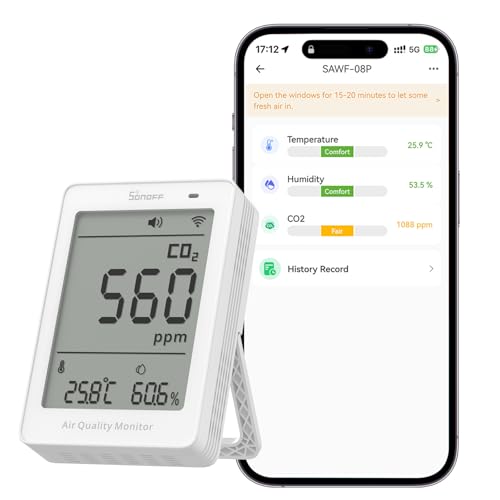
Every connected air quality monitor wants its own app, and a house with four connected devices ends up with four apps that do not talk to each other. Matter is the standard that fixes that, and the AirGuard is the one device on this page whose listing states Matter compatibility along with integration into major smart home platforms including Apple Home.
The practical payoff is automation. A carbon dioxide reading that only appears on a screen requires somebody to look at it and act. A reading that a smart home platform can see becomes a trigger: extractor fan on above a threshold, a notification on a phone, a heat recovery ventilator stepped up, a log kept without anyone doing anything. That turns the monitor from an information display into part of a control loop, which is where these devices actually earn their cost.
It runs on 2.4 GHz Wi-Fi, which is normal for this class and worth checking against a network that has been set up for 5 GHz only. The listing does not state the sensor technology, the measurement range, the accuracy or whether automatic baseline calibration can be disabled. For carbon dioxide those omissions matter more than usual, because the difference between a true optical sensor and an estimated reading derived from a volatile organic compound sensor is the difference between a measurement and a guess.
Strengths
Matter support avoids yet another isolated app
Readings can drive ventilation automatically
Works with mainstream smart home platforms
Wi-Fi rather than a proprietary hub
Limitations
Sensor technology not stated
No accuracy or range figures published
2.4 GHz only, which some networks need configuring for
VETOUCH Plug-in 3 in 1 CO2 Monitor and Alarm Best Value
The monitor that gets used is the one that never needs attention, and a plug-in device with no batteries is the least demanding form factor there is. VETOUCH states plug and play operation from any outlet with no batteries needed, a digital display, a three parameter measurement set and a carbon dioxide alarm.
That combination suits the specific case these devices are best at: a bedroom, a small office or a study where the question is simply whether the room needs more ventilation. Continuous mains power means the readings never stop, which matters because carbon dioxide behaviour overnight in a closed bedroom is exactly what most people want to see and exactly what a battery device tends to miss.
The constraint is placement, and it is a real one. A plug-in device goes where the sockets are, which in most rooms means close to the floor and often behind furniture. Carbon dioxide mixes reasonably well so this is less damaging than it would be for a particle monitor, but a socket in an alcove behind a sofa will read differently from breathing height in the middle of the room. Our guide on placing a monitor covers the trade-off. The listing states no sensor type, no range and no accuracy figure.
Short answer: the bonoch AirSentry 16 in 1 is the monitor to buy if you want one readable display covering gas, particle and comfort readings in a living space; the SONOFF AirGuard is the pick for a connected home because Matter support lets the reading drive ventilation rather than just sit on a screen; and the VETOUCH plug-in monitor is the cheap, reliable way to watch carbon dioxide in a bedroom without ever thinking about batteries.
What these twelve devices have in common, and what they do not
All twelve report something about indoor air. Beyond that they are four different kinds of product. Desktop monitors with large displays are built to be looked at, and cover the widest parameter sets. Smart monitors are built to be queried by something else, and their value is in automation rather than display. Plug-in monitors trade placement freedom for never needing power. And two of these, the Kidde units, are certified carbon monoxide alarms that have had air quality measurement added, which makes them a different category of device with a different legal and safety standing. Working out which of the four you need is a bigger decision than choosing between models within one, and the Type column exists for that reason.
The parameter count problem
Three devices here advertise a 16-in-1 parameter set. That figure counts numbers on a screen, not sensing elements inside the case. One laser particle sensor measures scattered light and produces PM1, PM2.5 and PM10 by inference from particle size distribution. One temperature and humidity element produces both readings plus dew point and sometimes a comfort index. An air quality index is computed from whatever else is available. A metal oxide gas sensor may produce a total volatile organic compound figure and a formaldehyde figure that are, in reality, two interpretations of the same resistance change. So a 16-in-1 monitor might contain four sensors, and a 7-in-1 monitor with better sensors can be the more accurate instrument. The question to ask a manufacturer is not how many parameters but which sensing elements, and specifically whether carbon dioxide is measured optically or estimated. Our guide on checking for a true optical CO2 sensor explains how to tell.
Carbon dioxide is the reading that changes behaviour
Of everything these devices measure, carbon dioxide is the one most likely to be actionable in an ordinary home or office. It has a clear baseline, since outdoor air sits close to 420 parts per million and is remarkably consistent. It has an obvious source, since people exhale it continuously. And it has an obvious remedy, since opening a window fixes it within minutes. That combination makes it a direct proxy for ventilation: a room whose carbon dioxide climbs through an evening is a room whose air is being recirculated rather than replaced, and a bedroom that reaches high figures by morning has been sealed all night. Particle readings matter too, but they spike with cooking and cleaning and settle on their own, and volatile organic compound readings from low-cost sensors are relative rather than absolute. If you buy one of these devices and watch one number, watch this one.
Placement decides the reading more than the sensor does
A monitor on a windowsill reads the window. A monitor on a desk reads the person sitting at it and jumps whenever they lean toward it. A monitor near an extractor or a vent reads the airflow rather than the room. For carbon dioxide, breathing height away from direct exhalation and away from doors and vents gives the most representative figure, which is roughly where a person sits rather than where a socket happens to be. For particles, proximity to the source matters enormously and a monitor in the kitchen will tell a very different story from one in the next room. The practical advice is to choose one position, leave the device there, and compare the room with itself over days rather than comparing two devices or two rooms. Our placement guide covers this in detail.
Guides in This Category
The narrower guides beneath this hub, and who each is written for:
For a bedroom, the plug-in monitor: continuous, unattended, and carbon dioxide overnight is the reading that matters. For a living room or home office where the display will be seen, the large desktop unit. For a house with existing smart home automation, the Matter device, because a reading that opens a vent is worth more than a reading you have to notice. For a workshop, the rechargeable POWERTEC, which is built around dust and fumes rather than occupancy. And if the actual worry is a fuel-burning appliance, buy a certified carbon monoxide alarm first and treat everything on this page as secondary.
How We Research
Monitors were compared on manufacturer listing text: the parameters each listing states, connectivity and smart home support, alarm functions, power source, display size and any logging or export capability. We treat stated parameter counts as marketing figures rather than sensor counts and say so. No listing on this page publishes an accuracy figure, so none is reported and none has been inferred from a datasheet or a comparable model. We ran no comparisons against reference instruments and publish no measurements of our own. Amazon data supplies images, availability and links only.
A pump suction handheld particle counter reading 0.3, 0.5 and 1.0 micron channels alongside PM2.5, PM10 and TSP, with temperature and humidity sensors, 32 GB of internal storage and a 3500 mAh battery.
A mains powered three in one monitor showing carbon dioxide, temperature and humidity on a 1.83 inch colour screen, with three brightness settings and a display that flips 180 degrees.
A mains powered Matter compatible monitor showing CO2, temperature and humidity on one screen, with an NDIR sensor, 5 second updates and 12 months of history in the eWeLink app.