As an Amazon Associate, Akermin earns from qualifying purchases. Product links on this page are affiliate links.
A classroom CO₂ monitor needs five things: a genuine NDIR sensor, a display large enough for the teacher to read from the front with a traffic-light color, battery power lasting years so there is no cable, a case that tolerates being handled, and thresholds set to school guidance (act above 1,000 ppm, ventilate urgently above 1,500). Wi-Fi logging is a bonus for the facilities team but is not what makes the monitor work in the room. Place it at 1.5 m on a side wall away from windows, doors and children.
Why classrooms are different
A classroom has the highest occupant density of almost any room: 30 people in 60 m² with the door shut. CO₂ climbs several hundred ppm every ten minutes and commonly exceeds 2,000 ppm before the bell. The monitor’s job is to prompt a simple action, opening windows or the door, in time. That makes visibility and simplicity the priorities. See what a good indoor CO₂ level is.
Step 1: Sensor
NDIR or photoacoustic NDIR with a stated accuracy. Anything estimating CO₂ from VOCs will react to hand gel and glue sticks instead of children. See how to check for a true NDIR sensor.
Step 2: Display and colors
- Digits at least 15 mm tall, readable from 6 to 8 m.
- A green / amber / red indicator with thresholds you can set (typically 800 and 1,500 ppm, or 1,000 and 1,500).
- Optional buzzer that can be turned off; a chime at red is helpful, a constant alarm is not.
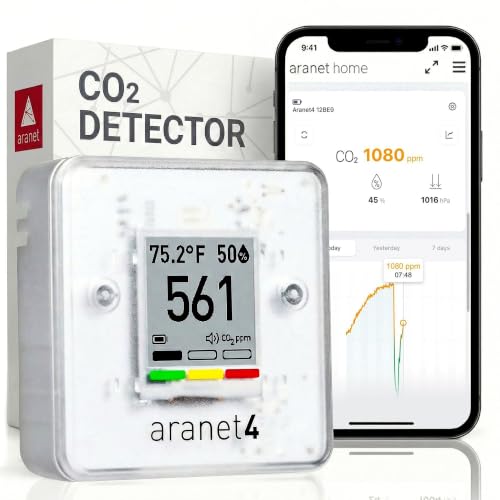
- E-ink displays (Aranet4) are readable in any light and never glow; LCD with backlight (Temtop C1+) is larger and brighter.
Step 3: Power
Battery, with a life measured in years at a 5 to 10 minute interval. The Aranet4’s two AA cells last up to four years; rechargeable units last weeks to months and need a charging routine somebody will forget. Avoid plug-in units unless a socket sits exactly where the monitor belongs.
Step 4: Durability and mounting
Choose a case that survives a fall from a shelf and a hook or screw mount so it stays put. Mount at about 1.5 m on a side or back wall, out of easy reach. Do not mount by the window (fresh air) or the door (corridor air) or above a radiator. See how to place a CO₂ monitor.
Step 5: Thresholds and the routine
| Reading | Color | Classroom action |
|---|---|---|
| Under 800 ppm | Green | None |
| 800 to 1,500 ppm | Amber | Open a window or the door at the next natural break |
| Over 1,500 ppm | Red | Open windows and door now; consider a short outdoor break |
Teach the class what the colors mean; pupils are reliable enforcers. Airing the room fully at every break resets it.
Step 6: Logging for the school
Facilities teams benefit from a record: which rooms are worst, whether mechanical ventilation is working, whether window policies are followed. Bluetooth monitors export from a phone during a walk-round; Wi-Fi units feed a dashboard. For a whole school, a fleet of simple battery monitors plus a few Wi-Fi loggers in the worst rooms is usually the practical mix. See how to export CO₂ monitor data.
Procurement checklist
- NDIR sensor, stated accuracy, range to 5,000 ppm or more
- Large display with configurable color thresholds
- Battery life of at least one school year
- Wall mount and robust case
- Manual calibration option (rooms never empty fully during the week; automatic correction can drift); see why automatic calibration can be wrong
- Data export for a sample of rooms
Monitors meeting this list are compared in best CO₂ monitors for home and office.
Recommended Tools


Products shown because their documented specifications fit this guide. Price and availability are on Amazon and can change.
Frequently Asked Questions
What CO₂ level should a classroom stay under?
Guidance in several countries targets under 1,000 ppm during lessons, with 800 ppm as the well-ventilated benchmark and 1,500 ppm as the level requiring immediate action.
Where should a classroom CO₂ monitor be placed?
At about 1.5 m on a side or back wall, away from windows, doors, radiators and the teacher's desk, and out of reach of pupils where possible.
Battery or plug-in for classrooms?
Battery, with multi-year life. Sockets are rarely where the monitor should go, and trailing cables in classrooms are a hazard.
Affiliate disclosure: Akermin earns a commission from qualifying Amazon purchases made through links on this page. Our editorial picks are based on documented specifications and owner feedback, not commissions.
Related Guides

Temtop Handheld Particle Counter Review: Three Channels and No Published Flow Rate
A pump suction handheld particle counter reading 0.3, 0.5 and 1.0 micron channels alongside PM2.5, PM10 and TSP, with temperature and humidity sensors, 32 GB of internal storage and a 3500 mAh battery.
Read More→
VETOUCH Plug In CO2 Monitor Review: An Alarm the Bullets Never Define
A mains powered three in one monitor showing carbon dioxide, temperature and humidity on a 1.83 inch colour screen, with three brightness settings and a display that flips 180 degrees.
Read More→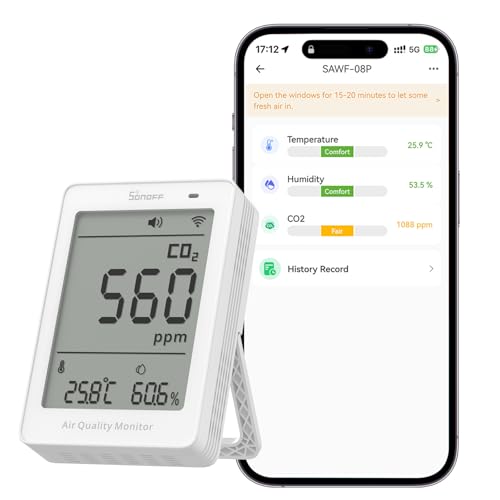
SONOFF AirGuard SAWF-08P Review: NDIR Accuracy Written as a Formula
A mains powered Matter compatible monitor showing CO2, temperature and humidity on one screen, with an NDIR sensor, 5 second updates and 12 months of history in the eWeLink app.
Read More→