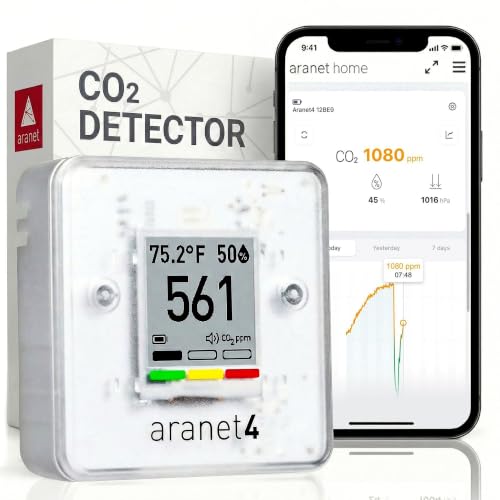
Aranet4 Home CO₂ Monitor
Accurate, reliable and easy to use.
- NDIR sensor (high accuracy)
- CO₂, temperature, humidity and pressure
- Battery life up to 4 years on two AA cells
- Bluetooth app with 90 days of history
Compare the best CO₂ monitors to improve indoor air quality, boost productivity and create a healthier environment.
Better Air
Healthier Spaces
Brighter Days
As an Amazon Associate, Akermin earns from qualifying purchases. Product links on this page are affiliate links.
We researched and compared the leading CO₂ monitors for different needs and budgets. Every product below is checked against manufacturer specifications and patterns in verified owner feedback; we do not claim laboratory testing.
Accurate, reliable and easy to use.

All-in-one indoor air quality monitor.

Affordable and reliable option.
No pick matches that combination yet. Try a wider budget or a different measurement.
| Product | CO₂ Range | Stated Accuracy | Additional Sensors | Battery Life | Connectivity | |
|---|---|---|---|---|---|---|
| Aranet4 Home | 0 to 9,999 ppm | ±(30 ppm + 3%) | Temp, humidity, pressure | Up to 4 years (2 AA) | Bluetooth | View |
| Airthings View Plus | 400 to 5,000 ppm | ±(50 ppm + 3%) | PM2.5, VOC, radon, temp, humidity, pressure | Up to 2 years (6 AA) or USB-C | Wi-Fi, Bluetooth | View |
| SwitchBot Meter Pro CO₂ | 400 to 9,999 ppm | ±(50 ppm + 5%) | Temp, humidity | Up to 12 months, USB-C | Bluetooth (hub for Wi-Fi) | View |
| Temtop C1+ | 400 to 5,000 ppm | ±(40 ppm + 5%) | Temp, humidity | Up to 70 days, USB-C | Bluetooth | View |
| GoveeLife H5140 | 400 to 5,000 ppm | ±(40 ppm + 5%) | Temp, humidity, pressure | Plug-in (USB) | Wi-Fi, Bluetooth | View |
Figures are manufacturer-published specifications at the time of research. Accuracy is typically stated at room temperature after calibration. Confirm the current listing and revision before buying.
When choosing a CO₂ monitor, consider the following factors:
Look for NDIR sensors for reliable readings and a published accuracy figure such as ±(50 ppm + 3%).
Temperature, humidity, VOCs and PM2.5 can give a fuller picture of a room; radon is worth having in ground-floor spaces.
Battery, rechargeable or plug-in depending on where the monitor will live and whether a socket is nearby.
Home, office, school or commercial spaces may require different alert thresholds, logging and connectivity.
Outdoor air is about 420 ppm. Indoors, readings under 800 ppm indicate good ventilation, 800 to 1,000 ppm is acceptable, and above 1,000 ppm most guidance recommends increasing fresh air. Readings above 1,500 ppm mean ventilation is clearly not keeping up with the number of people in the room.
Consumer NDIR monitors typically state accuracy of ±(30 to 50 ppm) plus 3 to 5 percent of the reading, so a true 1,000 ppm room might read anywhere from about 920 to 1,080 ppm. That is more than precise enough to decide when to ventilate. Devices that estimate CO₂ from a VOC sensor ("eCO₂") can be off by hundreds of ppm and should not be used for ventilation decisions.
At roughly breathing height (1 to 1.5 m), away from windows, doors, vents and at least a meter from the nearest person so their exhaled breath does not inflate the reading. In a classroom or meeting room, the middle of an interior wall is usually representative.
Some do. Combination monitors such as the Airthings View Plus add PM2.5, VOCs, humidity, temperature and radon. A dedicated CO₂ monitor like the Aranet4 measures CO₂ plus temperature, humidity and pressure. Neither type detects carbon monoxide; that needs a separate CO alarm.
NDIR (nondispersive infrared) sensors shine infrared light through the air and measure how much is absorbed at the wavelength CO₂ absorbs, so they detect CO₂ directly. "eCO₂" or "CO₂ equivalent" is an estimate derived from a metal-oxide VOC sensor and can be wildly wrong when someone uses hand sanitizer or cooks. Only NDIR (including photoacoustic NDIR) is suitable for ventilation monitoring.
Most consumer monitors use automatic baseline correction, which assumes the room reaches outdoor levels (about 420 ppm) at some point each week and adjusts to it. If a monitor lives in a space that is never empty, or reads below 400 ppm, run a manual calibration in fresh outdoor air following the manual. Once every few months is plenty for most homes.
Indirectly. CO₂ is a proxy for how much exhaled air is being re-breathed, which is what carries respiratory aerosols. A low CO₂ reading means good dilution; it does not measure viruses and does not account for filtration, which lowers aerosol levels without changing CO₂.
The Aranet4 Home is the monitor most air-quality researchers reach for, and the documentation explains why. It uses a nondispersive infrared (NDIR) sensor, the measurement principle that actually detects CO₂ rather than estimating it from other gases, with a manufacturer-stated accuracy of ±(30 ppm + 3% of reading) across a 0 to 9,999 ppm range.
The e-ink display is the practical advantage. It is readable from across a room in any light, and because it only draws power when the number changes, two AA batteries last up to four years at the default 10-minute interval (about two years at the fastest setting). There is no charging cable to forget and no wall socket to find, which matters for classrooms and rented offices.
The Bluetooth app stores up to 90 days of readings and exports CSV files, so you can see how a room behaves over a working week rather than glancing at one number. A color indicator and optional buzzer flag the 1,000 and 1,400 ppm thresholds, both adjustable.
The trade-offs are cost and connectivity. It is the most expensive monitor in this guide, it has no Wi-Fi (the Aranet Home app on a phone or the separate Aranet Cloud gateway is needed for remote access), and it measures CO₂ only. If you want particulates or VOCs, look at the Airthings View Plus below.
The View Plus is the monitor to choose when CO₂ is one of several things you want to know about a room. Alongside an NDIR CO₂ sensor (manufacturer-stated range 400 to 5,000 ppm), it measures PM2.5 particulates, airborne chemicals (VOCs), humidity, temperature, air pressure and, unusually for a consumer device, radon. Radon is a documented cause of lung cancer and there is no other way to know your level than to measure it.
Wi-Fi is built in, so readings go to the Airthings app and dashboard without a phone nearby. Alerts, weekly reports and integrations with Alexa, Google Home and IFTTT mean the monitor can trigger a fan or air purifier when a threshold is crossed. Power comes from six AA batteries (up to two years, according to Airthings) or USB-C.
The e-ink display cycles through readings, which is fine for a glance but slower to read than the Aranet4's single big number. The radon reading needs about a week to settle, and the PM2.5 and VOC sensors, like all consumer sensors of their type, are best treated as trend indicators rather than reference measurements. Airthings offers an optional free five-year warranty on registration.
The SwitchBot Meter Pro CO₂ does the important thing right at a much lower price: it uses a real NDIR sensor (SwitchBot specifies a Swiss-made Sensirion module) instead of the metal-oxide estimators found in most cheap air-quality gadgets. Manufacturer-stated accuracy is ±(50 ppm + 5% of reading), which is looser than the Aranet4 but more than adequate for deciding when to ventilate.
The 92 mm screen shows CO₂, temperature, humidity, a comfort indicator and the time at once, and it updates every second. A built-in rechargeable battery lasts up to 12 months per SwitchBot's specification, with USB-C charging; it can also stay plugged in permanently. Alerts are configurable for CO₂, temperature and humidity and come as a buzzer, an on-screen indicator and app notifications over Bluetooth.
Remote access and data export require a SwitchBot Hub, sold separately, which is the main compromise. The plastic housing also feels less premium than the Aranet4, and the alert buzzer is the first thing most owners turn off. For most homes, offices and classrooms it is the sensible starting point.
Short answer: buy a monitor with a true NDIR sensor and a published accuracy figure. For most people that is the Aranet4 Home if budget allows, the SwitchBot Meter Pro CO₂ if not, and the Airthings View Plus if you also want PM2.5, VOCs and radon in one device.
People exhale CO₂ at a predictable rate, so the concentration in a room tracks how much fresh air is replacing the air people have already breathed. Outdoors it is about 420 ppm. A well-ventilated room stays under 800 ppm; a stuffy meeting room after an hour can pass 1,500 ppm. CO₂ at these levels is not itself harmful, but it is the best cheap indicator that a room is under-ventilated, which matters for concentration, for comfort and for anything airborne that other people are breathing out.
A monitor turns that invisible number into a visible one. Most owners find the same thing in the first week: the bedroom overnight, the car on a long drive and the small meeting room are far worse than they assumed.
There are two kinds of “CO₂ monitor” on the market and only one of them measures CO₂.
Manufacturers state accuracy as a fixed part plus a percentage of the reading, for example ±(50 ppm + 3%). At 1,000 ppm that is ±80 ppm. For deciding whether to open a window, anything in the ±(30 to 50 ppm + 3 to 5%) band is fine. Tighter figures matter for research or for verifying a building’s ventilation system.
Range is rarely a constraint. Most monitors read to 5,000 ppm, some to 9,999 ppm. Occupied rooms almost never exceed 3,000 ppm; higher readings suggest a CO₂ source such as fermentation, dry ice or a cylinder leak.
NDIR sensors draw a burst of power on every measurement, so battery life depends on how often the monitor samples. The Aranet4’s e-ink display and 10-minute default interval give it years on AA cells. Rechargeable monitors such as the SwitchBot and Temtop last weeks to a year between charges. Plug-in monitors such as the GoveeLife H5140 can sample continuously and run Wi-Fi without worrying about power, at the cost of needing a socket.
Choose battery power for classrooms, rented spaces and anywhere you want to move the monitor around. Choose plug-in for a fixed location where you want Wi-Fi logging.
Bluetooth is enough if you will look at the app while in the building. Wi-Fi is worth paying for if you want alerts when you are away, long-term charts, or to trigger a fan or purifier through a smart-home platform. Look for CSV export if you plan to analyze a room over weeks; the Aranet4, Airthings and Govee apps all export.
NDIR sensors drift slowly. Most consumer monitors correct for this automatically by assuming the lowest reading each week was outdoor air. That works in a home that empties out; it fails in a space that is always occupied, and it can be thrown off by a monitor living in a bedroom with the door closed. A manual calibration in fresh outdoor air, described in every manual, resets the baseline in about 10 minutes. See how to calibrate a CO₂ monitor.
Breathing height, away from vents, windows and people. A monitor on a desk directly in front of you will read hundreds of ppm high from your own breath. For a whole-room reading, put it on a shelf or interior wall a meter or more from the nearest seat.
| Situation | Pick | Why |
|---|---|---|
| Home office or living room, one monitor | Aranet4 Home | Best stated accuracy, no cable, years of battery, readable across the room |
| Several rooms on a budget | SwitchBot Meter Pro CO₂ | NDIR sensing at the lowest cost; buy two or three |
| Whole-house air quality including radon | Airthings View Plus | Seven measurements, Wi-Fi, smart-home triggers |
| Classroom or meeting room | Aranet4 Home or SwitchBot | Battery power, big display, adjustable alerts |
| Fixed spot with Wi-Fi logging and no batteries | GoveeLife H5140 | Plug-in, Wi-Fi, CSV export, Alexa and Google |
| Travel, car, hotel rooms | Aranet4 Home or Temtop C1+ | Compact, battery powered, quick readings |
We did not test these monitors in a laboratory and we do not publish figures as if we had. Each pick was selected from manufacturer documentation (sensor type, range, stated accuracy, calibration method, battery specification, connectivity), from the datasheet of the sensing module where the maker names it, and from recurring patterns in verified owner feedback such as drift, app reliability and battery life. Amazon data is used only for images, availability and links.
A product had to use a true NDIR or photoacoustic NDIR CO₂ sensor and publish an accuracy figure to be considered. Monitors that estimate "eCO₂" from a VOC sensor were excluded regardless of price.