As an Amazon Associate, Akermin earns from qualifying purchases. Product links on this page are affiliate links.
Automatic baseline correction (ABC) works by assuming that the lowest CO₂ reading in each period, usually a week, was outdoor air at about 400 to 420 ppm, and adjusting the sensor so that reading matches. In rooms that never reach outdoor levels, such as a closed bedroom, a basement, a greenhouse or a continuously occupied office, the lowest weekly reading is not fresh air, and ABC gradually shifts the baseline so the room’s stale minimum reads as 400 ppm. Every reading is then too low.
How ABC works
NDIR sensors drift slowly as the lamp ages and the optics collect dust. Sending every monitor back for calibration is impractical, so sensor makers built in a self-correction: track the minimum reading over a rolling window (7 days is common, some use 8 or 30), assume that minimum was outdoor air, and nudge the calibration so it reads the reference value. In a home that empties during the day or has windows open at night, the assumption holds and ABC keeps the monitor honest for years. See how to calibrate a CO₂ monitor.
Where the assumption fails
- Closed bedrooms. Occupied every night, door shut; the weekly minimum might be 700 ppm during the day with the door still closed.
- Basements and cellars. Poor exchange with outdoors; often elevated from soil gas and slow leakage.
- Greenhouses and grow rooms. Deliberately enriched CO₂ or heavy plant respiration at night.
- Continuously occupied spaces. 24-hour control rooms, hospital wards, shift-work offices.
- Sealed storage. Wine cellars and fermentation rooms with their own CO₂ sources.
In each case the monitor’s weekly minimum is above outdoor air, ABC pulls the baseline down, and the display underreports by the difference. A bedroom whose real overnight peak is 2,500 ppm may show 1,800 ppm after a few weeks of drift.
Symptoms of a drifted baseline
- Readings under 400 ppm anywhere, including outdoors.
- A stuffy room that reads 450 to 600 ppm.
- A large, stable gap against a second monitor that has recently been in fresh air. See why two CO₂ monitors show different readings.
- A monitor that reads about 400 ppm at the same time every day, whatever is happening in the room.
What to do
- Check the monitor outdoors for 15 minutes. It should read about 400 to 450 ppm. See why outdoor CO₂ is useful for checking a monitor.
- If it does not, run the manual fresh-air calibration.
- If the monitor lives in one of the spaces above, disable ABC in the settings if the monitor allows it, and repeat the manual calibration every two to three months.
- If ABC cannot be disabled, take the monitor outside or into a ventilated room for an hour each week so the algorithm sees a genuine minimum.
Which monitors let you control it
Most monitors built on Senseair and Sensirion modules expose an ABC toggle in the app or menu; some lower-cost units do not document it. The best CO₂ monitors guide notes calibration options for each pick.
Recommended Tools
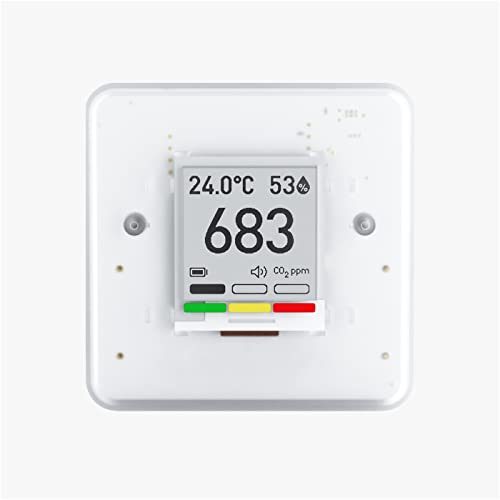
Products shown because their documented specifications fit this guide. Price and availability are on Amazon and can change.
Frequently Asked Questions
Should I turn off automatic calibration?
Only in a space that never reaches outdoor CO₂ levels: a sealed bedroom, basement, greenhouse or continuously occupied room. Then calibrate manually in fresh air every few months.
How do I know if ABC has drifted?
The monitor reads below 400 ppm, or reads 400 to 450 ppm in a room that is clearly stuffy, or disagrees with a freshly calibrated monitor by hundreds of ppm.
How long does ABC take to drift?
Most algorithms adjust in small steps over 7 to 8 day windows, so a monitor in a room that never empties can drift noticeably within a few weeks.
Affiliate disclosure: Akermin earns a commission from qualifying Amazon purchases made through links on this page. Our editorial picks are based on documented specifications and owner feedback, not commissions.
Related Guides

Sacnahe Air Quality Monitor Review: Seven Readings, No Sensor Named, No Accuracy Given
A WiFi monitor claiming AQI, CO2, PM2.5, PM1.0, PM10, TVOC and HCHO with Tuya app logging, reviewed from a listing that never says how any of it is measured.
Read More→
POWERTEC AD1001 Review: An NDIR Monitor Aimed at the Workshop, With Ranges but No Accuracy
A seven inch multi sensor monitor with an NDIR CO2 sensor, electrochemical formaldehyde, semiconductor TVOC and laser particle sensing, reviewed from the listing.
Read More→
Six Handheld Particle Counters for HVAC Filter Testing
A comparison of six handheld particle counters suitable for HVAC filter testing, covering channel count, sampling flow, data logging, and calibration claims.
Read More→