As an Amazon Associate, Akermin earns from qualifying purchases. Product links on this page are affiliate links.
Outdoor air is useful because its CO₂ concentration is almost the same everywhere: about 420 ppm, varying by a few tens of ppm with location and time of day. That makes it a free reference gas. Put a monitor outdoors in shade for 15 minutes and it should read roughly 400 to 450 ppm. If it does not, the baseline has drifted and the monitor needs calibrating. Every automatic baseline correction routine in a consumer monitor is built on the same assumption.
Why outdoor CO₂ is so stable
CO₂ is well mixed through the atmosphere. Sources and sinks are spread across the planet and the gas lingers for centuries, so the concentration at ground level differs by only a few percent between continents. The global background measured at reference stations was about 315 ppm when continuous measurement began and has passed 425 ppm, rising roughly 2.5 ppm per year. For checking a monitor with a ±50 ppm tolerance, “about 420” is precise enough.
Where it varies
- Cities and roads: traffic and heating add 20 to 100 ppm, more beside a busy road at rush hour.
- Night and early morning: plants respire and the air near the ground is still, so readings in gardens and valleys can run 50 to 150 ppm high before sunrise. Mid-afternoon in a breeze is closest to background.
- Near people, chimneys, vents and car exhausts: obviously high; move away.
- Altitude: the concentration in ppm is the same, but the number of molecules in the sensor’s light path is lower, so uncompensated NDIR monitors read a little low at altitude.
Doing a fresh-air check properly
- Choose a shaded outdoor spot with some air movement, away from roads, people and buildings’ exhaust vents. Mid-morning to mid-afternoon is best.
- Leave the monitor for 15 to 20 minutes so the sensing chamber fully exchanges air. Stand a couple of meters away.
- Read it. 400 to 450 ppm is a pass. 450 to 500 ppm may just be a city; check again elsewhere. Under 400 ppm is a fail: the baseline has drifted low. Over 550 ppm in clean air is a fail the other way.
- If it fails, run the manual calibration while it is still outdoors; see how to calibrate a CO₂ monitor.
How monitors use it automatically
Automatic baseline correction records the lowest reading over a window, usually a week, and assumes that value was outdoor air. It then nudges the baseline so that value reads about 400 to 420 ppm. This works in homes that empty out or ventilate; it fails in rooms that never reach outdoor levels, which is why a manual outdoor check every few months is worth doing. See CO₂ monitor accuracy explained for how drift compares with the stated tolerance.
Using two monitors
If you have more than one, check them outdoors together. Monitors that agree outdoors but disagree indoors are telling you about placement, not calibration. See why two CO₂ monitors show different readings.
A note on “sub-400” claims
A monitor that reads 350 or 380 ppm anywhere is wrong. The pre-industrial level was about 280 ppm and the planet last saw 380 ppm around 2005. Any modern outdoor reading below 400 ppm is a calibration fault, and it is one of the most useful red flags a monitor can give you.
Recommended Tools
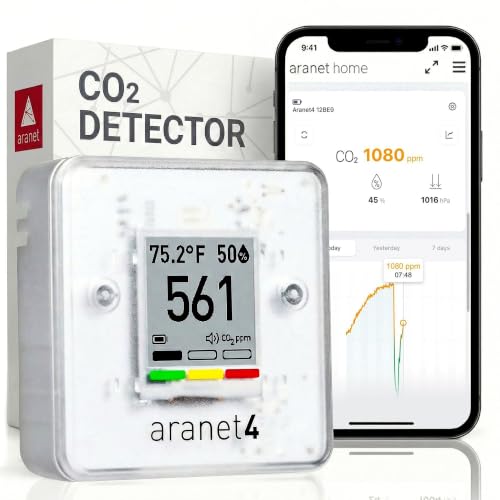

Products shown because their documented specifications fit this guide. Price and availability are on Amazon and can change.
Frequently Asked Questions
What should a CO₂ monitor read outdoors?
About 400 to 450 ppm in an open, shaded spot away from traffic and people. The global background is roughly 420 to 425 ppm and climbing.
Does outdoor CO₂ vary?
A little. Cities, roads, valleys at night and dense vegetation before dawn can run 50 to 150 ppm above background. Mid-afternoon in a breeze is closest to the global figure.
My monitor reads 380 ppm outdoors. Is that possible?
No. Nowhere on Earth is below about 415 ppm today. A reading under 400 ppm means the baseline has drifted low and the monitor needs a fresh-air calibration.
Affiliate disclosure: Akermin earns a commission from qualifying Amazon purchases made through links on this page. Our editorial picks are based on documented specifications and owner feedback, not commissions.