As an Amazon Associate, Akermin earns from qualifying purchases. Product links on this page are affiliate links.
Two CO₂ monitors disagree because each has its own tolerance (typically ±50 ppm plus 3 to 5 percent), its own baseline drift, and its own spot in the room. A gap of 50 to 100 ppm between two NDIR monitors is normal. A gap of several hundred ppm points to one of four things: a drifted baseline, placement near a person or vent, one unit still warming up, or one unit estimating CO₂ from a VOC sensor rather than measuring it.
Normal disagreement
A monitor rated ±(50 ppm + 3%) is allowed to read anywhere from 920 to 1,080 ppm in a true 1,000 ppm room. Two such monitors can legitimately differ by 160 ppm and both be within specification. In practice most agree more closely than that, but nobody should expect them to match to the ppm. See CO₂ monitor accuracy explained for how to read the specification.
The causes of larger gaps
1. Baseline drift and calibration
NDIR sensors drift over months. Automatic baseline correction fixes this by assuming the lowest reading each week was fresh air. If one monitor has lived in a room that never empties, its baseline has crept up or down and every reading is offset. This is the most common cause of a persistent 200 to 500 ppm gap. Fix: fresh-air calibration; see how to calibrate a CO₂ monitor.
2. Placement
A monitor within a meter of a person reads their breath. One beside a window or supply vent reads fresh air before it mixes. Move both to the same shelf for a fair comparison. See why a CO₂ monitor spikes when people enter.
3. Warm-up and sampling interval
A freshly powered monitor can be off for a few minutes. Monitors with long sampling intervals (5 or 10 minutes to save battery) lag behind fast-sampling ones when the room is changing. Compare readings after 15 minutes of stable conditions.
4. Sensor technology
If one monitor reports “eCO₂” or does not name an NDIR sensor, it is estimating CO₂ from volatile organic compounds and can be off by a thousand ppm. The gap is not a calibration problem; the device is not measuring CO₂. See NDIR vs metal-oxide sensors.
5. Pressure compensation
NDIR readings shift with air pressure. Monitors with a pressure sensor compensate; those without read about 1 percent low per 100 m of altitude and drift slightly with weather. This produces small, consistent gaps rather than large ones.
A five-minute arbitration test
- Put both monitors on the same shelf, a meter from anyone, for 15 minutes. Note the gap.
- Take both outdoors into shade for 15 minutes. Each should read roughly 400 to 450 ppm. The one that does not needs calibration.
- Bring both back in. If the gap persists after calibration and is under 100 ppm, that is tolerance. If it is larger, suspect sensor type or a failing unit.
Which to trust for decisions
For deciding when to ventilate, either NDIR monitor is fine; the thresholds (800, 1,000, 1,500 ppm) are far apart. Use the trend from one monitor rather than comparing absolute numbers across two. If you need agreement across many rooms, calibrate them all on the same day in the same fresh air.
Recommended Tools
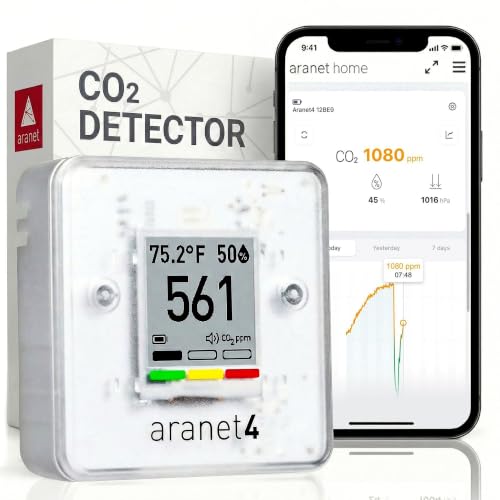

Products shown because their documented specifications fit this guide. Price and availability are on Amazon and can change.
Frequently Asked Questions
How close should two CO₂ monitors read?
Two calibrated NDIR monitors placed together and warmed up usually agree within 50 to 100 ppm at typical indoor levels. Their combined stated tolerances allow up to about 150 to 200 ppm at 1,000 ppm.
Which monitor is right if they disagree?
Put both outdoors in shade for 15 minutes. The one reading close to 400 to 450 ppm has the correct baseline. Calibrate the other in fresh air.
Can one monitor read 800 and the other 2,000 in the same room?
Only if one is an eCO₂ estimator, one has a badly drifted baseline, or one is within breathing distance of a person. That gap is not explained by normal tolerance.
Affiliate disclosure: Akermin earns a commission from qualifying Amazon purchases made through links on this page. Our editorial picks are based on documented specifications and owner feedback, not commissions.