As an Amazon Associate, Akermin earns from qualifying purchases. Product links on this page are affiliate links.
To compare CO₂ monitor accuracy, convert each specification to an absolute ppm figure at the levels that matter (800, 1,000 and 2,000 ppm) using the fixed part plus the percentage of reading, then check the conditions under which the figure applies: temperature, the ppm sub-range, and whether it is after calibration. Monitors that state only a percentage, or nothing, should be traced to their sensor module’s datasheet or treated as unverified. For home and office use, any NDIR monitor within about ±100 ppm at 1,000 ppm is adequate; the comparison mostly separates honest specifications from missing ones.
Step 1: Write the spec as fixed + percentage
The standard form is ±(A ppm + B% of reading). Some listings give only one part. If only a percentage appears, the fixed part is probably in the module datasheet; if only a fixed ppm appears, it usually applies at one reference level. See CO₂ monitor accuracy explained.
Step 2: Compute at three levels
| Specification | At 800 ppm | At 1,000 ppm | At 2,000 ppm |
|---|---|---|---|
| ±(30 ppm + 3%) | ±54 | ±60 | ±90 |
| ±(40 ppm + 5%) | ±80 | ±90 | ±140 |
| ±(50 ppm + 3%) | ±74 | ±80 | ±110 |
| ±(50 ppm + 5%) | ±90 | ±100 | ±150 |
| ±5% only (fixed part unknown) | ±40 plus unknown | ±50 plus unknown | ±100 plus unknown |
Step 3: Check the conditions
- Sub-range. Many modules specify the figure for 400 to 2,000 ppm and a looser one above. If you care about stuffy bedrooms at 3,000 ppm, find the second figure.
- Temperature. Typically stated at 25 °C; some add a temperature coefficient. Cold rooms and warm devices both shift readings.
- Pressure. Modules with a pressure sensor compensate; those without read low at altitude.
- After calibration. The spec applies to a freshly calibrated sensor. Add drift for a monitor that has not been calibrated in a year; see what sensor drift is.
Step 4: Look for the other figures
- Repeatability (±10 to 20 ppm typical): how steady the reading is; matters for trends. See what repeatability is.
- Long-term drift (1 to 2% per year typical): matters for monitors that will not be calibrated.
- Response time (T63 or T90, 1 to 3 minutes): matters for alerts. See how to check CO₂ monitor response time.
Step 5: Trace the module
Consumer monitors rarely publish more than the accuracy line. The sensor module inside does: Sensirion SCD30 (±(30 ppm + 3%)), SCD40 (±(50 ppm + 5%)), SCD41 (±(40 ppm + 5%)), Senseair S8 (±(40 ppm + 3%)), Cubic CM1106 (±(50 ppm + 5%)) and so on. If the monitor names its module, the datasheet is the authoritative spec. If it names none, the stated accuracy is a claim without a source.
Worked comparison
| Monitor | Stated accuracy | At 1,000 ppm | Module named? | Verdict |
|---|---|---|---|---|
| Aranet4 Home | ±(30 ppm + 3%) | ±60 ppm | NDIR, Senseair | Tightest consumer spec |
| GoveeLife H5140 | ±(40 ppm + 5%) | ±90 ppm | Sensirion SCD4x | Good, traceable |
| SwitchBot Meter Pro CO₂ | ±(50 ppm + 5%) | ±100 ppm | Sensirion, per maker | Adequate, traceable |
| Unnamed “10-in-1” device | “High precision” | Unknown | No | Unverified; likely eCO₂ |
How much accuracy you need
The action thresholds (800, 1,000, 1,500 ppm) are far enough apart that ±100 ppm does not change a decision. Spend the comparison effort on placement and calibration instead; see how to place a CO₂ monitor. Monitors with stated, traceable specs are compared in best CO₂ monitors for home and office.
Recommended Tools
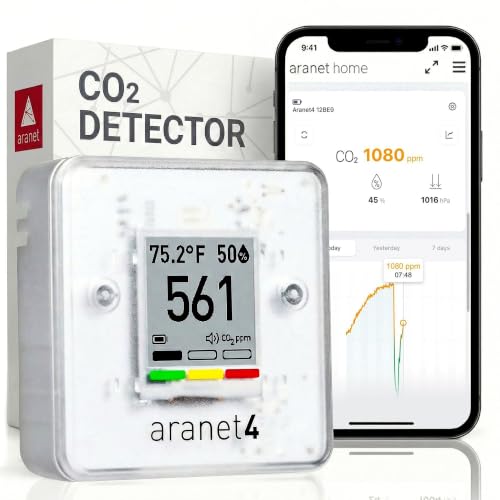


Products shown because their documented specifications fit this guide. Price and availability are on Amazon and can change.
Frequently Asked Questions
Which is better, ±(30 ppm + 3%) or ±(50 ppm + 5%)?
The first, at every level. At 1,000 ppm it is ±60 versus ±100 ppm; at 2,000 ppm ±90 versus ±150 ppm.
What if a monitor only states a percentage?
Assume a fixed term is hidden. Look up the sensor module's datasheet, which will state both parts. If the module is unnamed, treat the spec as unverified.
Does a better accuracy spec matter for home use?
Rarely. Decision thresholds are hundreds of ppm apart. Placement and calibration cause larger errors than the difference between ±60 and ±100 ppm.
Affiliate disclosure: Akermin earns a commission from qualifying Amazon purchases made through links on this page. Our editorial picks are based on documented specifications and owner feedback, not commissions.
Related Guides

Temtop Handheld Particle Counter Review: Three Channels and No Published Flow Rate
A pump suction handheld particle counter reading 0.3, 0.5 and 1.0 micron channels alongside PM2.5, PM10 and TSP, with temperature and humidity sensors, 32 GB of internal storage and a 3500 mAh battery.
Read More→
VETOUCH Plug In CO2 Monitor Review: An Alarm the Bullets Never Define
A mains powered three in one monitor showing carbon dioxide, temperature and humidity on a 1.83 inch colour screen, with three brightness settings and a display that flips 180 degrees.
Read More→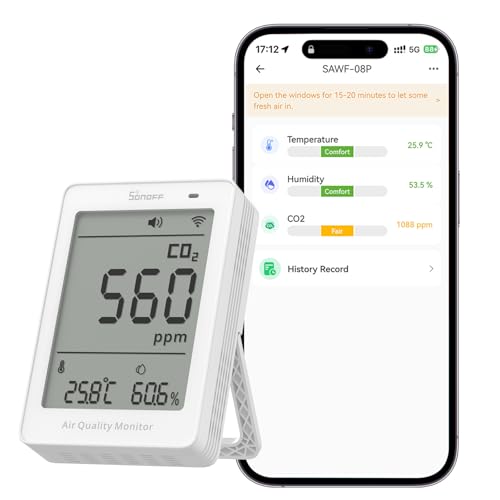
SONOFF AirGuard SAWF-08P Review: NDIR Accuracy Written as a Formula
A mains powered Matter compatible monitor showing CO2, temperature and humidity on one screen, with an NDIR sensor, 5 second updates and 12 months of history in the eWeLink app.
Read More→