As an Amazon Associate, Akermin earns from qualifying purchases. Product links on this page are affiliate links.
Set the monitor to its fastest sampling interval and let it run for five minutes. Test 1: breathe gently toward it from arm’s length for ten seconds, start a stopwatch, and note when the reading peaks and when it returns to within 10 percent of the starting value; a healthy NDIR monitor peaks within one or two samples and recovers in two to five minutes. Test 2: carry it from a stuffy room into fresh air and time how long it takes to cover 63 and 90 percent of the drop; expect one to three minutes plus the sampling interval. A monitor that fails both is estimating CO₂, still warming up, or faulty.
What you are measuring
Sensor response time is how quickly the sensing chamber exchanges air and the electronics register it, quoted as T63 (time to 63 percent of a step change) or T90 (to 90 percent). The sampling interval is separate: the sensor is only read every N seconds or minutes. The display shows the combination. See how fast a CO₂ monitor should respond.
Preparation
- Set the sampling interval to the shortest available (1 minute on the Aranet4; seconds on plug-in units).
- Power the monitor for at least five minutes in the test room.
- Note the stable reading.
- Have the app’s live chart or history open, or a notepad and a stopwatch.
Test 1: Breath spike and recovery
- From about arm’s length, breathe gently toward the monitor for ten seconds. Do not blow hard; you want a plume, not a jet.
- Start the stopwatch as you stop.
- Record the peak reading and its time.
- Record the time the reading falls back to within 10 percent of the start.
Typical result: peak of several hundred ppm above baseline within one to two samples; recovery within two to five minutes in a normal room. A very slow recovery means poor air movement around the monitor rather than a sensor fault; repeat with a window open.
Test 2: Fresh-air step
- Start in a room reading at least 1,000 ppm (a closed bedroom in the morning is ideal).
- Carry the monitor outdoors or to an open window, start the stopwatch, and read every sample.
- Calculate the total drop (start minus final outdoor reading, about 420 ppm).
- T63 is the time to cover 63 percent of that drop; T90 the time to cover 90 percent.
Example: start 1,400 ppm, final 420 ppm, drop 980. T63 is when the reading passes 1,400 − 617 = 783 ppm; T90 when it passes 1,400 − 882 = 518 ppm. Expect T63 of 1 to 3 minutes and T90 of 2 to 6 minutes, each plus up to one sampling interval.
Interpreting
| Result | Meaning |
|---|---|
| Peaks fast, recovers in minutes, T90 under 5 min | Healthy NDIR or photoacoustic sensor |
| Responds only at long intervals | Sampling interval; shorten it for alerts |
| No breath response but responds to sanitizer | eCO₂ estimator; see checking for a true NDIR sensor |
| Slow, drifting response | Warm-up incomplete, or the sensor inlet is obstructed |
| Outdoor reading well off 400 to 450 ppm | Calibration needed; see how to calibrate |
Why it matters
Alerts in classrooms and meeting rooms depend on response; a monitor with a 10-minute interval alerts ten minutes late. Logging for ventilation analysis tolerates slow response because the room changes slowly. Choose the interval for the job; see how often sensors should record data. Monitors and their interval options are in best CO₂ monitors for home and office.
Recommended Tools
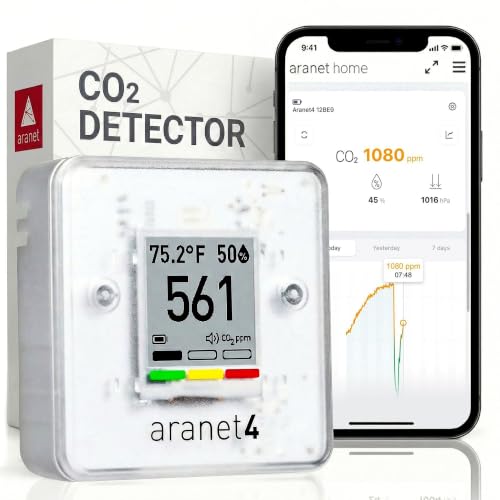

Products shown because their documented specifications fit this guide. Price and availability are on Amazon and can change.
Frequently Asked Questions
What response time should a CO₂ monitor have?
Datasheets for consumer NDIR sensors state T63 or T90 of one to three minutes. Fan-assisted sensors are faster; monitors with long sampling intervals add up to the interval on top.
Why does my monitor take ten minutes to change?
Probably the sampling interval. Battery monitors often sample every 5 or 10 minutes to save power; set a 1 or 2 minute interval for the test.
What if the monitor never responds to a breath?
Either it is still warming up, its interval is long and you did not wait for the next sample, or it is estimating CO₂ from a VOC sensor. Repeat with a 1-minute interval after five minutes of operation.
Affiliate disclosure: Akermin earns a commission from qualifying Amazon purchases made through links on this page. Our editorial picks are based on documented specifications and owner feedback, not commissions.
Related Guides

Temtop Handheld Particle Counter Review: Three Channels and No Published Flow Rate
A pump suction handheld particle counter reading 0.3, 0.5 and 1.0 micron channels alongside PM2.5, PM10 and TSP, with temperature and humidity sensors, 32 GB of internal storage and a 3500 mAh battery.
Read More→
VETOUCH Plug In CO2 Monitor Review: An Alarm the Bullets Never Define
A mains powered three in one monitor showing carbon dioxide, temperature and humidity on a 1.83 inch colour screen, with three brightness settings and a display that flips 180 degrees.
Read More→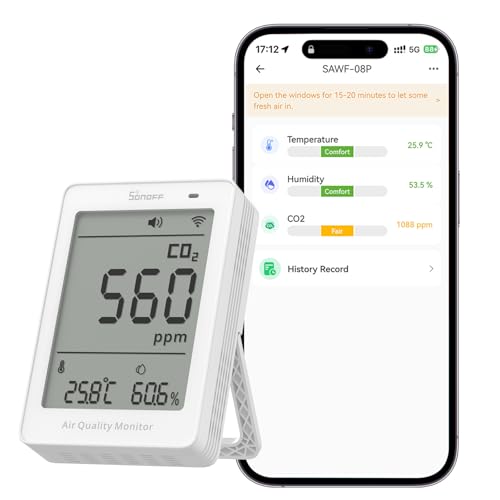
SONOFF AirGuard SAWF-08P Review: NDIR Accuracy Written as a Formula
A mains powered Matter compatible monitor showing CO2, temperature and humidity on one screen, with an NDIR sensor, 5 second updates and 12 months of history in the eWeLink app.
Read More→