As an Amazon Associate, Akermin earns from qualifying purchases. Product links on this page are affiliate links.
Sensor drift is the slow change in a sensor’s output for the same real-world input, over weeks to years. A CO₂ sensor that read 420 ppm in outdoor air when new may read 460 ppm in identical air a year later. Drift is caused by aging components, contamination and chemical change inside the sensor. It is separate from noise (reading to reading scatter) and from the accuracy stated on the box, and it is the reason every sensor needs periodic calibration or an automatic correction routine.
Drift, offset, noise and accuracy
| Term | Meaning | Example |
|---|---|---|
| Accuracy | How close a reading is to the true value | ±(50 ppm + 3%) on the datasheet |
| Offset | A constant error across all readings | Always 40 ppm high |
| Noise | Random reading-to-reading scatter | Flickers between 812 and 828 ppm |
| Drift | Change in offset or gain over time | Offset grows from 0 to 40 ppm over a year |
Datasheets usually specify drift separately, as a percentage of reading per year or a fixed ppm per year. It is the number that tells you how often calibration is needed.
What causes it
- NDIR CO₂: the infrared source dims with age, the detector’s sensitivity changes, and dust or condensation on the optics absorb light. Dual-channel designs with a reference wavelength cancel most of this.
- Electrochemical gas sensors (CO, refrigerants, toxic gases): the electrolyte is consumed and the electrodes age. These sensors have a finite life of a few years and drift steadily toward it.
- Metal-oxide VOC sensors: the heated sensing layer changes chemistry with exposure; manufacturers rely on continuous baseline adaptation, which is why the readings are relative.
- Capacitive humidity sensors: the polymer absorbs contaminants; typically around 1 percent RH per year.
- Laser particle sensors: the optics and fan collect dust; the sensor gradually undercounts.
Why it matters
A CO₂ monitor drifting 40 ppm a year is still fine for ventilation decisions after two years. An uncorrected monitor in a room where automatic correction cannot work can drift hundreds of ppm in the wrong direction, reporting a stuffy room as fresh. See why automatic CO₂ calibration can be wrong. For gas detectors, drift is a safety matter, which is why they require bump tests and scheduled calibration rather than trust.
How products manage drift
- Automatic baseline correction for CO₂: assumes a weekly fresh-air minimum and re-zeros to it.
- Manual calibration in a known reference: outdoor air for CO₂, saturated salt solutions for humidity, calibration gas for gas detectors.
- Reference channels inside the sensor that measure the drift directly.
- Replacement intervals for sensors that cannot be recalibrated, such as electrochemical cells.
Checking your own sensors
For CO₂, an outdoor check every few months catches drift before it matters; see why outdoor CO₂ is useful for checking a monitor. For humidity, a salt test. For particle monitors, comparison with a second unit or the local outdoor reference. For anything safety-related, follow the manufacturer’s bump-test and calibration schedule without exception. See CO₂ monitor accuracy explained for how drift fits alongside the stated tolerance.
Recommended Tools
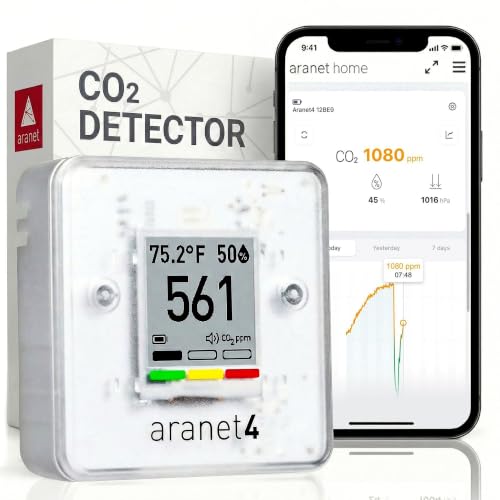
Products shown because their documented specifications fit this guide. Price and availability are on Amazon and can change.
Frequently Asked Questions
How much do CO₂ sensors drift?
Typical NDIR datasheets quote long-term drift of about 1 to 2 percent of reading per year, or a few tens of ppm, if uncorrected. Automatic baseline correction is designed to cancel most of it.
Is drift the same as inaccuracy?
No. Accuracy is how close a reading is to the truth right now. Drift is how that error changes over time. A sensor can be accurate when new and inaccurate a year later purely through drift.
Which sensors drift most?
Electrochemical gas sensors and metal-oxide VOC sensors drift more than NDIR CO₂ sensors. Humidity sensors drift a percent or two per year. Particle sensors drift as the optics accumulate dust.
Affiliate disclosure: Akermin earns a commission from qualifying Amazon purchases made through links on this page. Our editorial picks are based on documented specifications and owner feedback, not commissions.