As an Amazon Associate, Akermin earns from qualifying purchases. Product links on this page are affiliate links.
Choose an office CO₂ monitor by working through six decisions in order: confirm it uses an NDIR (or photoacoustic NDIR) sensor with a published accuracy; pick plug-in power for permanent rooms so it logs continuously; require Wi-Fi with a dashboard and CSV export so facilities can act on the data; check the display is readable across the room; set alerts that go to the right person; and plan one unit per meeting room and per open-plan zone. Then place each at breathing height on an interior wall away from vents and people.
Step 1: Insist on a real CO₂ sensor
Only NDIR and photoacoustic NDIR sensors measure CO₂. Devices reporting “eCO₂” estimate it from a VOC sensor and react to hand sanitizer and cleaning products rather than people. Look for a stated accuracy such as ±(50 ppm + 3%). See how to check whether a monitor uses a true NDIR sensor.
Step 2: Decide power
| Room | Power | Why |
|---|---|---|
| Meeting rooms, permanent | Plug-in (USB) | Continuous sampling and Wi-Fi without battery worries |
| Open-plan zones | Plug-in | Same |
| Survey of many rooms over weeks | Battery, long life | Move between rooms; no cable |
| Rooms with no socket at the right spot | Battery with long interval | Placement matters more than sampling rate |
Step 3: Require logging and export
An office monitor without a record is a gadget. Specify Wi-Fi with a web dashboard showing every unit, alert emails, and CSV export of at least a year. Check the export actually works before buying a fleet; some apps show charts but will not release the data. The GoveeLife H5140 (two years, CSV) and the Airthings dashboard are examples that do. See how to export and read CO₂ monitor data.
Step 4: Check the display
People in the room should be able to see the number and a color state from their seats. A large numeric display with a traffic-light indicator beats a cycling e-ink panel in a shared room; the cycling display is fine where the dashboard is the main interface. Adjustable brightness with a night schedule prevents complaints about glow.
Step 5: Design the alerts
- Alert at 1,000 ppm to the facilities inbox, not to everyone.
- Second alert at 1,500 ppm that also shows in the room (buzzer or red light), so the people there open a door.
- Avoid a buzzer that fires constantly; it will be switched off within a week.
Step 6: Plan the count and placement
- One per enclosed room where people spend more than an hour; meeting rooms first.
- One per open-plan zone on the same air handler.
- Mount at 1 to 1.5 m on an interior wall or shelf, at least a meter from the nearest desk, away from doors, windows and supply vents. See how to place a CO₂ monitor.
- Label each unit with its room in the app before installing.
Specification checklist
- NDIR or photoacoustic NDIR sensor; accuracy stated
- Range to at least 5,000 ppm
- Automatic baseline correction that can be disabled, or a manual calibration
- USB power; Wi-Fi; dashboard; email alerts; CSV export
- Readable display with color indicator and dimming schedule
- Temperature and humidity included (useful for comfort complaints)
- Optional: PM2.5 and VOC where sources exist
Using the data
After a fortnight, the charts show which rooms exceed 1,000 ppm and when. That is the evidence for adjusting the HVAC fresh-air schedule, changing room capacities or adding ventilation. See how to use CO₂ data to evaluate ventilation. Products that meet this specification are compared in best air quality monitors for offices and best CO₂ monitors.
Recommended Tools


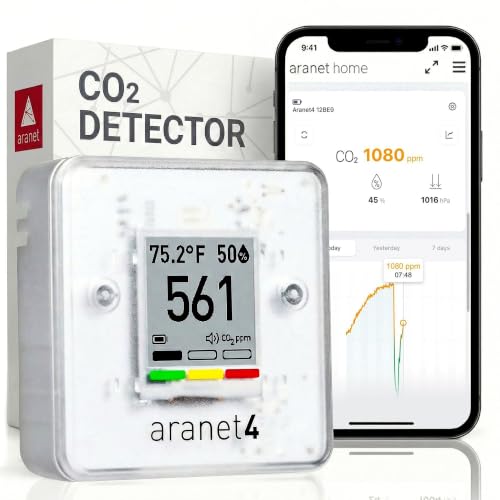
Products shown because their documented specifications fit this guide. Price and availability are on Amazon and can change.
Frequently Asked Questions
How many CO₂ monitors does an office need?
One per enclosed meeting room and one per open-plan zone served by the same air handler. Start with the rooms people complain about.
Should office CO₂ monitors be plug-in or battery?
Plug-in for permanent rooms, so they log continuously and keep Wi-Fi on. Battery units for surveys and rooms without a convenient socket.
Does an office monitor need to measure PM2.5 and VOCs?
Not for the ventilation question, which CO₂ answers alone. Add them where there are printers, new fit-outs, cleaning concerns or outdoor pollution.
Affiliate disclosure: Akermin earns a commission from qualifying Amazon purchases made through links on this page. Our editorial picks are based on documented specifications and owner feedback, not commissions.
Related Guides

Temtop Handheld Particle Counter Review: Three Channels and No Published Flow Rate
A pump suction handheld particle counter reading 0.3, 0.5 and 1.0 micron channels alongside PM2.5, PM10 and TSP, with temperature and humidity sensors, 32 GB of internal storage and a 3500 mAh battery.
Read More→
VETOUCH Plug In CO2 Monitor Review: An Alarm the Bullets Never Define
A mains powered three in one monitor showing carbon dioxide, temperature and humidity on a 1.83 inch colour screen, with three brightness settings and a display that flips 180 degrees.
Read More→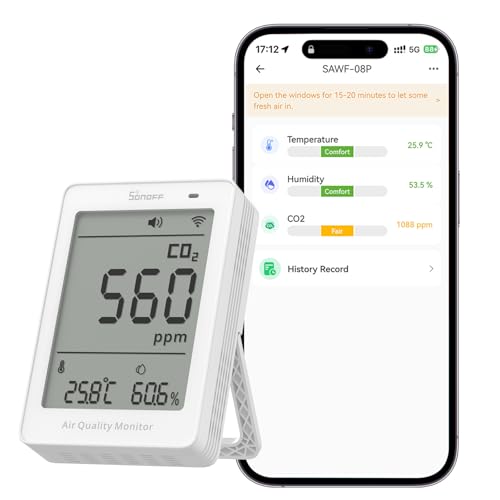
SONOFF AirGuard SAWF-08P Review: NDIR Accuracy Written as a Formula
A mains powered Matter compatible monitor showing CO2, temperature and humidity on one screen, with an NDIR sensor, 5 second updates and 12 months of history in the eWeLink app.
Read More→