As an Amazon Associate, Akermin earns from qualifying purchases. Product links on this page are affiliate links.
Log CO₂ at 1 to 5 minute intervals for a week in the room of interest. Read two things from the chart. The plateau the room reaches when fully occupied estimates fresh air per person: about 1,000 ppm corresponds to the rate most standards require; higher means less fresh air. The decay after the room empties gives the air-change rate: ACH = ln(excess CO₂ at start ÷ excess at end) ÷ hours. Together they tell you whether the ventilation is adequate for the occupancy, and the weekly pattern shows whether the HVAC schedule matches when people are actually there.
Step 1: Set up the logger
- NDIR monitor with logging and export; plug-in for continuous sampling. See how to choose a CO₂ data logger.
- Interval 1 to 5 minutes.
- Placement per the rules: breathing height, interior wall, away from people and vents. See how to place a CO₂ monitor.
- Note occupancy: how many people, when. A sign-in sheet or calendar is enough.
- Calibrate outdoors first so the baseline is right.
Step 2: Read the plateau
When occupancy is steady for an hour or more, CO₂ settles where production equals removal. The excess above outdoor (plateau minus about 420 ppm) is inversely proportional to fresh air per person:
| Plateau | Excess over outdoor | Approximate fresh air per seated person | Verdict |
|---|---|---|---|
| 700 ppm | 280 ppm | About 18 L/s | Well above standard |
| 900 ppm | 480 ppm | About 10 L/s | At standard |
| 1,200 ppm | 780 ppm | About 6.5 L/s | Below standard |
| 1,800 ppm | 1,380 ppm | About 3.6 L/s | Well below |
| 2,500 ppm | 2,080 ppm | About 2.4 L/s | Severely under-ventilated |
The figures assume about 0.005 L/s of CO₂ per seated adult; active people produce more. See why CO₂ readings change with occupancy.
Step 3: Read the decay
When the room empties, CO₂ falls exponentially toward outdoor level. The rate is the air-change rate:
ACH = ln((C_start − 420) ÷ (C_end − 420)) ÷ time in hours
Example: 2,000 ppm at 17:00, 1,100 ppm at 18:30. Excess falls from 1,580 to 680; ln(2.32) = 0.84; over 1.5 h that is 0.56 ACH. Residential guidance often expects around 0.5 ACH; offices with mechanical ventilation 2 to 6 ACH. A decay that barely moves overnight means the ventilation system switched off, which is common and often unintended.
Step 4: Read the week
- Morning rise before people arrive: the HVAC starts too late.
- Plateau above 1,000 ppm every afternoon: under-ventilated for the occupancy; adjust fresh-air damper or reduce capacity.
- Flat high overnight: no ventilation after hours; fine if the room is empty, a problem if it is a bedroom or a 24-hour space.
- Weekend baseline near outdoor: the building does exchange air when empty; the weekday problem is capacity, not leakage.
- Sharp drops at fixed times: doors opening at breaks; shows how much manual ventilation helps.
Step 5: Compare and act
Compare the plateau with the 1,000 ppm benchmark and the ACH with what the room type expects. Then the action is one of three: more fresh air (damper, schedule, windows, extract), fewer people, or mechanical ventilation where none exists. Re-log after the change to confirm. See how to monitor CO₂ in meeting rooms for the room that usually needs it first, and best air quality monitors for offices for loggers that export the data.
Recommended Tools


Products shown because their documented specifications fit this guide. Price and availability are on Amazon and can change.
Frequently Asked Questions
How do I calculate air changes per hour from CO₂?
After the room empties, note the CO₂ above outdoor level at two times. ACH = ln(C1 ÷ C2) ÷ hours between them, where C is the excess over outdoor. A fall from 1,600 to 900 excess over 1 hour gives ln(1.78) ≈ 0.58 ACH.
What steady-state CO₂ indicates adequate ventilation?
Roughly 1,000 ppm corresponds to the fresh-air rate many standards specify (about 8 to 10 L/s per person). Lower means better than the standard; higher means worse.
How long should I log for?
At least one full working week, at 1 to 5 minute intervals, to capture occupancy patterns, HVAC schedules and weekend behavior.
Affiliate disclosure: Akermin earns a commission from qualifying Amazon purchases made through links on this page. Our editorial picks are based on documented specifications and owner feedback, not commissions.
Related Guides

Temtop Handheld Particle Counter Review: Three Channels and No Published Flow Rate
A pump suction handheld particle counter reading 0.3, 0.5 and 1.0 micron channels alongside PM2.5, PM10 and TSP, with temperature and humidity sensors, 32 GB of internal storage and a 3500 mAh battery.
Read More→
VETOUCH Plug In CO2 Monitor Review: An Alarm the Bullets Never Define
A mains powered three in one monitor showing carbon dioxide, temperature and humidity on a 1.83 inch colour screen, with three brightness settings and a display that flips 180 degrees.
Read More→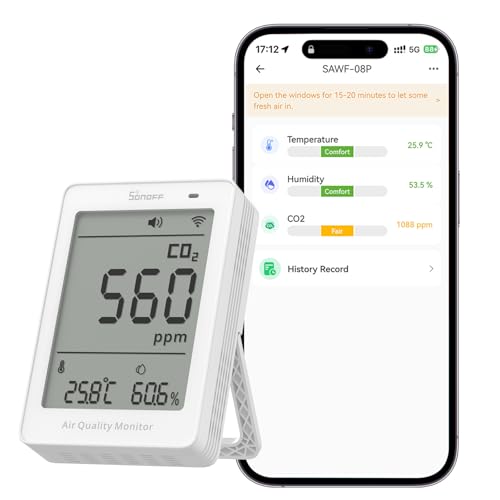
SONOFF AirGuard SAWF-08P Review: NDIR Accuracy Written as a Formula
A mains powered Matter compatible monitor showing CO2, temperature and humidity on one screen, with an NDIR sensor, 5 second updates and 12 months of history in the eWeLink app.
Read More→