As an Amazon Associate, Akermin earns from qualifying purchases. Product links on this page are affiliate links.
A long-term CO₂ logger needs an NDIR sensor whose drift you can check and correct, continuous power (mains or a battery life that outlasts the study), a sampling interval of 1 to 10 minutes, storage that will not overwrite or vanish (on-device memory you download regularly, or a cloud service with export), and a CSV export you have tested before relying on it. Monitors with disable-able automatic baseline correction and a manual calibration routine suit rooms that never empty. Professional loggers add calibration certificates and stated uncertainty.
Step 1: The sensor
NDIR or photoacoustic NDIR, with stated accuracy; see how to compare accuracy specifications. For long deployments the drift figure (typically 1 to 2 percent per year) and the calibration method matter more than the headline accuracy. Prefer monitors where automatic baseline correction can be turned off and a manual fresh-air calibration is available; see why automatic calibration can be wrong.
Step 2: Power and interval
| Study | Power | Interval |
|---|---|---|
| Bedroom or office, months | Mains (USB); or a battery unit at 5 to 10 min | 2 to 5 min |
| Ventilation evaluation, one to four weeks | Mains | 1 to 2 min |
| Classroom survey, term | Battery, multi-year life | 5 to 10 min |
| Research, compliance | Mains with battery backup | 1 min or per protocol |
See how often sensors should record data.
Step 3: Storage
- On-device memory: the Aranet4 holds up to 90 days at 10 minutes (fewer at faster intervals) and syncs to the phone. Download before it overwrites.
- Cloud: Airthings, Govee and others keep months to years. Check retention and export; a dashboard is not a backup.
- Local logging: monitors with open APIs or Home Assistant integration let you keep the record on your own hardware, immune to service changes.
Step 4: Export you have tested
Before committing a monitor to a year of logging, export a day’s data and check: CSV format, correct time zone, the interval you set, no gaps. Some apps show pretty charts and export nothing useful. See how to export and read CO₂ monitor data.
Step 5: Time stamps and reliability
- The logger should keep time through power cuts or re-sync from the phone or network.
- Wi-Fi loggers should buffer readings during outages and upload later; cheaper ones lose them.
- Battery units should warn well before dying.
Step 6: Calibration routine
- Calibrate outdoors before deployment; record the reading.
- Check outdoors every 3 to 6 months; recalibrate if more than about 50 ppm off.
- Note every calibration in the log so later analysis can account for it.
Consumer versus professional
Consumer NDIR monitors with export (GoveeLife H5140, Aranet4, Airthings View Plus) are adequate for understanding and improving rooms. Professional loggers (Onset HOBO MX CO₂, Extech, Testo) add calibration certificates, stated uncertainty, longer memory and ruggedness for research, compliance and evidence. See what an environmental data logger is. Consumer options are compared in best CO₂ monitors for home and office.
Recommended Tools


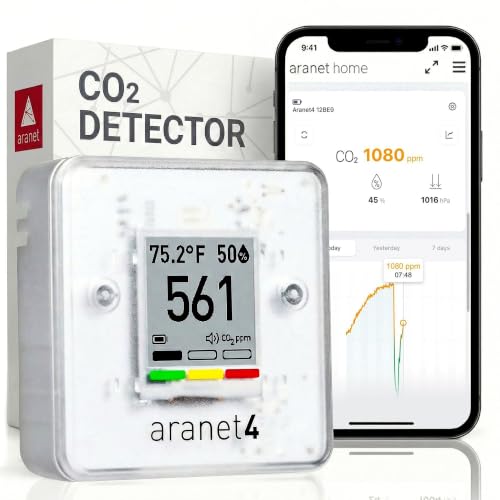
Products shown because their documented specifications fit this guide. Price and availability are on Amazon and can change.
Frequently Asked Questions
How long can a CO₂ logger record?
On-device memory typically holds weeks to a few months at 1 to 10 minute intervals; cloud-connected loggers keep years. Check the retention and whether export is possible before the device overwrites.
Do I need a professional logger?
For research, compliance or evidence, a logger with a calibration certificate and stated uncertainty. For understanding a home or office, a consumer NDIR monitor with export is enough.
How often should a long-term logger be calibrated?
Check it outdoors every 3 to 6 months, or whenever readings look implausible. Rooms that never reach outdoor levels need manual calibration, since automatic correction will drift.
Affiliate disclosure: Akermin earns a commission from qualifying Amazon purchases made through links on this page. Our editorial picks are based on documented specifications and owner feedback, not commissions.
Related Guides

Temtop Handheld Particle Counter Review: Three Channels and No Published Flow Rate
A pump suction handheld particle counter reading 0.3, 0.5 and 1.0 micron channels alongside PM2.5, PM10 and TSP, with temperature and humidity sensors, 32 GB of internal storage and a 3500 mAh battery.
Read More→
VETOUCH Plug In CO2 Monitor Review: An Alarm the Bullets Never Define
A mains powered three in one monitor showing carbon dioxide, temperature and humidity on a 1.83 inch colour screen, with three brightness settings and a display that flips 180 degrees.
Read More→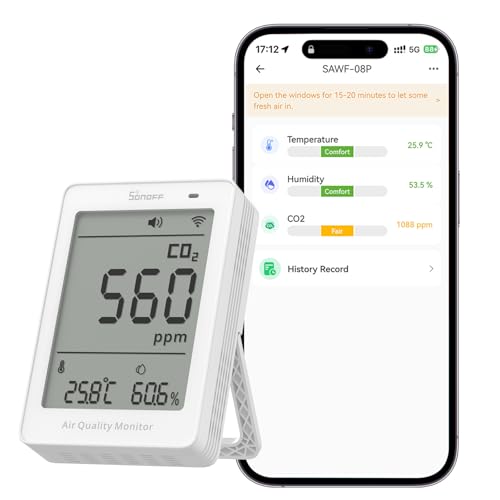
SONOFF AirGuard SAWF-08P Review: NDIR Accuracy Written as a Formula
A mains powered Matter compatible monitor showing CO2, temperature and humidity on one screen, with an NDIR sensor, 5 second updates and 12 months of history in the eWeLink app.
Read More→