Best Shunt Battery Monitors: 4 Picks for RV, Marine and Off-Grid Systems
Battery voltage is a poor guide to state of charge, and on lithium it is close to useless. A shunt monitor counts the energy going in and out instead, which is the only way to know how much is actually left.
As an Amazon Associate, Akermin earns from qualifying purchases. Product links on this page are affiliate links.
Our Top Picks
Monitors were compared on stated measurement accuracy, voltage and current range, the values calculated beyond voltage and current, alarm capability, how results are displayed, supported battery chemistries and installation requirements. We did not run laboratory tests and publish no measurements of our own.
Best Overall
Victron SmartShunt 500 A
No display at all, because the phone is the display, and it shares data with the rest of the system.
6.5 to 70 V, 500 A, all in one smart battery monitor
Data presented in the VictronConnect app with instant readout and alarm notifications
Calculates state of charge, time remaining, voltage, current, amp hours, charge cycles, deepest discharge, highest and lowest voltage
Wirelessly shares live battery data with other devices in the system
A shunt must be installed in the negative conductor so that every amp entering or leaving the bank passes through it. A monitor connected any other way will not count correctly.
How to Choose a Shunt Battery Monitor
Installation position and accuracy matter more than screen size, because errors accumulate.
Voltage Alone Cannot Tell You the Charge
Lithium iron phosphate holds a nearly flat voltage across most of its usable range, so a voltmeter shows the same figure at 80 percent and 20 percent. Only counting amp hours resolves it.
Everything Must Pass Through the Shunt
The shunt goes in the battery negative, with every load and every charge source on the far side. One cable connected directly to the battery makes the count wrong from that moment on.
Accuracy Accumulates
A small percentage error on every measurement builds into a large drift over a week of cycling. This is why a published accuracy figure matters more here than display resolution.
Direction Is the Whole Question
Charging at 12 amps and discharging at 12 amps look identical on a monitor that reports magnitude only. Confirm the display shows direction before buying.
Tell It Which Chemistry It Is Watching
Lead acid and lithium discharge very differently, and monitors apply different assumptions. Setting the battery type and capacity correctly is not optional.
Check the Top of the Voltage Range
A 48 volt bank in absorption sits well above 48 volts. Confirm the monitor covers the charging voltage, not just the nominal one.
Because voltage is a poor proxy for state of charge and on lithium iron phosphate it is close to useless. LiFePO4 holds a nearly flat voltage across most of its usable range, so the same reading appears at 80 percent and at 20 percent. A shunt counts amp hours in and out, which is the measurement that actually corresponds to remaining capacity.
Where does the shunt go?
In the battery negative conductor, between the battery negative terminal and everything else. Every load and every charging source must connect on the system side of the shunt so that all current passes through it. A single cable connected directly to the battery negative bypasses the shunt and corrupts the count.
Do I need to set the battery capacity?
Yes, and the chemistry too. The monitor calculates state of charge as a percentage of the capacity you tell it, so an incorrect figure produces a confidently wrong percentage. Discharge behaviour also differs between lead acid and lithium, and monitors apply different assumptions accordingly.
Why does my state of charge drift over time?
Because counting amp hours accumulates small measurement errors, and because charging is not perfectly efficient. Most monitors re-synchronise when they detect a full charge, which is why periodically charging a lead acid bank fully matters for the monitor as well as for the battery.
Panel display or phone app?
A panel display works instantly and needs no phone, but requires a cut-out and a cable run to somewhere visible. An app avoids both and puts the data where you already are, at the cost of depending on a phone and Bluetooth. Several installations end up with both.
What voltage range do I need for a 48 volt bank?
More than 48 volts. A 48 volt lithium bank in absorption can sit above 58 volts and some configurations go higher, so check the monitor covers the charging voltage rather than the nominal figure. The LNEX unit here states 8 to 100 V and the MORNING GROUP states up to 300 V.
Reviews
Victron SmartShunt 500 A Best Overall
Leaving the display out is a deliberate design decision and the right one for most installations. A panel meter has to be mounted somewhere visible, which means a hole in a cabinet, a cable run and a compromise about where you will actually be standing when you want to know. A shunt that reports to a phone goes wherever the wiring is convenient, usually right at the battery negative, and the display is already in your pocket.
The list of calculated values is the other reason this is the reference product. Deepest discharge and charge cycle count are the figures that tell you how the bank has actually been treated over months, which matters enormously for battery life and for any warranty conversation. Sharing data with other devices in the system is the feature that pays off in a well built installation, because a charge controller or an inverter that knows the true state of charge behaves better than one guessing from voltage.
Strengths
Comprehensive calculated values including cycles and deepest discharge
No panel cut-out or display cabling required
Shares state of charge with other system devices
Wide 6.5 to 70 V range covers 12, 24 and 48 V banks
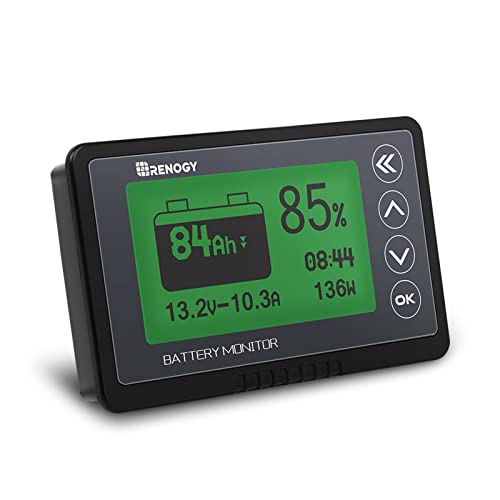
Renogy 500 A Battery Monitor Best Published Accuracy
Publishing an accuracy figure is rare in this category and worth rewarding. One percent on a shunt measurement is a meaningful specification, and it is the number that determines whether the accumulated amp hour count drifts over a week of cycling. A monitor that is slightly wrong on every measurement accumulates that error, which is why shunt accuracy matters more than display resolution.
The alarm implementation is sensibly aggressive: the backlight and the voltage value flash together rather than a small icon appearing. In a van or a cabin, where nobody is watching the panel, a change that catches peripheral vision is the one that gets noticed. Naming four battery chemistries explicitly is also helpful, because the discharge behaviour of lithium iron phosphate and lead acid differ enough that a monitor needs to be told which it is watching.
Strengths
Published 1 percent accuracy
Prominent flashing alarm for high and low capacity
Four chemistries named explicitly
Works across 12, 24 and 48 volt systems
Limitations
Requires a panel cut-out and display cabling
No app or remote access stated
No cycle count or deepest discharge history stated
Sixteen feet of shielded cable is a practical specification that most listings omit, and it decides whether the installation is possible. The shunt has to be at the battery negative, and the display has to be somewhere people look, which in a van or a boat can be a long way apart. Shielding matters too, because a low level signal running alongside inverter cables picks up noise that shows as a jumping reading.
Automatically saving the latest data at shutdown addresses a real annoyance with cheaper monitors. Disconnect the bank for maintenance, or trip a main breaker, and a monitor without retention restarts believing the battery is full, which then requires a full charge and discharge cycle to re-learn. The 8 to 100 V range also covers higher voltage banks that the Victron does not, which matters for 48 V systems that run above 70 V when charging.
MORNING GROUP 300 V 100 A Monitor Best for High Voltage
A 300 volt ceiling is far above the other monitors here and puts this in a different bracket of system. For a larger off-grid bank, a high voltage series string or an installation where the battery voltage rises well above 70 volts during absorption, it is the only option on this page that can read it at all.
Direction indication is the feature to look for on any battery monitor and it is easy to overlook. A monitor reporting magnitude alone cannot tell you whether the bank is charging at 12 amps or discharging at 12 amps, and on a hybrid system with solar and a charger that is the entire question. The accumulated kilowatt hour total is the other genuinely useful figure, because it turns a system's performance into a running total rather than an instantaneous reading. No accuracy figure is published, so treat the readings as indicative.
Short answer: the Victron SmartShunt is the best overall because it calculates everything worth knowing, including cycle count and deepest discharge, and needs no panel cut-out; the Renogy 500 A is the pick if you want a panel display with a published 1 percent accuracy; and the LNEX is the value choice with a colour screen, 16 feet of shielded cable and a 100 volt range.
Why voltage is not state of charge
Reading a battery’s voltage and inferring how full it is works acceptably for lead acid and barely at all for lithium. A lead acid bank’s resting voltage does fall steadily as it discharges, which is why the approach became habit. Lithium iron phosphate behaves completely differently: its voltage sits on a long flat plateau across most of the usable range, so a reading taken at 80 percent and one taken at 20 percent can differ by a fraction of a volt. Add the voltage sag under load and the rise during charging and a voltmeter becomes close to meaningless as a fuel gauge.
A shunt monitor takes the other approach. It measures the current flowing in and out through a precision resistor and integrates it over time, so it is literally counting the energy that has entered and left. That count is what corresponds to the charge remaining, regardless of chemistry.
Everything has to pass through the shunt
This is the installation detail that determines whether the whole system works, and it is the one most often got wrong. The shunt goes in the battery negative conductor, and every single load and every single charging source must connect on the far side of it. If one cable is connected directly to the battery negative terminal, the current through that cable is invisible to the monitor, and from that moment the count is wrong and drifts further every day.
In practice that means the battery negative goes to one side of the shunt and nothing else does, while the negative bus bar, the inverter, the charge controller and every load connect to the other side. It is worth checking the wiring twice, because a monitor that appears to work while quietly missing a circuit is worse than no monitor at all.
Accuracy matters because errors accumulate
On most instruments a one percent error is unremarkable. On a shunt monitor it compounds, because the device is summing measurements continuously. A small consistent bias on every sample builds into a visible drift in the state of charge figure across a week of cycling, which is why monitors re-synchronise when they detect a full charge and why a published accuracy figure deserves attention. The Renogy listing quoting 1 percent is the only stated accuracy on this page.
Direction is the whole question
A monitor that reports only magnitude cannot tell you whether the bank is being charged at twelve amps or drained at twelve amps, and on a system with solar and a charger operating alongside loads, that is the only thing you actually want to know. Every serious battery monitor shows direction, and the MORNING GROUP listing calls it out explicitly. If a product description is vague about it, assume nothing.
Set it up properly or the percentage is fiction
A shunt monitor calculates state of charge as a proportion of the capacity you tell it the bank has, using assumptions about the chemistry you select. Enter the wrong capacity and the percentage is wrong by that ratio forever. Select the wrong chemistry and the charge efficiency assumptions are wrong too. Five minutes with the manual at installation saves months of mistrusting the display. For the wider decision, see how to choose a battery monitor for an off-grid system.
How We Research
Monitors were compared on stated measurement accuracy, voltage and current range, the values calculated beyond live voltage and current, alarm capability, readout method, supported battery chemistries, cable length and installation requirements. We did not run laboratory tests and publish no measurements of our own.
Six instruments for checking deep cycle battery capacity, from true load testers to conductance testers and a hydrometer, with guidance on what each method can and cannot tell you.
A solar kit pairing the Fluke 1587 FC insulation multimeter with TLPV1 MC4 test leads, stating insulation testing up to 1000 V and Fluke Connect wireless data logging.
A solar test kit stating a CAT III 1500 V and CAT IV 1000 V rated multimeter, a wireless 60 A AC and DC current clamp, Staubli MC4 test leads and TL175-HV premium leads.