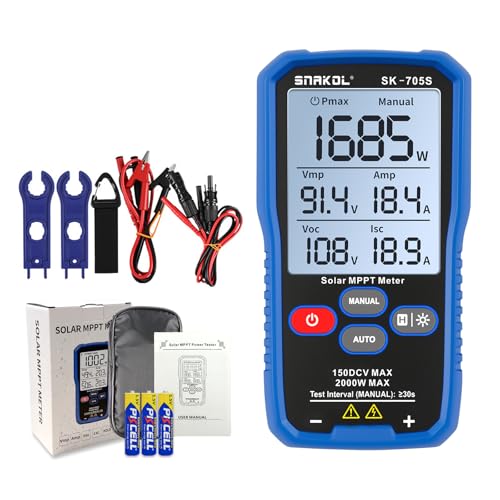
Best Solar Panel Testers: 7 Powerful Picks for Accurate PV Diagnostics
A solar panel tester puts a variable load across one module or string and sweeps it until it finds the maximum power point, reporting Pmax, Voc and Isc in one pass. This hub compares the handheld testers by stated power, voltage and current limits, and is explicit about which entries are MPPT charge controllers with a display rather than dedicated test instruments.
As an Amazon Associate, Akermin earns from qualifying purchases. Product links on this page are affiliate links.
Our Top Picks
Seven of the ten entries below are handheld MPPT panel testers: you connect one module or string and the instrument sweeps a load to find the maximum power point. The last three are MPPT charge controllers that display the same quantities on a permanently installed array, and the Type column says so on every row, because a controller is not a substitute for a tester and we are not going to pretend otherwise. All figures come from the manufacturer listings; we ran no tests of our own.
Best Overall
ALLmeter 2000W MPPT Solar Panel Tester
The one listing here that publishes its voltage and current windows rather than a headline wattage.
The last three rows are MPPT charge controllers rather than test instruments. They appear because they report the same quantities on an array that is already installed, and buyers searching for a solar panel tester frequently land on them by mistake. A controller cannot sweep a module you are holding in your hand, and a tester cannot charge a battery. Every other figure is quoted from the manufacturer listing; blanks read Not stated.
How to Choose a Solar Panel Tester
The specification that matters is rarely the one printed largest:
Voltage Ceiling First
Open-circuit voltage rises as temperature falls, so a string measured on a cold clear morning reads higher than its label. Choose a ceiling with headroom above the coldest expected Voc, never at it.
Current Window Second
Short-circuit current scales with irradiance and multiplies with parallel strings. A 20 A instrument is fine on a single module and wrong on three strings in parallel.
Which Readings You Need
Voc and Isc prove a module is alive. Pmax proves it is producing. Vmp and Imp, which only the Fienzio states, tell you where on the curve the loss is.
Tester or Controller
A handheld tester diagnoses a module or string on demand. A charge controller monitors an installed system continuously. If you need a fault found today, you need the tester.
What is the difference between a solar panel tester and a multimeter?
A multimeter reads open-circuit voltage with nothing drawing current, or short-circuit current with the terminals bridged, but it cannot do both at once and it cannot find the point between them where the module delivers most power. A panel tester applies a variable electronic load and sweeps it, which is how it reports Pmax. For the voltage and current readings alone, a suitably rated multimeter is enough.
Why does my panel never reach its rated wattage?
Because the rating is measured under standard test conditions, which means 1000 W per square metre of irradiance at a cell temperature of 25 degrees C. Real roofs rarely offer both at once: full sun usually comes with cells well above 25 degrees C, and output falls as cells heat. Measuring 80 percent of the label in warm bright conditions is normal, not a fault.
Can I test a module while it is connected to the inverter?
No. Isolate the module or string first. The tester needs to control the load itself, and an inverter or charge controller on the other end is already doing that, so the readings will be meaningless and the instrument may be damaged. Follow the isolation procedure for the system, and treat every PV conductor as live whenever there is light on the array.
Do these testers work in cloudy weather?
They will produce a reading, but the reading is not comparable to anything. Current scales almost linearly with irradiance, so a module under cloud looks like a faulty module under sun. Test in stable clear conditions, note the irradiance if you have a meter for it, and compare modules against each other on the same day rather than against the label.
Is a charge controller a substitute for a tester?
Only for monitoring. A controller such as the Victron SmartSolar reports what the installed array is producing over time, which is useful for spotting a gradual decline. It cannot sweep an individual module on the ground, cannot tell you which of twelve panels is dragging the string down, and cannot be carried to the next job.
Reviews
ALLmeter 2000W MPPT Solar Panel Tester Best Overall
Most solar panel tester listings shout a wattage and stay quiet about everything else. The ALLmeter is the one in this group that gives the two numbers that decide whether the instrument will work on your array: a stated open-circuit voltage window of 3 to 90 V and a stated short-circuit current window of 0 to 40 A. Those brackets, not the 2000 W headline, tell you whether a given string is inside the instrument.
In practice the 3 V lower limit matters as much as the 90 V upper one. Testers with a higher minimum cannot read a single small module, and a lower limit this low means the instrument is usable on a 12 V panel as well as on a series string. The 40 A current ceiling is generous for residential work, where module short-circuit current is typically well under 15 A and parallel strings are what push the figure up.
The listing states Pmax, Voc and Isc as the measured quantities. It does not state an accuracy figure, a sweep time, whether the instrument logs readings, or what happens above 90 V, so the voltage ceiling has to be respected rather than tested. For residential and small commercial module checks it is the best-documented instrument on the page.
Strengths
Voltage and current windows stated, not just a wattage
Reads from 3 V, so single small modules are in range
Pmax, Voc and Isc in one pass
40 A current ceiling covers parallel residential strings
Fienzio Solar MPPT Power Tester, 150 V DC Best for Higher Voltage
The Fienzio is the handheld to reach for when a string has more than a couple of modules in series. Its stated ceiling is 150 V DC against the 90 V of the ALLmeter and the 60 V of the VEYFIY, which is the difference between testing one module at a time and testing a short residential string as it is actually wired.
It is also the only listing here that names Vmp and Imp as separate readings alongside Pmax, Voc and Isc. That matters more than it sounds. Voc and Isc tell you the module is alive; Vmp and Imp tell you where on the curve it is delivering, which is what you compare against the module label when a string is underperforming and nothing is obviously broken.
Automatic and manual sweep modes are both stated, so the instrument can hunt the maximum power point on its own or be walked along the curve by hand. The listing describes the intended use as fast performance checks during installation and commissioning. No accuracy figure, sweep duration or logging capability is published, and 45 A is the stated current ceiling.
Strengths
150 V DC ceiling, the highest of the handhelds here
Reports Vmp and Imp as well as Pmax, Voc and Isc
Automatic and manual sweep modes
45 A stated current ceiling
Limitations
Accuracy not stated
Sweep time not stated
Still far below the 1000 V and 1500 V of commercial arrays
ELEJOY 400W Solar Panel Tester Best for Small Systems
Buying capacity you will never use is the commonest mistake on this page. If the array is a caravan roof, a shed, a boat or a small off-grid cabin, a 2000 W instrument measures the same 300 W module as a 400 W instrument and costs more to do it. ELEJOY scopes this one explicitly at 12 V and 24 V panels up to 400 W and describes it as being for DIY home solar maintenance.
The job it does is the ordinary one: connect a panel that you suspect is underperforming, read what it is actually producing, and compare that against the label and against its neighbours. For a system of four or six modules that is the whole diagnostic, and it catches the common faults, which are a shaded or soiled module, a failed bypass diode showing as a step in output, and a bad MC4 connection showing as low current.
The listing publishes no accuracy figure, no Voc or Isc window and no sweep detail, so the ceiling in the product name is effectively the whole specification. Anyone planning to grow the array should look at the ELEJOY 1800 W version or the ALLmeter instead, because this instrument does not scale.
Short answer: the ALLmeter 2000W MPPT tester is the best-documented handheld here because it states its 3 to 90 V and 0 to 40 A windows instead of only a wattage; the Fienzio 150 V DC tester is the one to buy for series strings, and the only listing that reports Vmp and Imp as well as Pmax; and the ELEJOY 400W is correctly scoped for 12 V and 24 V systems where a 2000 W instrument is wasted money.
What a panel tester does that a meter does not
A photovoltaic module does not have one output. It has a curve, running from open-circuit voltage at zero current to short-circuit current at zero volts, and somewhere along that curve is the knee where the product of volts and amps is highest. That knee is the maximum power point, and it is the only number that describes what the module is worth. A multimeter can stand at either end of the curve but cannot walk along it. A panel tester contains a variable electronic load, sweeps it from one end to the other in a fraction of a second and reports the peak it found. Everything else on the specification sheet is about how much module the instrument can survive while doing that.
Reading the specification that is not printed
Seven listings here lead with a wattage and four of them state nothing else. A wattage ceiling on its own is close to useless, because a module can exceed the instrument on voltage or on current long before it exceeds it on power. Two examples make the point. A string of four 60-cell modules in series sits comfortably under 2000 W but will pass 140 V open-circuit on a cold morning, which is outside the ALLmeter and inside the Fienzio. Three high-current modules in parallel may produce 45 A of short-circuit current at 30 V, which is under 2000 W and over the ALLmeter current window. Always check the voltage and current brackets against the array as wired, and where a listing does not state them, treat the instrument as suitable for single modules only. Our guide on how to measure open-circuit voltage covers the temperature correction that decides the real ceiling.
Why three charge controllers are in the table
The last three rows are not testers and the table says so. They are MPPT charge controllers: permanently wired between the array and the battery, they run their own maximum power point tracking continuously and report the result through a display or an app. They are in this comparison for two reasons. The first is that a great many people searching for a solar panel tester end up buying one of these by accident, and a hub page that quietly omitted them would not prevent that. The second is that for one specific job, watching an installed system for a slow decline in yield across a season, a controller with logging genuinely is the better instrument. What it cannot do is diagnose. It sees the array as one thing. When a string is down by a sixth, it tells you the string is down by a sixth and nothing more, and finding which module is responsible needs a handheld tester and a walk along the row.
Working safely on a live array
There is no off switch on a photovoltaic module. In daylight it is a live DC source at its open-circuit voltage, and DC does not self-extinguish at an arc the way AC does, which is why PV connector faults burn rather than trip. Isolate at the string and at the combiner before disconnecting anything, use the correct MC4 disconnect tool rather than pulling on the cable, and never break a connection under load. The instrument must be rated above the cold-weather open-circuit voltage of whatever you connect it to, and an instrument rated at 90 V has no business on a 300 V string. Residential strings commonly sit under 600 V, commercial systems reach 1000 V and utility-scale arrays 1500 V, none of which the handhelds on this page will touch; that work needs the instruments in our solar PV tester guide.
Guides in This Category
The specific guides below sit under this hub. Each is written for a narrower job:
How to choose a solar PV tester for installers who need commissioning-grade instruments rather than a handheld module checker.
Match the instrument to the array, not to the price. A single small system needs the ELEJOY 400 W. A residential roof wired as short strings needs the Fienzio for its voltage headroom and its Vmp and Imp readings. A mixed bag of module-level checks on installations that vary needs the ALLmeter, because it is the one that tells you where its limits are. And if what you actually want is a number on a screen showing what the array made yesterday, buy a controller with logging and do not call it a tester.
How We Research
Products were compared on manufacturer listing text: stated maximum power, stated voltage and current limits, the quantities each listing says it measures, sweep behaviour where described, and the intended system size. Entries that are charge controllers rather than test instruments are labelled as such in the Type column instead of being presented as testers. Owner feedback was reviewed for recurring reports of unstable readings and connector failures. We ran no field or laboratory tests, scanned no arrays and publish no measurements of our own. Amazon data supplies images, availability and links only.
A PV tester measures panel voltage, current and power at the maximum power point to check performance, but it cannot diagnose every fault or replace a full system monitor.