As an Amazon Associate, Akermin earns from qualifying purchases. Product links on this page are affiliate links.
For solar work, choose a multimeter with a DC voltage range and CAT rating above the string’s cold-morning open-circuit voltage: 600 V CAT III suffices for single panels, small arrays and 12/24/48 V battery systems; 1000 V CAT III (Fluke 87V class) for residential rooftop strings. Require millivolt resolution for voltage drop tests, a diode test for bypass diodes, a temperature input and fused 10 A DC current for small panels only. Then add a DC clamp meter, because string current should never be measured by breaking the circuit.
What the multimeter does on a solar system
| Task | Function | Notes |
|---|---|---|
| Panel or string Voc | DC volts | Isolated panel or string; must be within the meter’s rating |
| Operating voltage under load | DC volts at the inverter input or controller | Compare with Vmp corrected for temperature |
| Battery bank voltage and state of charge | DC volts, 10 mV resolution | See how to test a 12 V battery |
| Voltage drop across cables, fuses, connectors | DC millivolts under load | Finds corroded MC4s and undersized cable |
| Bypass diode check | Diode test (panel shaded, isolated) | Forward drop about 0.4 to 0.7 V; OL both ways means open |
| Small-panel current | 10 A DC in series | Portable panels under 10 A only; never strings |
| Inverter AC output | AC volts, True-RMS | |
| Continuity of grounding and bonding | Continuity, ohms | System isolated |
Specifications
- DC voltage range and CAT rating: 600 V CAT III for panels and battery systems; 1000 V CAT III for strings. See CAT ratings.
- Resolution: 6000 counts or more; 1 mV on the low range for drop tests. See resolution in a digital meter.
- Current: fused 10 A DC input with HRC fuses; used only on small panels.
- Diode test with a readable forward voltage.
- True-RMS for inverter output.
- Temperature input for panel back temperature.
- Leads: rated to the CAT category; MC4-to-banana adapters for safe connection to panel leads.
- Environment: IP rating and a holster for rooftops.
The clamp meter is not optional
Opening a DC connection under load draws an arc that does not extinguish, and a multimeter in series is exactly that. A Hall-effect DC clamp reads string, battery and controller current through the insulation. For strings, a solar-rated clamp (CAT III 1000 or 1500 V DC); for 12 to 48 V systems, any AC/DC clamp. See how to choose a clamp meter for solar PV and how to measure solar panel current.
Picks
| System | Multimeter | Add |
|---|---|---|
| Portable, RV, off-grid 12 to 48 V | CAT III 600 V True-RMS (Fluke 117, Klein MM420) | AC/DC clamp (Klein CL390, Fluke 325) |
| Residential rooftop strings | CAT III 1000 V (Fluke 87V) | Solar DC clamp (Fluke 393 FC); string tester |
| Commercial | CAT IV 600 V / CAT III 1000 V | 1500 V clamp; string tester with I-V curve |
The measurements are described in how to measure solar panel open-circuit voltage. Meter comparisons are in best multimeters for home and DIY; a complete toolkit in how to build a basic solar testing toolkit.
Recommended Tools


Fluke 117 Digital Multimeter, Non-Contact AC Voltage Detection, Measures Resistance/Continuity/Frequency/Capacitance/Min
View on Amazon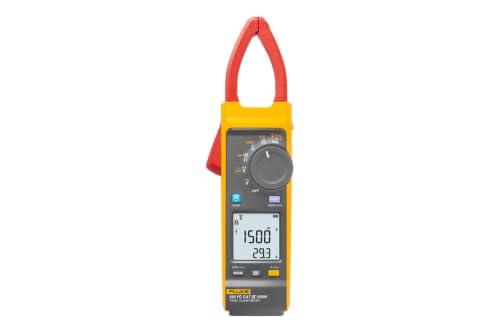
Products shown because their documented specifications fit this guide. Price and availability are on Amazon and can change.
Frequently Asked Questions
Can a standard multimeter measure solar panel voltage?
A single panel, yes; any CAT II or III meter with a 600 V DC range handles 40 to 50 V. A string can exceed 600 V, so check the meter's DC voltage rating and CAT category first.
Can I measure string current with a multimeter?
Not safely. It requires breaking the DC circuit and putting the meter in series, up to its 10 A fuse, and DC arcs sustain when connections open under load. Use a DC clamp meter.
What multimeter do solar installers use?
A CAT III 1000 V True-RMS meter (Fluke 87V class) for voltage, insulation and diagnostics, paired with a solar-rated DC clamp (Fluke 393 FC class) and a string tester.
Affiliate disclosure: Akermin earns a commission from qualifying Amazon purchases made through links on this page. Our editorial picks are based on documented specifications and owner feedback, not commissions.
Related Guides

UNI-T UT503PV Review: A DC 1000 V Headline on a CAT III 600 V Body
A solar insulation resistance tester that works on energised PV strings up to DC 1000 V, with test voltages of 125, 250, 500 and 1000 V, a range to 4000 megohms, automatic discharge, 1000 stored result sets and USB or Bluetooth transfer.
Read More→
ANCEL BA101 Review: The Exclusion List Is the Most Useful Bullet
A 12 volt battery, cranking and charging system tester covering 100 to 2000 CCA that reports state of health, state of charge, voltage, current and CCA, drawing its own power from the battery under test.
Read More→
Tenmars Solar Power Meter Review: One Accuracy Figure, Two Very Different Jobs
A handheld solar irradiance meter reading 0 to 1999 watts per square metre or 0 to 634 BTU per square foot per hour, with a selectable 199.9 or 1999 scale, maximum and minimum tracking, data hold and manual zeroing.
Read More→