As an Amazon Associate, Akermin earns from qualifying purchases. Product links on this page are affiliate links.
A basic solar testing kit is five instruments and a few accessories: a multimeter rated CAT III at your string voltage for Voc and drop tests; a DC clamp meter (solar-rated for strings) for current; an irradiance meter to judge readings against the sun; an MPPT panel tester for real power; and an infrared thermometer for panel temperature and hot connectors. Add MC4 crimp and disconnect tools, MC4-to-banana adapters, a battery tester and shunt monitor for off-grid, and a thermal camera for arrays. Buy the multimeter and irradiance meter first, the clamp second, the PV tester third.
The instruments
| Instrument | Question it answers | Specification | Guide |
|---|---|---|---|
| Multimeter | Is there voltage? How much? Is the connection dropping voltage? Is the diode good? | DC range and CAT III rating above string Voc; mV resolution; diode test | Choosing a multimeter for solar |
| DC clamp meter | How much current, without breaking anything? | Hall-effect; solar-rated for strings; mA resolution useful for controllers | Choosing a clamp for solar PV |
| Irradiance meter | How much sun right now? | Silicon sensor; to 1,200 W/m²; ±5% | Choosing an irradiance meter |
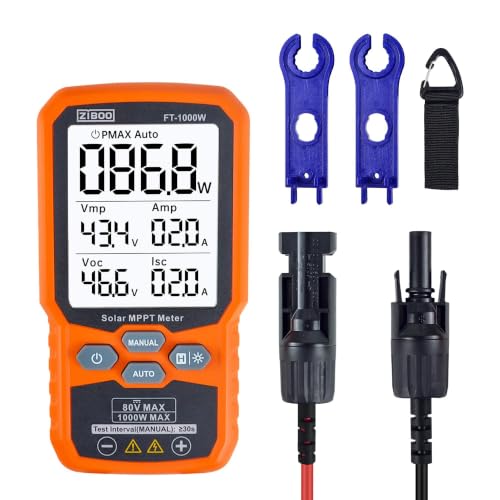
| MPPT panel tester | How much power can this panel deliver? | Voc range above panel or string; Pmax sweep; CAT III | Choosing a PV tester |
| Infrared thermometer | How hot is the panel (for correction)? Is this connector hot? | Adjustable emissivity; 12:1 or better | Choosing an infrared thermometer |
| Thermal camera (optional) | Which cell, diode or connector is hot across a whole array? | 160×120 or better; range to 300 °C | Best thermal cameras |
| Battery tester and shunt monitor (off-grid) | Is the bank healthy? What is its state of charge? | Conductance or discharge tester; shunt monitor sized for the bank | Battery testers, battery monitors |
Accessories
- MC4 crimping tool, MC4 disconnect tool, spare connectors.
- MC4-to-banana adapters and MC4 test leads, rated for the voltage.
- CAT-rated leads with caps, alligator clips.
- Bubble level or tilt meter and a compass (or a phone app) for plane-of-array irradiance.
- Cable ties, tape, marker, a notebook or app for readings and panel serials.
- Insulated gloves for the voltage class, eye protection, and fall protection for roofs.
Kits by user
| User | Kit |
|---|---|
| Homeowner, portable panels or small off-grid | CAT III 600 V multimeter; AC/DC clamp; pocket irradiance meter; MC4 tools; battery tester |
| Homeowner with a rooftop system | Add a 1000 V-rated multimeter or leave string work to the installer; infrared thermometer; the inverter app for monitoring |
| Installer | CAT III 1000 V multimeter; solar-rated DC clamp; irradiance meter with temperature and tilt; string tester with I-V curve; thermal camera; insulation tester; full PPE |
Buying order
- Multimeter with the right rating: every other measurement depends on knowing the voltage safely.
- Irradiance meter: cheap, and without it no output reading can be judged.
- DC clamp meter: current without breaking circuits.
- PV tester: finds the panels the first three cannot.
- Infrared thermometer, then thermal camera.
The method the kit supports
Voc to prove alive (see measuring Voc); current against irradiance (see measuring current); Pmax against the corrected rating (see measuring output); temperature for the correction; comparison across panels to find the outlier. Products are compared in best solar panel testers.
Recommended Tools

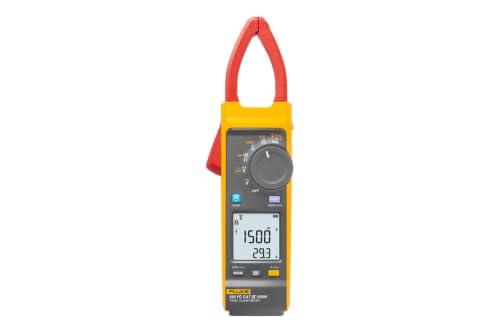

Fluke 117 Digital Multimeter, Non-Contact AC Voltage Detection, Measures Resistance/Continuity/Frequency/Capacitance/Min
View on AmazonProducts shown because their documented specifications fit this guide. Price and availability are on Amazon and can change.
Frequently Asked Questions
What is the minimum kit to check a solar panel?
A multimeter rated for the panel voltage and a cheap irradiance meter. Together they give Voc and a rough expectation. A DC clamp meter is the next purchase for current without breaking circuits.
Do I need a PV tester if I have a multimeter and clamp?
For finding underperforming panels, yes. Voc and current say a panel is alive; only an MPPT sweep gives its actual maximum power.
What safety gear do I need?
Insulated gloves rated for the voltage, eye protection, CAT-rated meters and leads, and the discipline never to open DC connectors under load. Rooftop work adds fall protection.
Affiliate disclosure: Akermin earns a commission from qualifying Amazon purchases made through links on this page. Our editorial picks are based on documented specifications and owner feedback, not commissions.
Related Guides

UNI-T UT503PV Review: A DC 1000 V Headline on a CAT III 600 V Body
A solar insulation resistance tester that works on energised PV strings up to DC 1000 V, with test voltages of 125, 250, 500 and 1000 V, a range to 4000 megohms, automatic discharge, 1000 stored result sets and USB or Bluetooth transfer.
Read More→
ANCEL BA101 Review: The Exclusion List Is the Most Useful Bullet
A 12 volt battery, cranking and charging system tester covering 100 to 2000 CCA that reports state of health, state of charge, voltage, current and CCA, drawing its own power from the battery under test.
Read More→
Tenmars Solar Power Meter Review: One Accuracy Figure, Two Very Different Jobs
A handheld solar irradiance meter reading 0 to 1999 watts per square metre or 0 to 634 BTU per square foot per hour, with a selectable 199.9 or 1999 scale, maximum and minimum tracking, data hold and manual zeroing.
Read More→