As an Amazon Associate, Akermin earns from qualifying purchases. Product links on this page are affiliate links.
Choose an infrared thermometer by first working out the smallest target you need to read and from how far: the distance-to-spot ratio (12:1, 30:1, 50:1) must give a spot smaller than the target at that distance. Then require adjustable emissivity unless every target is matte and non-metallic, a temperature range that covers the hottest job (cooking surfaces and exhaust manifolds need 500 °C or more), a stated accuracy of ±1 to 2 °C, and a laser that shows the spot boundary (dual or circle laser) rather than just its center. Add a K-type probe input for contact readings and data hold or logging if the readings go into a record.
Step 1: Spot size
The thermometer averages the temperature over a circle whose diameter grows with distance. Spot = distance ÷ D:S ratio.
| D:S ratio | Spot at 30 cm | Spot at 1 m | Spot at 3 m |
|---|---|---|---|
| 8:1 | 38 mm | 125 mm | 375 mm |
| 12:1 | 25 mm | 83 mm | 250 mm |
| 30:1 | 10 mm | 33 mm | 100 mm |
| 50:1 | 6 mm | 20 mm | 60 mm |
The target should be at least twice the spot size for a clean reading. A 12:1 unit reading a 20 mm terminal must be within 12 cm; a 30:1 unit can be 30 cm away.
Step 2: Emissivity
Fixed-emissivity units assume 0.95, which is right for food, painted surfaces, wood, drywall and skin and wrong for stainless, aluminum, copper, glass and galvanized steel. Adjustable emissivity, or at least a few presets, makes the thermometer usable on metal with the tape-patch method. See how to set emissivity; the physics is identical.
Step 3: Range and accuracy
| Use | Range needed | Accuracy |
|---|---|---|
| Kitchen (pans, oil, griddles, pizza ovens) | −20 to 500 °C or more | ±2 °C |
| HVAC (registers, coils, lines) | −30 to 300 °C | ±1 to 2 °C |
| Automotive (brakes, exhaust, radiators) | −30 to 600 °C | ±2 °C |
| Electrical (breakers, motors) | −30 to 400 °C | ±1 °C |
| Building surveys (surface temps, dew point checks) | −30 to 100 °C | ±1 °C |
Step 4: Features
- Laser: single-dot marks the center only; dual or circle lasers show the spot boundary and prevent aiming errors.
- Response time: under a second for handheld use.
- K-type input: lets the same meter take contact readings for calibration checks and for air temperature.
- Max/min, hold, alarms: useful for scanning across a surface.
- Logging and Bluetooth: for reports.
- Thermal imaging hybrids: spot thermometers with a small thermal array (FLIR TG165-X class) show where the hot spot is before reading it. See thermal camera vs infrared thermometer.
Step 5: Using it correctly
- Know the spot size at your distance; get closer for small targets.
- Set emissivity for the surface, or read a tape patch on metal.
- Aim square-on; glancing angles read low.
- Let the thermometer equilibrate to the room; a cold unit reads low for minutes.
- Keep the lens clean; grease and dust scatter the reading.
- Remember it reads surface, not air, and not internal temperature of food.
Picks by use
- Kitchen and general: a 12:1 unit with adjustable emissivity and a range to 550 °C (Etekcity 774 class).
- Trade (HVAC, electrical): 12:1 or better with dual laser, adjustable emissivity and a K-type input (Klein IR1 and higher models).
- Small distant targets: 30:1 or 50:1 professional units.
- Finding rather than reading: a spot thermal camera.
Infrared thermometers and spot cameras are in the thermal and inspection category; for the camera route see best thermal cameras for home inspection.
Recommended Tools
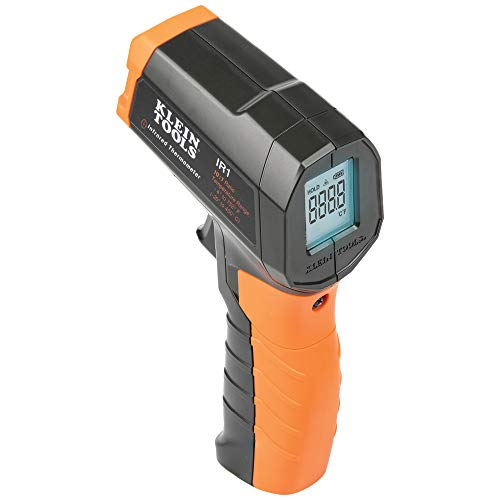


Products shown because their documented specifications fit this guide. Price and availability are on Amazon and can change.
Frequently Asked Questions
What does 12:1 mean on an infrared thermometer?
The distance-to-spot ratio: at 12 units of distance the measured spot is 1 unit across. At 60 cm the spot is 5 cm. Small targets need a higher ratio or a closer reading.
Do I need adjustable emissivity?
For anything other than matte, non-metallic surfaces, yes. Fixed 0.95 units misread stainless pans, bare metal, glass and aluminum ducts by tens of degrees.
Can an infrared thermometer measure air temperature?
No. It reads surfaces only. For air, use a probe thermometer or thermohygrometer.
Affiliate disclosure: Akermin earns a commission from qualifying Amazon purchases made through links on this page. Our editorial picks are based on documented specifications and owner feedback, not commissions.
Related Guides

Best Borescopes for Plumbing and Drains: Waterproof Picks for Traps, Stacks and Sewer Lines
IP67 inspection cameras for wet work: the TGJOR 5-inch sewer camera with a 16.4 ft probe, the Teslong NTS500 dual lens and the DEPSTECH DS300 that records.
Read More→
Best Borescopes for Home Inspection: Picks for Wall Cavities, Attics and Crawl Spaces
Cameras for confirming what the thermal camera flagged: the Teslong NTS500 through a small hole, the wireless Klein ET30 on a fish rod and the DEPSTECH DS300.
Read More→Best Borescopes: Inspection Cameras for Walls, Engines, Drains and Ducts
Inspection cameras sorted by probe diameter, cable length and display: the Teslong NTS500 dual lens, the Klein ET21 Wi-Fi scope and the 16.5 ft DEPSTECH DS300.
Read More→