As an Amazon Associate, Akermin earns from qualifying purchases. Product links on this page are affiliate links.
An infrared thermometer measures the average temperature of a single spot using one detector; a thermal camera measures thousands of spots at once and displays them as an image. Both read surface temperature from emitted infrared and both depend on emissivity. The thermometer is cheaper, quicker and adequate when you already know where to point it. The camera is for finding what you did not know was there: the cold stripe of missing insulation, the warm breaker, the damp patch.
Side by side
| Infrared thermometer | Thermal camera | |
|---|---|---|
| Output | One number | Image of thousands of temperatures |
| Detector | Single thermopile | Microbolometer array (80×60 to 640×480) |
| Spot size | Grows with distance (D:S ratio, e.g. 12:1) | Per pixel; small at close range |
| Accuracy | ±1 to 2 °C typical | ±2 to 3 °C or ±2 to 3% typical |
| Speed | Instant | Instant image; setup for accurate readings |
| Emissivity | Often fixed at 0.95; adjustable on better units | Adjustable, with reflected temperature |
| Finds unknown problems | No | Yes |
| Cost | Low | Moderate to high |
The spot-size problem
An infrared thermometer’s laser marks the center of the spot, not its size. The measured area is a cone that widens with distance according to the distance-to-spot ratio. A 12:1 thermometer at 1.2 m measures a 100 mm circle; if the target is a 30 mm terminal, the reading is mostly the panel around it. Get close, or use a higher-ratio thermometer (30:1 or 50:1) for small or distant targets. Thermal cameras have the same effect per pixel; see thermal camera resolution explained.
Which for which job
- Cooking, grills, pizza ovens: thermometer. Known target, fast reading. Mind the emissivity of shiny pans.
- HVAC supply and return temperatures: thermometer at the grille; camera to see distribution across a room or coil.
- Radiators and underfloor heating: thermometer to check a radiator; camera to see which loops are flowing and where a pipe runs.
- Electrical panels: camera to find the odd one out; thermometer to confirm a reading on an insulated part. Both misread bare metal; see why shiny metal misleads a thermal camera.
- Insulation and air leaks: camera. A thermometer cannot scan a wall.
- Moisture: camera to find the cool patch, moisture meter to confirm it. See can thermal imaging find water leaks.
- Bearings, motors, brakes: thermometer for a quick check; camera for a machine with many points.
The hybrid
Spot thermal cameras such as the FLIR TG-series combine a low-resolution thermal image (80×60 or 160×120) with a laser-marked spot reading. They show enough of a picture to aim at the hot point and then give a thermometer-style number, which suits electricians and HVAC technicians who mostly need the number but occasionally need to find it.
Both instrument types depend on the same emissivity rules; see what emissivity is. Cameras are compared in best thermal cameras for home inspection.
Recommended Tools
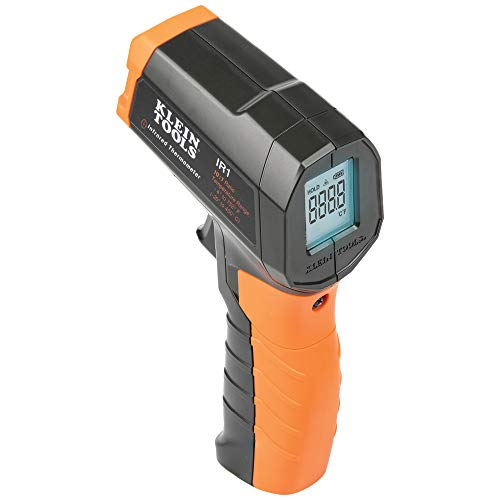

Products shown because their documented specifications fit this guide. Price and availability are on Amazon and can change.
Frequently Asked Questions
Is an infrared thermometer accurate?
On a matte surface within its distance-to-spot ratio, typically ±1 to 2 °C. On shiny metal or from too far away, it can be off by tens of degrees.
What does distance-to-spot ratio mean?
How large the measured area is at a given distance. A 12:1 thermometer measures a 25 mm spot at 300 mm; at 3 m the spot is 250 mm, larger than most targets.
Should I buy a spot thermometer or a cheap thermal camera?
For checking known targets (a vent, a pan, a radiator, a bearing) the thermometer. For finding unknown problems in a wall, ceiling or panel, the camera. Many people end up with both.
Affiliate disclosure: Akermin earns a commission from qualifying Amazon purchases made through links on this page. Our editorial picks are based on documented specifications and owner feedback, not commissions.
Related Guides

PHOEBUS LINK RCX100 Review: 40 mK Is the Figure This Job Needs
A handheld thermal camera with a 160 by 120 infrared detector, a 320 by 240 enhanced image, 40 mK sensitivity, a focus free 40 by 30 degree field of view, a 25 Hz refresh rate and still JPG image capture.
Read More→
Fluke 62 MAX+ Review: The Cold End Is Printed Three Different Ways
A non contact infrared thermometer for electrical, mechanical, HVAC and automotive surfaces, with dual rotating lasers that mark the edges of the measurement area, minimum, maximum, difference and average readings, and an IP54 rating.
Read More→
General Tools MMD7NP Review: Percent on Wood, Relative on Drywall
A pinless non invasive moisture meter that reads up to three quarters of an inch into a surface, with scales of 0 to 53 percent for softwood, 0 to 35 percent for hardwood and relative readings on wallboard, drywall and masonry.
Read More→