As an Amazon Associate, Akermin earns from qualifying purchases. Product links on this page are affiliate links.
Thermal camera resolution is the number of infrared-sensitive elements in the detector, quoted as width × height: 80×60 (4,800 pixels), 160×120 (19,200), 256×192 (49,152), 320×240 (76,800), 640×480 (307,200). That native figure decides how small a defect the camera can resolve at a given distance. Super-resolution modes, interpolated display sizes and visible-light overlays make images look sharper but add no thermal information. Compare cameras on the native number.
Why native pixels matter
Each pixel reports one temperature averaged over the patch of the scene it covers. The size of that patch is the pixel’s instantaneous field of view (IFOV), set by the detector pitch and the lens. A 160×120 camera with a 50° lens covers about 5.5 milliradians per pixel: at 3 m, each pixel sees a patch about 16 mm across. A defect smaller than a few pixels is smeared into its surroundings and its temperature reads wrong. Doubling the resolution halves the patch size at the same distance, or doubles the working distance for the same detail.
| Native resolution | Pixel patch at 3 m (typical lens) | Smallest reliably measured target at 3 m |
|---|---|---|
| 80×60 | About 30 mm | About 90 mm |
| 160×120 | About 16 mm | About 50 mm |
| 256×192 | About 10 mm | About 30 mm |
| 320×240 | About 8 mm | About 25 mm |
| 640×480 | About 4 mm | About 12 mm |
Figures vary with lens angle; a narrow lens gives smaller patches over a smaller area. The “smallest measured target” is roughly three pixels across, the usual rule for an accurate spot reading.
What the other numbers mean
- Super-resolution / TISR / VividIR / SuperResolution: software that combines slightly shifted frames or interpolates to output a larger image (240×240 from 128×128, 480×360 from 160×120). It can genuinely reduce noise and improve apparent sharpness, but it cannot recover detail below the native pixel patch.
- Display resolution: the screen the image is shown on, often much higher than the detector. Irrelevant to measurement.
- MSX, fusion, picture-in-picture: blends of the visible camera’s image with the thermal one. They make the picture readable and change nothing in the thermal data.
- Visible camera resolution: the megapixels of the ordinary camera used for overlays and reports.
Resolution versus sensitivity
Resolution is how fine; sensitivity (NETD) is how faint. A high-resolution camera with poor sensitivity shows a sharp, noisy image where small temperature differences are lost; a low-resolution camera with excellent sensitivity shows a blurry image where they are visible. Building surveys need both, since insulation defects are often only 1 to 2 °C different. See what NETD is.
How much you need
- Spot checks at arm’s length (breakers, pipes, seals): 80×60 works.
- Home inspection, room by room: 160×120 native is the practical floor; 256×192 is a comfortable step up and now common in mid-priced cameras.
- Whole facades from outside, roofs, large plant: 320×240 or more, or get closer.
- Professional reporting and small electrical components: 320×240 to 640×480.
The cameras in best thermal cameras for home inspection are listed by native resolution first. For the physics behind the detector, see how a thermal camera sees heat.
Recommended Tools

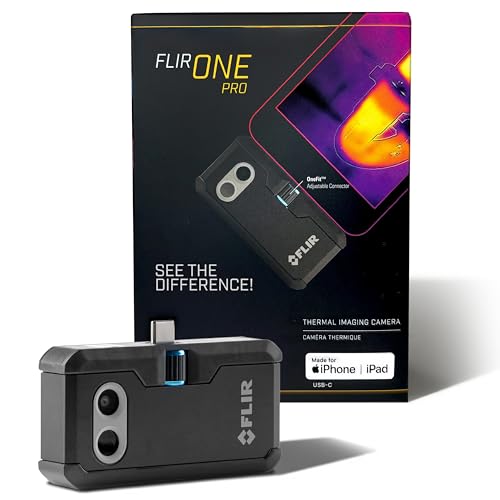
Products shown because their documented specifications fit this guide. Price and availability are on Amazon and can change.
Frequently Asked Questions
What resolution thermal camera do I need for home inspection?
160×120 native is the practical minimum for whole-wall surveys at a few meters. 320×240 shows finer detail and works from further away. 80×60 is usable at close range for spot checks.
Is 480×360 super-resolution the same as a 480×360 detector?
No. Super-resolution combines several frames or interpolates to produce a smoother, larger image from a smaller detector. It can look sharper but cannot reveal detail the detector did not capture.
Does MSX increase thermal resolution?
No. MSX draws edges from the visible camera onto the thermal image so shapes are recognizable. The thermal data underneath is unchanged.
Affiliate disclosure: Akermin earns a commission from qualifying Amazon purchases made through links on this page. Our editorial picks are based on documented specifications and owner feedback, not commissions.
Related Guides

PHOEBUS LINK RCX100 Review: 40 mK Is the Figure This Job Needs
A handheld thermal camera with a 160 by 120 infrared detector, a 320 by 240 enhanced image, 40 mK sensitivity, a focus free 40 by 30 degree field of view, a 25 Hz refresh rate and still JPG image capture.
Read More→
Fluke 62 MAX+ Review: The Cold End Is Printed Three Different Ways
A non contact infrared thermometer for electrical, mechanical, HVAC and automotive surfaces, with dual rotating lasers that mark the edges of the measurement area, minimum, maximum, difference and average readings, and an IP54 rating.
Read More→
General Tools MMD7NP Review: Percent on Wood, Relative on Drywall
A pinless non invasive moisture meter that reads up to three quarters of an inch into a surface, with scales of 0 to 53 percent for softwood, 0 to 35 percent for hardwood and relative readings on wallboard, drywall and masonry.
Read More→