Best Thermal Cameras for Home Inspection: 10 Smart Picks for Finding Hidden Problems
A home inspection camera has to show a missing patch of insulation, a cold draft at a rim joist and a warm breaker in the same walkthrough, which makes native detector resolution the specification that decides everything. This hub separates native resolution from software upscaling across ten current cameras and links down to the room-by-room guides.
Independent Research
Verified Specifications
Honest Recommendations
Native Not Upscaled
Delta T First
Shoot At An Angle
As an Amazon Associate, Akermin earns from qualifying purchases. Product links on this page are affiliate links.
Our Top Picks
Ten cameras compared on the figures that decide whether a finding is visible: native detector resolution, what the software upscales it to, screen, battery and fusion imaging. Upscaled resolution adds pixels, not measurements, and the table separates the two. We did not test these cameras and publish no thermal measurements of our own.
Best Overall
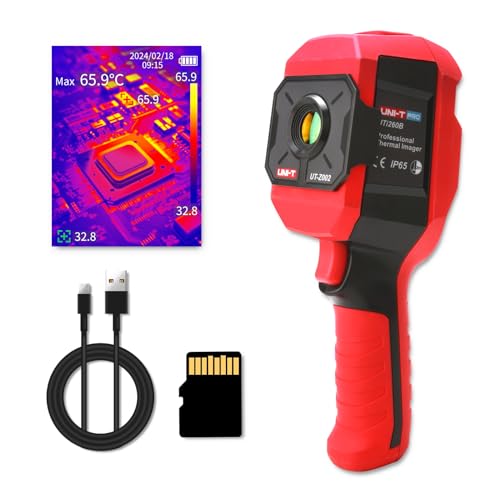
UNI-T UTi260B Thermal Camera with Macro Lens
A stated 256 x 192 native detector in a standalone body, with a macro lens included.
Stated 256 x 192 infrared resolution, native rather than upscaled
Ships with the UT-Z002 macro lens for close detail work
Standalone camera with its own screen, no phone required
Established meter brand with wide accessory support
Where a listing gives a native figure and an upscaled figure, both are shown. Upscaling adds pixels by interpolation and does not add measurements. Cells read Not stated wherever the manufacturer publishes nothing.
How to Choose a Home Inspection Camera
Five checks, in order of how much they change the result:
Native Detector Resolution
Count the real detector elements. 256 x 192 is 49,152 measurements; 128 x 128 upscaled to 240 x 240 is still 16,384 measurements in a bigger picture.
Thermal Sensitivity
Building findings are often a difference of one or two degrees. NETD in millikelvin is the figure that decides whether that difference is visible, and almost none of these listings publish it.
Phone or Standalone
A phone module is always with you and costs least. A standalone camera keeps working in a cold crawl space, leaves your phone free and is easier to hand to a client.
Getting Images Out
If findings go into a written report, check that the camera stores images and transfers them. One camera here states JPG export, 512 MB of storage and PC transfer; most state nothing.
Fusion or Blending
Overlaying a visible image on the thermal one makes a warm spot identifiable as a specific outlet or stud bay. Several listings here state dual-light or fusion imaging.
For building envelope work, a native 160 x 120 detector finds missing insulation and air leaks, and 256 x 192 gives enough detail to identify which stud bay or which connection. What matters is the native figure. A 128 x 128 detector upscaled to 240 x 240 still takes 16,384 measurements.
Does a thermal camera see through walls?
No. It measures the temperature of the surface it is pointed at. What you see is the effect of what is behind the wall on the wall surface, which is why missing insulation, a wet patch or a warm pipe shows up. Anything that does not change the surface temperature is invisible.
When is the best time to scan a house?
When there is a temperature difference across the envelope, ideally 10 degrees Celsius or more between inside and outside, and outside of direct sun on the surface you are imaging. Early morning after a cold night is the classic window. A mild afternoon shows almost nothing regardless of the camera.
Is a phone-based camera good enough?
For finding problems, often yes, and it has the advantage of being in your pocket. For documenting them, a standalone camera with its own screen and storage is easier: it keeps working in a cold crawl space, does not drain the phone you need for the report, and can be handed to a client.
Can a thermal camera confirm moisture?
It can show where to check. Evaporation cools a wet surface, so damp areas usually read cooler, but so do air leaks, cold pipes and thermal bridges. The camera narrows the search and a moisture meter confirms the finding. Never report moisture on a thermal image alone.
Reviews
UNI-T UTi260B Thermal Camera with Macro Lens Best Overall
The UTi260B takes the top slot because the specification that matters is stated plainly and is not an upscaled figure. UNI-T lists 256 x 192 infrared resolution, which is 49,152 real detector elements, and the kit arrives with the UT-Z002 macro lens that snaps on for close work on a connection or a small component.
Standalone matters more for inspection work than it does on paper. A camera with its own screen survives a cold crawl space and a hot attic without the phone that also holds your notes, your appointments and your report app, and it does not stop working because the phone is at 4 percent. It also means the image on the screen is what the sensor sees rather than a composited phone display.
The listing does not state thermal sensitivity in millikelvin, refresh rate, temperature range or battery life, all of which matter, so a buyer who needs an NETD figure for a report has to go to the UNI-T datasheet. The macro lens is an accessory rather than a general-purpose upgrade: it improves close detail and is not used for scanning a wall.
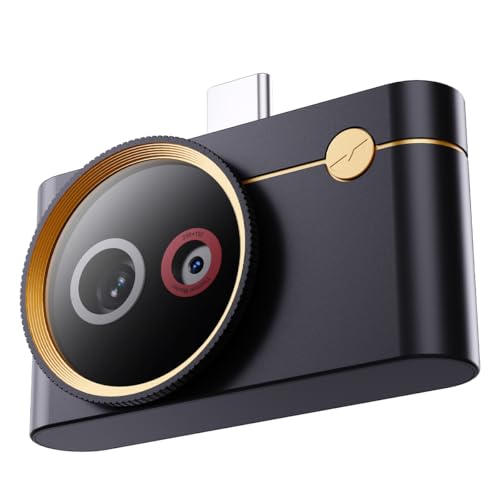
InfiRay P2 Pro with Magnetic Macro Lens Best Phone-Based
The argument for a phone-based imager is that it is always with you. At a stated 9 grams in an all-metal shell, the P2 Pro lives in the same pocket as a pen and comes out when a wall feels cold or a ceiling stain looks fresh, which is exactly the situation where a camera left in the van does no good.
The magnetic macro lens is the distinguishing feature of this listing. InfiRay describes it as being for swift identification, alignment and focusing, which in practice means getting close enough to a specific fitting or joint that the thermal image lines up with what your eyes see. On a general wall scan the lens comes off.
The costs of the format are real. The phone becomes the camera, so battery, screen brightness in an attic, and the awkwardness of holding a phone with a module hanging off it all apply. The listing states no native resolution, no NETD and no temperature range, so treat this as a finding tool rather than a measuring instrument, and use a standalone camera where numbers go into a report.
BSIDE HX1 Thermal Imaging Camera Best Value Standalone
The HX1 is the standalone camera for someone who wants their own screen without paying a professional tier. BSIDE states 240 x 240 resolution and fifteen thermal palettes, and the listing frames the camera around detecting potential problems early, which is the correct framing for a homeowner or a general trade rather than a certified thermographer.
Palettes are underrated on a budget camera. Iron and rainbow exaggerate small differences and make a faint cold band across a ceiling obvious, while grayscale keeps edges readable and is easier to interpret on a busy scene. Fifteen of them is more than most people will use but it means the useful three or four are there.
BSIDE does not state whether 240 x 240 is native or enhanced, and several cameras in this table reach a similar figure by upscaling a smaller detector. It also states no NETD, no refresh rate, no temperature range and no battery life. Buy it to find problems, not to document them with numbers.
Strengths
240 x 240 resolution stated
15 palettes
Standalone, no phone needed
Lowest standalone tier here
Limitations
Listing does not say whether the resolution is native
Short answer: the UNI-T UTi260B kit is the home inspection camera to buy, because its listing states a genuine 256 x 192 native detector in a standalone body and includes the macro lens. The InfiRay P2 Pro is the pocket option at a stated 9 grams for anyone who would rather have a camera always with them than a better one left in the van, and the BSIDE HX1 gives you a standalone screen and 240 x 240 at the budget tier.
Native resolution is the specification, and upscaling is not
Every thermal camera number in this category deserves one question: is that the detector, or is that the picture. The AMPBANK H128 listing is admirably honest about it, stating 128 x 128 native upgraded to 240 x 240 by TISR. That means the camera takes 16,384 temperature measurements and the software interpolates them into a 57,600 pixel image. The image looks smoother. It does not contain more information. By contrast the UNI-T listing states 256 x 192 infrared resolution, which is 49,152 real measurements, and the VEVOR listing states 256 x 192 native going to 512 x 384 enhanced. In the table both figures are shown wherever a manufacturer gives both, because the difference decides whether you can tell one stud bay from the next across a room.
Thermal sensitivity is the number nobody publishes
Building inspection findings are small. A missing batt of insulation might show as a two degree difference on the interior wall surface; a rim joist leaking air on a windy day might show as three. NETD, the noise equivalent temperature difference measured in millikelvin, is the figure that says whether a camera can resolve that at all, and it is absent from every one of the ten listings on this page. That is a genuine gap in the consumer end of the market. A camera with a high resolution detector and poor sensitivity produces a detailed picture of nothing in particular. If you are buying at the professional end, get the NETD from the manufacturer datasheet before ordering, and treat the listings here as a shortlist.
Conditions matter more than the camera
A thermal camera measures surface temperature, so it only reveals what is behind a surface when something is driving heat through it. That means a temperature difference across the building envelope, conventionally at least ten degrees Celsius, is the precondition for envelope work. Scan a house on a mild afternoon and a professional camera shows the same flat, uninformative image as a phone module. Early morning after a cold night is the reliable window, before the sun has loaded the exterior walls. The other condition is solar loading: a wall in direct sun stores heat unevenly and produces patterns that have nothing to do with insulation. Our guide to choosing a camera for home inspection covers the full set of working conditions.
Fusion imaging is how a finding becomes identifiable
A warm rectangle on a grey field is not a report entry. Blending a visible-light image with the thermal one puts edges back into the picture, so the warm rectangle is clearly the third outlet along the north wall. Several listings here state some form of it: the Yukicam unit describes dual-light fusion combining infrared heat maps with real visual images, and the GOYOJO GH192 states a 2 MP visible camera feeding a fusion image. It is not the same as radiometric accuracy and it does not improve the measurement, but for a home inspector who has to communicate a finding to a homeowner, it is the difference between a picture that explains itself and one that needs a paragraph.
Phone modules, standalone bodies and the crawl space test
Three of the ten here plug into a phone and seven have their own screen. The phone modules win on cost, size and the simple fact that they are always in a pocket. They lose in the places home inspections actually happen. A crawl space in winter drains a phone battery fast, an attic in summer can push a phone into thermal shutdown, a phone screen at full brightness is still hard to read in a bright roof space, and the phone you are using as a camera is the same phone holding your schedule and your report app. A standalone body with its own screen and storage sidesteps all of it. One camera here, the PHOEBUS LINK, states 512 MB of storage, JPG export and PC transfer, which is the workflow a written report needs.
Cameras were compared on manufacturer listing text: native detector resolution and any upscaled figure, screen, stated battery life, fusion imaging, stated temperature range and storage or export. Two macro lens accessories and an automotive night-vision dashcam that appeared in the source data were excluded, so all ten rows are cameras a home inspector can actually use. We did not run thermal tests and publish no measurements. Amazon data supplies images, availability and links only.
A 17 gram USB-C thermal attachment stating 320 by 240 after X3 processing from a 160 by 120 detector, with 0.04 C sensitivity, isotherm mode and adjustable emissivity.
An Android phone attachment with a 256 by 192 detector upscaled to 512 by 384, NETD below 35 mK, a 56 by 42 degree field of view and no battery of its own.
A 1080P borescope with a 4.3 inch screen, a 16.4 foot semi rigid IP67 probe, eight LEDs and an accessory kit. Reviewed from a listing whose own bullets contradict its title.