Best Thermal Cameras for Roof Inspections: Picks for Wet Insulation and Membrane Faults
A roof moisture survey is done at the end of a sunny day, when wet insulation under the membrane holds the heat it absorbed and shows warmer than the dry roof around it. That makes sensitivity, native resolution and a wide lens the specifications that matter, plus a form factor that is safe to use at height. These picks were sorted on those figures from manufacturer listings.
As an Amazon Associate, Akermin earns from qualifying purchases. Product links on this page are affiliate links.
Our Top Picks
Cameras were compared for roof surveys on native resolution, stated NETD, field of view, refresh rate, handling at height and reporting workflow, all from manufacturer listings. We did not run laboratory tests or roof surveys of our own; figures are the manufacturers' own and Not stated marks the gaps.
Best Overall
FLIR E8 Pro Thermal Imaging Camera
Native 320x240 with MSX and cloud upload for a survey report that maps the wet areas.
320 x 240 native detector, 76,800 pixels
Measures -20 to 550 C (-4 to 1022 F)
MSX embosses seams, curbs and drains onto the thermal image
Wi-Fi to FLIR Ignite cloud with over-the-air updates; 2-year camera, 10-year detector warranty
All values come from the manufacturers' Amazon listings at the time of research. Upscaled figures are software output and are not comparable with native counts. Not stated means the listing gives no value; FLIR publishes NETD and field of view in its datasheets.
How to Choose a Thermal Camera for Roof Surveys
Four points decide it:
Sensitivity at Dusk
Wet insulation is only a few degrees warmer than dry at the right time of evening, and less when marginal. A stated NETD of 40 mK or lower is worth having.
Native Pixels on a Big Roof
A low-slope roof is scanned from standing height across long distances. 320 x 240 defines the edge of a wet area; 160 x 120 blurs it.
Safe Handling at Height
A wireless camera on a pole or a one-handed camera with a wrist strap. Never scan a steep roof while holding a phone in one hand and a ladder in the other.
The Weather, Not the Camera
A sunny day followed by a clear, calm evening. Wind, cloud and a wet surface flatten the image whatever the camera.
When is the best time to scan a roof for wet insulation?
The evening after a sunny day, once the sun is off the roof and the dry areas have started to cool. Wet insulation holds the heat it absorbed during the day and shows warmer than dry insulation for a few hours. A clear, calm night works best; wind and cloud cover reduce the difference, and rain on the surface hides it.
Why does wet roof insulation show warm when a wet ceiling shows cold?
Two different effects. A wet ceiling indoors is cooled by evaporation, so it reads cold. Wet insulation under a membrane cannot evaporate freely, and water has more thermal mass than dry insulation, so it stores daytime heat and releases it slowly after sunset, reading warm against the dry roof. Scan a roof at dusk and a ceiling at any time.
Can a thermal camera survey a gravel or ballasted roof?
Poorly. Ballast and gravel sit between the camera and the insulation and hold heat unevenly, so the pattern reflects the ballast rather than the moisture beneath. Smooth-surfaced membranes give the clearest survey. On a ballasted roof the survey is usually done with a nuclear or capacitance moisture scanner and core samples instead.
Does a thermal roof scan replace core samples?
No. The scan maps the areas that are probably wet; a core cut or a probe moisture reading at a few of those areas confirms it and tells you how wet the insulation is. Roofers and consultants mark the suspect areas on the membrane during the scan and take cores in daylight.
Why use a wireless camera on a roof?
Because it separates the camera from the person. FLIR states that the Edge Pro connects to a phone by Bluetooth and can be held into tight spaces or around corners, which on a roof means a camera on a pole over an eave, a parapet or a skylight curb while the image is viewed from a safe stance. The trade is a 160 x 120 detector rather than the 320 x 240 in the handhelds.
Reviews
FLIR E8 Pro Thermal Imaging Camera Best Overall
A roof survey ends in a drawing that shows where the wet insulation is, and the E8 Pro is the camera whose images translate into that drawing most easily. FLIR states a native 320 x 240 detector, 76,800 pixels, so a warm area of wet insulation on a large low-slope roof is resolved with a defined edge from a standing position rather than a smear, and MSX embosses the visible outline of seams, curbs, drains and HVAC units onto the thermal image, which is what lets the finding be located on the roof plan.
Images upload over Wi-Fi to FLIR Ignite for storage, editing and sharing with the building owner or roofer, and FLIR covers the detector for 10 years.
The listing states no NETD, field of view, refresh rate or battery figure, and all four matter on a roof: sensitivity decides whether marginally wet insulation shows, field of view decides how many frames a roof takes, and runtime decides whether one charge covers a large building at dusk. FLIR publishes those in its datasheet; the TR20 states them on the listing.
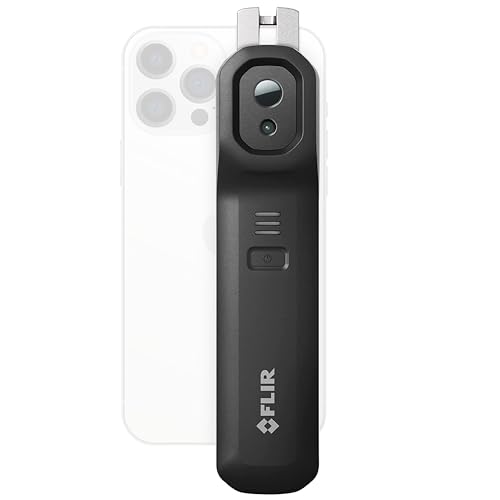
FLIR Edge Pro Wireless Thermal Imaging Camera Best Wireless
The Edge Pro is on this page for one reason: FLIR states that it connects to a phone or tablet wirelessly by Bluetooth so the camera can be held where the user is not, into tight spaces or around corners. On a steep roof that means the camera can be raised on a pole or held over an eave from a ladder while the image is watched on a phone held safely, and in an attic it means reaching a section of roof deck that is not accessible on foot.
MSX blending carries over from the handhelds, the stated accuracy is plus or minus 3 C or 5 percent within the listed ambient and scene range, and images can be uploaded, organized and shared through Ignite cloud from a Wi-Fi connected camera.
The detector is 160 x 120 native, upscaled to 480 x 360 by Vivid IR, so it resolves a quarter of what the E8 Pro does and is not a survey camera for a large low-slope roof. The listing does not state NETD, range, battery life or a field of view.
Strengths
Wireless viewing keeps the person on the ladder and the camera at the eave
The TR20 is the only camera on this page whose listing states a sensitivity, NETD under 40 mK, and sensitivity is the figure that decides whether insulation that is only slightly wet shows against the dry roof around it at dusk. MiLESEEY pairs it with a 320 x 240 detector, a 50-degree wide-angle lens that takes in a large area of roof per frame and 25 Hz refresh, so the image does not smear while walking the field of the roof.
The manufacturer also states automatic hot and cold spot tracking, which flags the warmest area in the frame as you walk, a customizable temperature alarm and width, video recording to review the whole walk afterwards and PC analyzer software. The 2.8-inch 480 x 640 display and the -4 to 1022 F range are more than roof work needs.
There is no visible-light overlay equivalent to MSX stated, so mapping a finding to the roof plan takes a photo or a chalk mark, and there is no cloud workflow. Battery life is not stated.
Short answer: the FLIR E8 Pro is the roof survey camera for a consultant or roofer who delivers a moisture map, with a native 320 x 240 detector, MSX to locate findings against seams and curbs, and Ignite cloud records; the FLIR Edge Pro is the wireless pick that streams to a phone by Bluetooth so the camera can be raised over an eave or into an attic corner while the person stays safe; and the MiLESEEY TR20 is the value pick and the only listing here that states a sensitivity, NETD under 40 mK, with a 320 x 240 detector, 25 Hz and a 50-degree lens for walking a large roof.
What a roof survey is looking for
Most roof thermal work is a moisture survey of a low-slope membrane roof: finding the areas where the insulation under the membrane has become wet through a failed seam, a flashing, a penetration or a clogged drain. Wet insulation has lost its insulating value, adds weight and rots the deck, and replacing only the wet areas rather than the whole roof depends on knowing where they are. The camera also shows the secondary faults: a seam that is lifting and letting water under the lap, a warm line where a scupper is blocked and water is ponding, a curb around a rooftop unit that is wetter than the field. On steep residential roofs the job is smaller and usually done from inside, in the attic, looking for wet sheathing around a chimney or a valley, or from a ladder at the eave.
Timing: the evening after a sunny day
Dry insulation and wet insulation absorb the same sun during the day, but water has far more thermal mass, so after sunset the dry areas cool quickly and the wet areas stay warm for a few hours. The survey is done in that window, starting once the sun is off the roof, on a clear and calm evening; cloud, wind and rain all flatten the difference, and a wet surface after a shower hides everything. This is the opposite of an indoor leak, where evaporation makes a wet ceiling read cool, and it is the reason a roof survey cannot be squeezed into a daytime site visit. Why thermal images change with the weather covers the conditions in detail. Whatever is found is marked on the membrane and confirmed the next day with a core cut or a probe reading; the camera maps, it does not prove.
Resolution and field of view on a large roof
A commercial roof is scanned from standing height across long distances, so native resolution decides whether the edge of a wet area is defined enough to mark and measure. The E8 Pro, C8 and TR20 state 320 x 240 detectors, 76,800 pixels; the E6 Pro states 240 x 180; the Edge Pro is 160 x 120 native under its 480 x 360 Vivid IR headline, and the TC001 Plus and Thor002 are 256 x 192 native under 512 x 384 TISR and X3 headlines. Field of view decides how many frames the roof takes: the TR20 states a 50-degree lens and the C8 35 degrees horizontal, while the FLIR E-series listings state none. Refresh rate matters because the survey is a walk, and at 25 Hz, which the TR20 and Thor002 state, the image follows the camera rather than smearing. The building envelope guide weighs the same figures for walls.
Wireless on a ladder: the Edge Pro case
Steep roofs raise a different problem, which is that the person holding the camera is also holding on. FLIR states that the Edge Pro connects to a phone or tablet wirelessly by Bluetooth and that the wireless design lets the user see into tight spaces or around corners. In practice that means the camera can be raised on a pole to look over a parapet or along an eave, or held into an attic corner where the roof deck meets the wall, while the image is watched on a phone from a stable stance. That is a safety feature as much as a convenience. The cost is a 160 x 120 native detector, a quarter of the E8 Pro count, so the Edge Pro is a fault-finder for a specific area rather than a survey camera for a whole roof, and the listing states no NETD, range or battery figure. A phone module on a cable, such as the TC001 Plus, gives some of the same reach at closer range.
Sensitivity: the figure most listings skip
NETD is the smallest temperature difference the detector distinguishes, in millikelvin, and lower is better. On a marginal evening the difference between wet and dry insulation can be a degree or less, so sensitivity is the figure that decides whether the survey finds the small wet areas or only the obvious ones. Only two listings on this page quote it: the TR20 at under 40 mK and the Thor002 at 40 mK. The FLIR listings state resolution, range and MSX but no sensitivity; FLIR publishes NETD in its datasheets, so the buyer should read the datasheet before choosing between an E8 Pro and a TR20 on that figure. What NETD means explains how to compare the numbers.
Limits: emissivity, ballast and reflections
A thermal camera reads the surface of the membrane, not the insulation under it, so everything it shows is inferred from how the surface warms and cools. That inference fails on a gravel or ballasted roof, where the stones hold heat unevenly and hide the pattern beneath; those roofs are surveyed with nuclear or capacitance scanners and cores instead. Metal roofs, aluminum-coated membranes and bare flashings have low emissivity and reflect the sky, which reads very cold on a clear night, so a reflective roof can show a false cold pattern that has nothing to do with moisture; set the emissivity for the surface and treat any reading on bare metal with suspicion. Ponded water reads at its own temperature and hides what is under it. Where a survey feeds a repair scope, confirm with cores.
How We Research
Cameras were compared on manufacturer listing figures for roof surveys: native detector resolution, upscaled output where quoted, stated NETD, field of view, refresh rate, wireless or standalone handling, battery runtime and reporting workflow. Owner feedback was reviewed for recurring comments on outdoor screen readability and wireless reliability. We did not run laboratory tests or roof surveys of our own and publish no measurements. Amazon data supplies images, availability and links only.
A handheld thermal camera with a 160 by 120 infrared detector, a 320 by 240 enhanced image, 40 mK sensitivity, a focus free 40 by 30 degree field of view, a 25 Hz refresh rate and still JPG image capture.
A non contact infrared thermometer for electrical, mechanical, HVAC and automotive surfaces, with dual rotating lasers that mark the edges of the measurement area, minimum, maximum, difference and average readings, and an IP54 rating.
A pinless non invasive moisture meter that reads up to three quarters of an inch into a surface, with scales of 0 to 53 percent for softwood, 0 to 35 percent for hardwood and relative readings on wallboard, drywall and masonry.