As an Amazon Associate, Akermin earns from qualifying purchases. Product links on this page are affiliate links.
Emissivity is a number from 0 to 1 describing how efficiently a surface emits infrared radiation compared with a perfect emitter (a blackbody) at the same temperature. Matte, non-metallic surfaces such as paint, plaster, wood, brick and skin have emissivity around 0.9 to 0.98. Polished metals are 0.05 to 0.3. A thermal camera converts radiation to temperature using the emissivity you set, so a shiny surface measured at the default 0.95 reads far too cold, and it also reflects the surroundings, which the camera mistakes for the surface’s own heat.
Emission and reflection
The infrared reaching the camera from a surface is emitted radiation plus reflected radiation from everything around it. For an opaque surface, emissivity plus reflectivity equals one. A wall at emissivity 0.95 emits 95 percent of what a blackbody would and reflects 5 percent of the surroundings; a chrome pipe at 0.1 emits 10 percent and reflects 90 percent. Point a camera at the pipe and the image is mostly a distorted reflection of the room, the ceiling lights and your own body heat.
Typical values
| Surface | Emissivity (approx.) |
|---|---|
| Human skin | 0.98 |
| Matte paint (any color), plaster, drywall | 0.90 to 0.95 |
| Wood, paper, cardboard | 0.90 to 0.95 |
| Brick, concrete, asphalt | 0.90 to 0.95 |
| Rubber, most plastics | 0.90 to 0.95 |
| Water | 0.96 |
| Glass | 0.85 to 0.92 (and reflective at shallow angles) |
| Oxidized steel, rusted iron | 0.7 to 0.9 |
| Anodized aluminum | 0.7 to 0.8 |
| Oxidized copper | 0.6 to 0.8 |
| Polished stainless steel | 0.15 to 0.3 |
| Polished aluminum, copper, chrome | 0.03 to 0.1 |
What goes wrong
With emissivity set to 0.95 and the camera pointed at bare aluminum at 60 °C in a 20 °C room, the surface emits about a tenth of what the camera expects and reflects the 20 °C room. The camera reports something near 25 °C. The error grows with the difference between surface and surroundings, which is exactly the situation in electrical inspection, where the hot terminal is the shiny one. See why shiny metal misleads a thermal camera.
Setting it
- Leave the camera at 0.95 for building surfaces, people, and painted or oxidized equipment.
- For a known material, set the value from a table; better cameras have a menu of materials.
- Set reflected apparent temperature: point the camera at a crumpled piece of aluminum foil in the scene (emissivity near 0, so it shows the reflected radiation), read it with emissivity at 1.0, and enter that figure. For an ordinary room, room temperature is close enough.
- For shiny surfaces you must measure, apply a patch of electrical tape (about 0.95) or matte paint, wait for it to reach the surface temperature, and measure the patch.
- Compare like with like: two similar shiny terminals at different apparent temperatures are genuinely different even if the absolute numbers are wrong.
Infrared thermometers too
Spot infrared thermometers work on the same physics and have the same setting, often fixed at 0.95 on cheap models. A fixed-emissivity thermometer reads cooking oil in a pan reasonably and a stainless pan itself badly. See thermal camera vs infrared thermometer. For how the camera turns radiation into a number, see how a thermal camera sees heat.
Recommended Tools

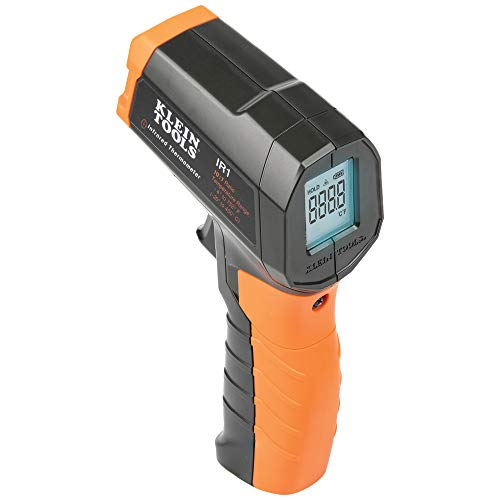
Products shown because their documented specifications fit this guide. Price and availability are on Amazon and can change.
Frequently Asked Questions
What emissivity should I set for most things?
0.95 covers paint, plaster, wood, brick, concrete, skin, rubber and most plastics. Change it only for bare metal, glass and other shiny or unusual surfaces.
What happens if emissivity is set too high?
The camera assumes more of the radiation is emitted by the surface, so it reports a temperature lower than the truth for a low-emissivity surface. Shiny metal at 60 °C can read near room temperature.
How can I measure a shiny surface accurately?
Apply electrical tape or matte paint to a small area, let it reach the surface temperature, and measure the tape with emissivity set to about 0.95.
Affiliate disclosure: Akermin earns a commission from qualifying Amazon purchases made through links on this page. Our editorial picks are based on documented specifications and owner feedback, not commissions.
Related Guides

PHOEBUS LINK RCX100 Review: 40 mK Is the Figure This Job Needs
A handheld thermal camera with a 160 by 120 infrared detector, a 320 by 240 enhanced image, 40 mK sensitivity, a focus free 40 by 30 degree field of view, a 25 Hz refresh rate and still JPG image capture.
Read More→
Fluke 62 MAX+ Review: The Cold End Is Printed Three Different Ways
A non contact infrared thermometer for electrical, mechanical, HVAC and automotive surfaces, with dual rotating lasers that mark the edges of the measurement area, minimum, maximum, difference and average readings, and an IP54 rating.
Read More→
General Tools MMD7NP Review: Percent on Wood, Relative on Drywall
A pinless non invasive moisture meter that reads up to three quarters of an inch into a surface, with scales of 0 to 53 percent for softwood, 0 to 35 percent for hardwood and relative readings on wallboard, drywall and masonry.
Read More→