As an Amazon Associate, Akermin earns from qualifying purchases. Product links on this page are affiliate links.
Set emissivity to 0.95 for painted, plastered, wooden, brick and concrete surfaces and leave it there for building surveys. Set reflected apparent temperature to the room temperature, or measure it by reading crumpled aluminum foil in the scene at emissivity 1.0. For metal, glass or unknown surfaces, apply a patch of black electrical tape, let it reach the surface temperature, read the tape at 0.95, then adjust the camera’s emissivity while aiming at the bare surface until it reads the same; that is the surface’s emissivity. Below about 0.5, treat readings as comparative only.
Why it matters
The camera converts received infrared to temperature assuming the surface emits like a blackbody scaled by the emissivity value. Set too high for a shiny surface and the camera under-reads by tens of degrees and mistakes reflections for heat. See what emissivity is.
Step 1: The defaults
| Surface | Emissivity |
|---|---|
| Paint (any color, matte or satin), plaster, drywall | 0.93 to 0.96 |
| Wood, paper, cardboard, textiles | 0.90 to 0.95 |
| Brick, concrete, asphalt, stone | 0.90 to 0.95 |
| Skin | 0.98 |
| Water | 0.96 |
| Rubber, most plastics | 0.90 to 0.95 |
| Glass (square-on) | 0.85 to 0.92 |
| Oxidized or painted metal | 0.70 to 0.95 |
| Galvanized steel (dull) | 0.25 to 0.30 |
| Polished aluminum, copper, stainless | 0.05 to 0.30 |
Step 2: Reflected apparent temperature
- Crumple a sheet of aluminum foil and flatten it roughly; the crumpled surface reflects diffusely.
- Place it on or beside the target, facing the camera.
- Set emissivity to 1.0 and read the foil’s apparent temperature.
- Enter that value as reflected apparent temperature (also called background or ambient reflected).
- Return emissivity to the value for the target.
For ordinary rooms the result is close to air temperature, and entering room temperature is adequate. For surfaces facing the sky, a hot machine or a window, measure it.
Step 3: Determining emissivity of a surface
- Apply a patch of black electrical tape (or matte black paint) to the surface.
- Wait a few minutes for the patch to reach the surface temperature.
- Set emissivity to 0.95 and read the tape’s temperature.
- Move the spot to the bare surface beside the tape.
- Adjust emissivity down until the reading equals the tape reading.
- Record that emissivity for the material.
This works when the surface is at least 10 to 20 °C from the reflected temperature; near ambient, any emissivity gives nearly the same reading and the method is insensitive.
Step 4: Angle
Emissivity falls as the viewing angle moves away from square-on, sharply beyond about 45 to 60°. View surfaces as square as safety allows and be sceptical of readings on surfaces seen at a glancing angle.
When the number cannot be trusted
- Bare polished metal (emissivity under about 0.3): the reflected component dominates; measure a tape patch or the insulation instead. See why shiny metal misleads a thermal camera.
- Glass: reflective and partially transparent; readings are the glass surface plus reflections.
- Surfaces near the reflected temperature: emissivity errors cancel, readings are fine, but the emissivity test above will not work.
Recording it
Note emissivity, reflected temperature and distance on every saved image or in the report. A thermal image without them cannot be interpreted later. See what makes a good thermal image. Infrared thermometers use the same setting; see how to choose an infrared thermometer.
Recommended Tools

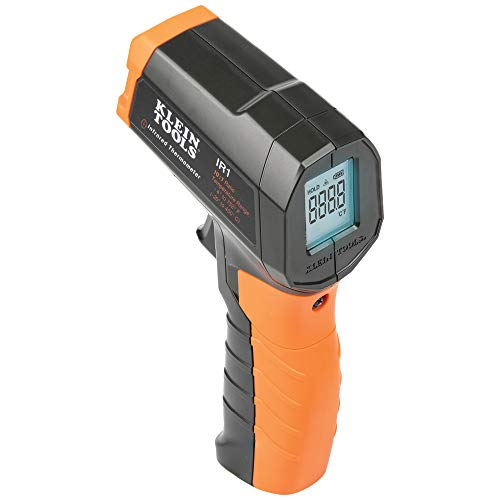
Products shown because their documented specifications fit this guide. Price and availability are on Amazon and can change.
Frequently Asked Questions
What emissivity should I use for walls and ceilings?
0.95. Paint, plaster, drywall, wood, brick and concrete are all 0.90 to 0.97, and 0.95 is within a degree of correct for any of them at room temperature.
How do I find the emissivity of an unknown surface?
Stick electrical tape (emissivity about 0.95) on it, let it equilibrate, read the tape at 0.95, then aim at the bare surface beside it and adjust emissivity until the reading matches. That value is the surface's emissivity.
What is reflected apparent temperature?
The apparent temperature of what the surface is reflecting, usually the room. The camera subtracts its contribution. Measure it with crumpled aluminum foil in the scene, read at emissivity 1.0.
Affiliate disclosure: Akermin earns a commission from qualifying Amazon purchases made through links on this page. Our editorial picks are based on documented specifications and owner feedback, not commissions.
Related Guides

PHOEBUS LINK RCX100 Review: 40 mK Is the Figure This Job Needs
A handheld thermal camera with a 160 by 120 infrared detector, a 320 by 240 enhanced image, 40 mK sensitivity, a focus free 40 by 30 degree field of view, a 25 Hz refresh rate and still JPG image capture.
Read More→
Fluke 62 MAX+ Review: The Cold End Is Printed Three Different Ways
A non contact infrared thermometer for electrical, mechanical, HVAC and automotive surfaces, with dual rotating lasers that mark the edges of the measurement area, minimum, maximum, difference and average readings, and an IP54 rating.
Read More→
General Tools MMD7NP Review: Percent on Wood, Relative on Drywall
A pinless non invasive moisture meter that reads up to three quarters of an inch into a surface, with scales of 0 to 53 percent for softwood, 0 to 35 percent for hardwood and relative readings on wallboard, drywall and masonry.
Read More→