As an Amazon Associate, Akermin earns from qualifying purchases. Product links on this page are affiliate links.
Choose a shunt-based battery monitor (coulomb counter) with a shunt rated above the bank’s maximum charge and discharge current, support for the system voltage (12, 24 or 48 V), chemistry settings including Peukert exponent and charge efficiency for lead-acid and appropriate cutoffs for LiFePO4, automatic synchronization when the bank reaches full charge, and a temperature sensor. Then choose how you will read it: a panel display, Bluetooth to a phone, or networked into the inverter or a home-automation system. Victron SmartShunt and BMV, Renogy and similar are the common choices.
How it works
A shunt in the negative lead of the bank carries all current; the monitor measures the tiny voltage across it, integrates current over time, and tracks amp-hours consumed relative to the bank’s capacity. Combined with voltage, it displays state of charge, time to empty, and history. It must be the only path for current; any load or charger bypassing the shunt goes uncounted.
Specifications
| Spec | Look for |
|---|---|
| Shunt rating | Above peak current; 500 A typical for inverter systems |
| Voltage range | Covers the bank (many do 6.5 to 70 V for 12 to 48 V) |
| Accuracy | ±0.5 to 1% current; 10 mA resolution |
| Chemistry settings | Capacity, Peukert exponent, charge efficiency, charged voltage and tail current for sync, discharge floor |
| Temperature | Sensor for capacity compensation and battery temperature display |
| Sync | Automatic when charged voltage and tail current conditions are met; manual sync button |
| Extras | Midpoint voltage (bank balance), second battery voltage (starter), programmable relay for low-SOC alarm or generator start |
| Interface | Display, Bluetooth app, VE.Direct or similar to an inverter or gateway, Home Assistant integration |
Choosing the interface
- Display unit: always visible; no phone needed; best for boats and cabins.
- Bluetooth only (Victron SmartShunt class): cheaper; readings on a phone; fine where the phone is always around.
- Networked: feeds the inverter, charge controller or a monitoring gateway; enables remote monitoring and automation, such as generator start at a set state of charge.
Installation notes
- Shunt in the main negative between the bank and everything else; all negatives (loads, chargers, inverter, solar controller) connect on the system side of the shunt.
- A fused sense lead to the bank positive powers the monitor.
- Enter capacity and chemistry settings before trusting the display; then fully charge to synchronize.
- Verify with a DC clamp meter that the shunt current matches what is flowing; see how to measure current with a clamp meter.
Reading it
State of charge is accurate only when the monitor synchronizes regularly at full charge; a bank that never reaches full drifts. Watch the amp-hours consumed and the tail current at the end of charge. Compare state of charge with a rested voltage occasionally as a sanity check; see how to test a 12 V battery. For capacity checks that a monitor cannot make, see how to choose a battery capacity tester. The rest of the off-grid kit is in how to build a basic solar testing toolkit.
Recommended Tools

Products shown because their documented specifications fit this guide. Price and availability are on Amazon and can change.
Frequently Asked Questions
Why is a voltage-based monitor not enough?
Battery voltage depends on load, charge current, temperature and chemistry as much as on charge. LiFePO4 stays near 13.2 V from 20 to 90 percent. Counting amp-hours through a shunt is the only accurate way to track state of charge.
What shunt size do I need?
Above the highest current the bank will see: inverter draw plus charging. 500 A covers most 12 V RV and marine systems; 200 A suits smaller banks; 1000 A for large inverters.
Do lithium batteries with a BMS need a separate monitor?
A BMS with Bluetooth reports its own state of charge for that battery. A shunt monitor covers the whole bank, all charge sources and loads, and is independent of any one battery's electronics; many systems have both.
Affiliate disclosure: Akermin earns a commission from qualifying Amazon purchases made through links on this page. Our editorial picks are based on documented specifications and owner feedback, not commissions.
Related Guides
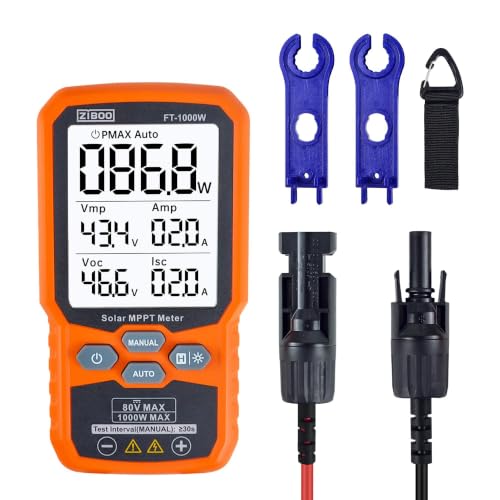
How to Build a Basic Solar Testing Toolkit
Multimeter, DC clamp, irradiance meter, PV tester, infrared thermometer, MC4 tools and the safety gear. Buy in that order.
Read More→
How to Measure Parasitic Battery Drain
Everything off, modules asleep, meter in series or a mA clamp on the cable, then pull fuses until the reading drops.
Read More→
How to Choose a Battery Capacity Tester
Conductance testers for a quick verdict on starter batteries; discharge testers for the real amp-hours on deep-cycle and lithium packs.
Read More→