As an Amazon Associate, Akermin earns from qualifying purchases. Product links on this page are affiliate links.
Select the current function (A~ for AC, A⎓ for DC) and a range above the expected current. For DC, press zero with the jaws closed on nothing. Open the jaws and close them around one conductor only, centered in the opening, with the jaws fully shut. Hold still and read. For appliance cords use a line splitter so a single conductor passes the jaws; for small currents wrap the conductor through the jaws several times and divide. Compare with the nameplate: running current near full-load amps is normal, well above indicates a problem, and inrush of several times running current for a fraction of a second is normal for motors.
Setup
- Function: AC amps or DC amps. Many clamps auto-select; check the display symbol.
- Range: auto, or a manual range above the expected current for best resolution.
- DC: with nothing in the jaws, press the zero (REL) button.
- Check the jaws close cleanly; dirt on the mating faces causes low readings.
Clamping
- One conductor only. Live and neutral together cancel to zero (or to the leakage current, on a leakage clamp).
- Center the conductor in the jaw opening; off-center readings are slightly low on some meters.
- Jaws fully closed; an air gap reads low.
- Perpendicular to the conductor where possible.
- Away from other conductors carrying large currents, which induce error.
Where to clamp
| Location | Method |
|---|---|
| Breaker in a panel | Clamp the single conductor leaving the breaker; panel opened by a qualified person |
| Appliance cord | Line splitter between plug and outlet; clamp the splitter’s single-conductor slot (×1) or the ×10 loop for small loads |
| Motor or compressor | One line at the contactor or terminal box, one phase at a time |
| Car battery | DC clamp around one battery cable; polarity shows charge or discharge |
| Solar string | DC clamp around one string conductor at the combiner |
| Lighting circuit | Single conductor at the switch or junction |
Small currents
A 400 A clamp with 0.1 A resolution cannot see 50 mA. Loop the conductor through the jaws N times and divide the reading by N; ten turns gives a tenfold reading. A ×10 line splitter does the same for cords. For parasitic drains and control circuits, a mini clamp with mA resolution is the better tool.
Inrush
Motors and compressors draw 5 to 8 times running current for about 100 ms at start. Clamps with an inrush function capture it; the reading diagnoses hard starts, failing capacitors and nuisance trips. Compare with the locked-rotor amps (LRA) on the nameplate.
Interpreting
- Near nameplate FLA/RLA under normal load: normal.
- Well above FLA: mechanical load, low voltage, failing bearings or windings, low airflow on HVAC.
- Well below expected: light load, open winding on one phase, belt slipping.
- Unbalanced phases on three-phase equipment (over 10 percent): supply or winding problem.
- Current on a ground conductor: a fault; investigate.
Convert amps to watts with the watts / volts / amps calculator, allowing for power factor on motors. See watts vs volts vs amps.
Safety
- The clamp is non-contact, but the panel or terminal box is not; open it under a safe procedure with the right PPE.
- Keep fingers behind the barrier on the jaw.
- Match the clamp’s CAT rating to the location; see what a CAT rating is.
- Use True-RMS for motor and electronic loads; see what True RMS is.
Clamp selection is in how to choose a clamp meter; the comparison with multimeters in multimeter vs clamp meter.
Recommended Tools

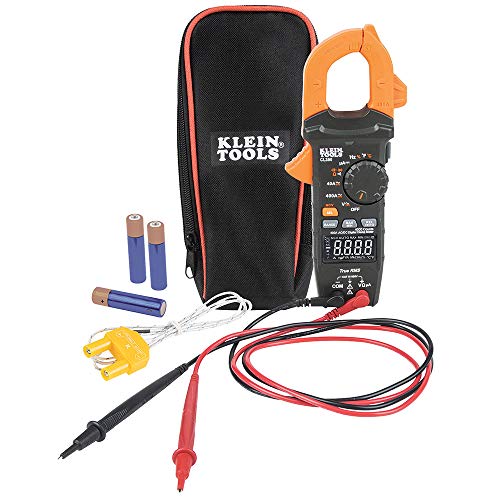

Products shown because their documented specifications fit this guide. Price and availability are on Amazon and can change.
Frequently Asked Questions
Why does my clamp meter read zero on an extension cord?
Because both conductors are inside the jaws and their currents cancel. Use a line splitter, which separates the conductors, or clamp a single wire.
Do I need to zero a clamp meter?
For DC measurements, yes, before each reading; Hall sensors drift and the earth's field registers. AC clamps do not need zeroing.
How do I measure a small current accurately?
Loop the conductor through the jaws several times and divide the reading by the number of turns. Ten turns multiplies a 50 mA current to a readable 500 mA.
Affiliate disclosure: Akermin earns a commission from qualifying Amazon purchases made through links on this page. Our editorial picks are based on documented specifications and owner feedback, not commissions.
Related Guides

Fluke 1AC II VoltAlert Review: Two Detection Thresholds in One Listing
A pocket sized non contact voltage tester whose tip glows red and beeper sounds when voltage is detected, with a continuous self test and a choice of audible or silent operation.
Read More→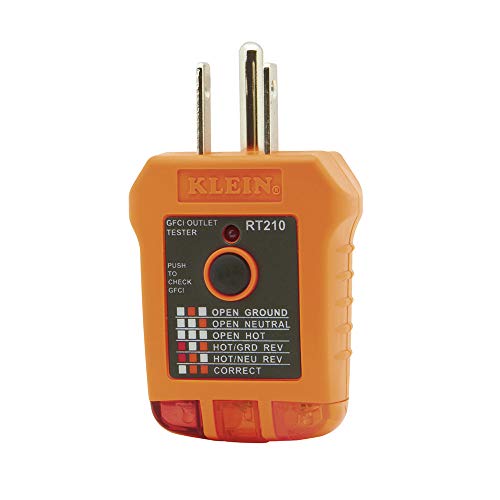
Klein Tools RT210 Review: A Fault Finder That Does Not List Its Faults
A three wire receptacle tester for standard and GFCI North American outlets, specified for 110 to 125 volts AC at 50 or 60 Hz, a 6.6 foot drop and an operating range of 32 to 140 degrees Fahrenheit.
Read More→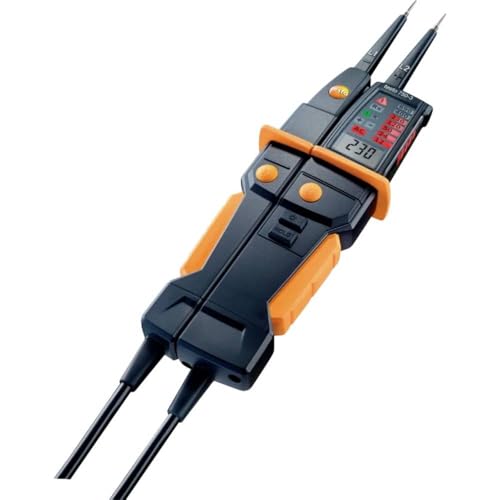
Testo 750-3 Review: Four Bullets, and No Published Category Rating
A two pole voltage tester with a three digit LCD showing measured voltage, a patented LED voltage bar viewable from any angle, polarity detection on DC and a GFCI test function for AC outlets.
Read More→