As an Amazon Associate, Akermin earns from qualifying purchases. Product links on this page are affiliate links.
A multimeter measures voltage, resistance, continuity and, on most models, capacitance, frequency and temperature, with current measured only by placing the meter in series with the circuit, which limits it to about 10 A and to circuits you can break. A clamp meter measures current by sensing the magnetic field around a single conductor inside its jaws, without disconnecting anything, at hundreds or thousands of amps, and adds basic voltage and resistance through test leads. If the question is mostly “how much current is this drawing”, buy the clamp; if it is mostly “is this live, is this open, what is this component”, buy the multimeter.
How they measure current
Multimeter: in series
Current flows through the meter’s internal shunt. That means breaking the circuit and connecting the meter across the gap, moving the lead to the amp jack, and staying under the fuse rating. It is exact and fine for a car fuse holder or a bench circuit. For a running washing machine it is neither practical nor safe. The classic mistake, leaving the leads in the amp jacks and then measuring mains voltage, blows the fuse or worse.
Clamp meter: around the conductor
A current-carrying conductor creates a magnetic field. The jaws form a core that concentrates it; a coil or Hall-effect sensor measures it. No contact, no disconnection, and ranges to 400, 600, 1000 A or more. The conductor must be alone in the jaws: clamp around a whole cord and live and neutral cancel to zero. AC-only clamps use a transformer principle; AC/DC clamps use a Hall sensor and can read DC for automotive, solar and battery work.
Side by side
| Multimeter | Clamp meter | |
|---|---|---|
| Current | In series; typically to 10 A; high resolution (mA, µA) | Non-contact; 400 to 2000 A; resolution 10 to 100 mA typical, better on mini clamps |
| Voltage | Full ranges, best resolution | Usually to 600 V, fewer ranges |
| Resistance, continuity | Full featured | Basic on most |
| Capacitance, frequency, temperature | Common | On HVAC and higher models |
| Low current (under 100 mA) | Yes | Poor, except specialist leakage clamps |
| Inrush current | No | On many models |
| Typical users | Electronics, automotive, general DIY | Electricians, HVAC, solar, energy audits |
Which for which job
- Is the outlet live? Is the fuse blown? Battery voltage? Multimeter.
- How much current is the compressor / heater / motor drawing? Clamp meter.
- Which circuit is overloaded? Clamp meter at the panel, one conductor at a time.
- Parasitic drain on a car battery? DC clamp meter around the battery lead, or multimeter in series for milliamp resolution.
- Solar string current? DC clamp meter.
- Capacitor, thermocouple, continuity of a wire? Multimeter.
- Appliance energy use over a day? Neither; a plug-in power meter logs kWh. See plug-in vs whole-home energy monitor.
Specifications that matter for both
True RMS for distorted loads (see what True RMS is), a CAT rating that matches where you will use it (see what a CAT rating is), and non-contact voltage detection as a first check. For clamp meters add jaw size (does it fit the cable?) and whether DC is needed. Multimeters are compared in best multimeters for home and DIY; clamp meters in the energy and electrical testing category.
Recommended Tools

Fluke 117 Digital Multimeter, Non-Contact AC Voltage Detection, Measures Resistance/Continuity/Frequency/Capacitance/Min
View on Amazon
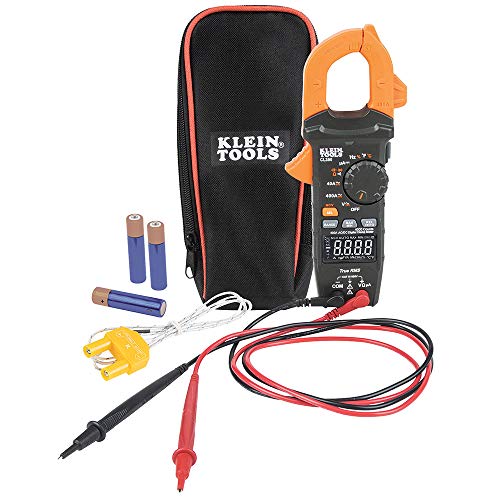
Products shown because their documented specifications fit this guide. Price and availability are on Amazon and can change.
Frequently Asked Questions
Can a clamp meter measure voltage?
Most can, using test leads like a multimeter, though often with fewer ranges and lower resolution. The clamp is for current; the leads handle voltage, resistance and continuity.
Can a multimeter measure current in an appliance?
Only by breaking the circuit and inserting the meter in series, up to its fused limit (usually 10 A). For mains appliances that is impractical and risky; use a clamp meter or a plug-in power meter.
Why does the clamp read zero around an appliance cord?
A cord carries live and neutral together, and their currents cancel. Clamp around one conductor only, or use a line splitter that separates them.
Affiliate disclosure: Akermin earns a commission from qualifying Amazon purchases made through links on this page. Our editorial picks are based on documented specifications and owner feedback, not commissions.
Related Guides

Fluke 1AC II VoltAlert Review: Two Detection Thresholds in One Listing
A pocket sized non contact voltage tester whose tip glows red and beeper sounds when voltage is detected, with a continuous self test and a choice of audible or silent operation.
Read More→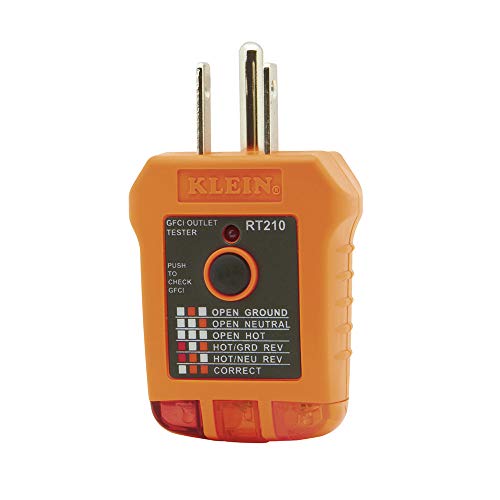
Klein Tools RT210 Review: A Fault Finder That Does Not List Its Faults
A three wire receptacle tester for standard and GFCI North American outlets, specified for 110 to 125 volts AC at 50 or 60 Hz, a 6.6 foot drop and an operating range of 32 to 140 degrees Fahrenheit.
Read More→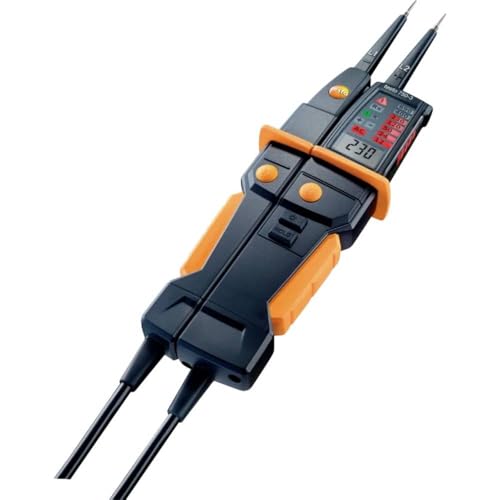
Testo 750-3 Review: Four Bullets, and No Published Category Rating
A two pole voltage tester with a three digit LCD showing measured voltage, a patented LED voltage bar viewable from any angle, polarity detection on DC and a GFCI test function for AC outlets.
Read More→