As an Amazon Associate, Akermin earns from qualifying purchases. Product links on this page are affiliate links.
A CAT rating (measurement category) tells you where in an electrical installation a meter can be safely used, based on the size of transient voltage spike that location can produce. CAT II is plug-in equipment and outlets; CAT III is fixed wiring, distribution panels and outlets near them; CAT IV is the service entrance and utility side. Each category has a voltage (300, 600, 1000 V) that sets the working voltage the rating applies to. A CAT III 600 V meter is designed to survive a 6,000 V transient; a CAT II 600 V meter only 4,000 V. The category, not the voltage, is the number that keeps you safe at a panel.
Why transients matter
Lightning, motor switching and utility faults put brief spikes of thousands of volts onto wiring. Close to the source they are large; further into the building, wiring impedance and branch circuits absorb them. A meter whose inputs, spacing and insulation cannot withstand the spike at its location can flash over internally, and the resulting arc, fed by the available fault current, is what injures people. The categories are defined in IEC 61010 to match meter design to the spike energy at each location.
The categories
| Category | Location | Examples | Transient (at 600 V rating) |
|---|---|---|---|
| CAT I | Circuits not directly connected to mains | Battery devices, protected electronics | 2,500 V |
| CAT II | Plug-in equipment and outlets far from the panel | Appliances, portable tools, long branch circuits | 4,000 V |
| CAT III | Fixed installation | Distribution panels, breakers, fixed wiring, outlets near the panel, motors, lighting circuits | 6,000 V |
| CAT IV | Origin of the installation | Service entrance, meter, overhead and underground lines, primary protection | 8,000 V |
Reading a rating
“CAT III 600 V / CAT IV 300 V” means the meter is safe on CAT III circuits up to 600 V and on CAT IV circuits up to 300 V. A higher category at a lower voltage is normal. Compare within a category: CAT III 1000 V is more robust than CAT III 600 V. Across categories, a higher category at a given voltage always wins.
What is not a CAT rating
- A “600 V” or “1000 V” maximum input alone. That is a working voltage, not a transient rating.
- Marketing terms like “professional grade”.
- A rating printed on the meter that the maker never had tested. Independent certification marks (UL, CSA, TÜV, ETL) indicate testing; self-declared CE marks do not.
Leads and accessories
The chain is only as safe as its weakest part. Leads, probes, alligator clips and clamp accessories each carry a rating. Probe caps that limit exposed tip length are what make many leads CAT III; remove the cap and they drop to CAT II. Keep the caps on for panel work.
Which rating you need
- Bench electronics, batteries, automotive: CAT I or II is adequate.
- Household outlets and appliances: CAT II 300 V minimum; CAT III 600 V is the sensible default because you will eventually open the panel.
- Distribution panels, fixed wiring, HVAC, motors: CAT III 600 V.
- Three-phase industrial distribution: CAT III 1000 V or CAT IV 600 V.
- Service entrance, utility work, solar DC combiners: CAT IV 600 V; solar clamps are often CAT III 1500 V DC.
Meters and their ratings are listed in best multimeters for home and DIY. For the other specification that matters, see what True RMS is.
Recommended Tools

Fluke 117 Digital Multimeter, Non-Contact AC Voltage Detection, Measures Resistance/Continuity/Frequency/Capacitance/Min
View on Amazon
Products shown because their documented specifications fit this guide. Price and availability are on Amazon and can change.
Frequently Asked Questions
What CAT rating do I need for household work?
CAT III 600 V covers the distribution panel, fixed wiring and outlets in a typical home. CAT II is enough only for plug-in equipment and outlets away from the panel.
Is CAT II 1000 V better than CAT III 600 V?
No. The category matters more than the voltage. CAT III 600 V is rated for larger transients than CAT II 1000 V and is the safer meter at a panel.
Do test leads have a CAT rating too?
Yes, and the lowest rating in the chain (meter, leads, probes, clips) is the rating you actually have. Leads with removable caps are often CAT III with the cap on and CAT II with it off.
Affiliate disclosure: Akermin earns a commission from qualifying Amazon purchases made through links on this page. Our editorial picks are based on documented specifications and owner feedback, not commissions.
Related Guides

Fluke 1AC II VoltAlert Review: Two Detection Thresholds in One Listing
A pocket sized non contact voltage tester whose tip glows red and beeper sounds when voltage is detected, with a continuous self test and a choice of audible or silent operation.
Read More→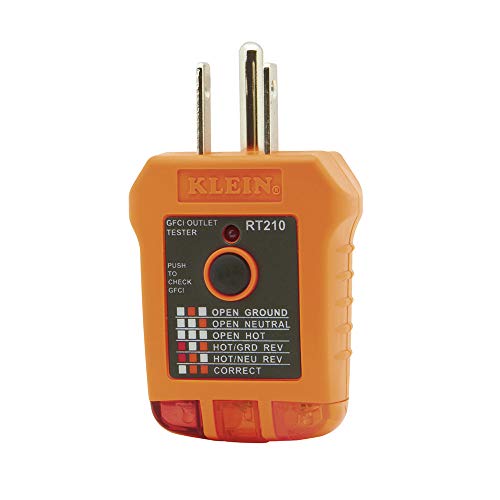
Klein Tools RT210 Review: A Fault Finder That Does Not List Its Faults
A three wire receptacle tester for standard and GFCI North American outlets, specified for 110 to 125 volts AC at 50 or 60 Hz, a 6.6 foot drop and an operating range of 32 to 140 degrees Fahrenheit.
Read More→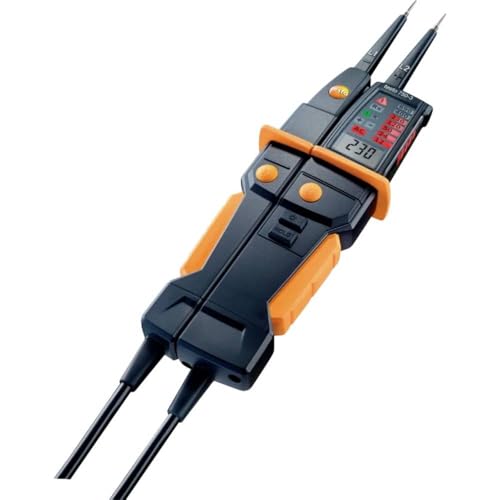
Testo 750-3 Review: Four Bullets, and No Published Category Rating
A two pole voltage tester with a three digit LCD showing measured voltage, a patented LED voltage bar viewable from any angle, polarity detection on DC and a GFCI test function for AC outlets.
Read More→