As an Amazon Associate, Akermin earns from qualifying purchases. Product links on this page are affiliate links.
A plug-in energy monitor measures one appliance at a time: watts now, kWh accumulated, sometimes cost, from an outlet. A whole-home monitor uses current clamps on the mains and, on better models, on individual circuits inside the panel, and reports the house’s consumption continuously to an app. The plug-in meter is cheap, needs no installation and gives exact figures for the things you can unplug. The whole-home monitor covers hard-wired loads (heating, cooling, water heater, oven, EV charger) and shows patterns over time, at the cost of a panel installation.
Side by side
| Plug-in meter | Whole-home monitor | |
|---|---|---|
| Measures | One outlet load | Whole house; per circuit with extra clamps |
| Install | Plug in | Clamps and power feed inside the panel; often licensed work |
| Hard-wired loads (HVAC, water heater, oven, EV) | No | Yes |
| Accuracy | 1 to 3% typical | 1 to 2% with correctly sized clamps |
| Data | On the display; some log to an app | Continuous cloud or local logging, charts, alerts |
| Solar and battery | No | Yes, with additional clamps on the solar feed |
| Cost | Low | Moderate plus installation |
| Best for | Finding what a specific device uses; checking standby; renters | Understanding the whole bill; hard-wired loads; solar owners; time-of-use tariffs |
What a plug-in meter tells you
Instantaneous watts, volts, amps, power factor and accumulated kWh. Leave it on a refrigerator for a week and you have the real average, not the nameplate. Leave it on the entertainment center overnight and you have the standby figure. Basic models (P3 Kill A Watt and similar) show numbers on a display; smart plugs with energy monitoring send them to an app and can switch the load. See standby power explained.
What a whole-home monitor tells you
The house’s consumption second by second, which reveals the shape of the day: the morning shower spike from the water heater, the afternoon air conditioning, the overnight baseline. Per-circuit clamps (Emporia Vue, Sense with disaggregation, IoTaWatt, Shelly EM and others) attribute it to circuits: kitchen, HVAC, garage, EV. Solar owners see generation, consumption and export together. Time-of-use tariff customers see what runs in peak hours.
Accuracy notes
- Clamps must match the conductor: a 200 A clamp on a 15 A circuit reads coarsely at low loads. Use small clamps for branch circuits.
- Clamp direction matters for solar and bidirectional flows.
- Disaggregation (guessing appliances from the aggregate signal) is clever and often wrong for similar loads; per-circuit clamps are reliable.
- Plug-in meters on very low loads may read zero or wander; a few tenths of a watt is below many meters’ floor.
Which to buy
- Renters, one-off questions, standby hunting: plug-in meter.
- Homeowners with electric heating, cooling, water heating or an EV: whole-home, since those loads are hard-wired and dominate.
- Solar owners: whole-home with solar clamps, unless the inverter app already covers it.
- Energy audits: both; the whole-home monitor finds the big circuits, the plug-in meter pins down individual devices.
For the arithmetic once you have the numbers, see what a kilowatt-hour is and the electricity cost calculator. Clamp meters, which measure current the same way as a whole-home monitor’s sensors, are covered in multimeter vs clamp meter.
Recommended Tools

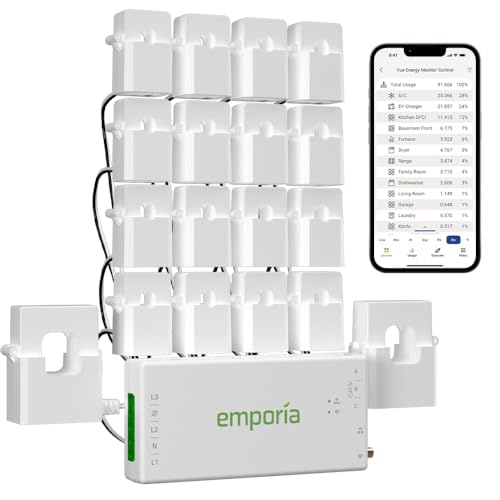
Products shown because their documented specifications fit this guide. Price and availability are on Amazon and can change.
Frequently Asked Questions
Can a whole-home monitor see individual appliances?
By circuit, if it has per-circuit clamps (typically 8 to 16). Some use load disaggregation to guess appliances from the whole-house signal; that is approximate.
Do I need an electrician for a whole-home monitor?
The clamps go inside the panel around the mains and circuit conductors, and the unit needs a power connection from a breaker. In most jurisdictions that is licensed electrical work.
How accurate are plug-in meters?
Good ones are within 1 to 2 percent for resistive loads and a few percent for electronics with low power factor. Very low standby loads (under 1 W) are at the limit of many meters.
Affiliate disclosure: Akermin earns a commission from qualifying Amazon purchases made through links on this page. Our editorial picks are based on documented specifications and owner feedback, not commissions.
Related Guides

Fluke 1AC II VoltAlert Review: Two Detection Thresholds in One Listing
A pocket sized non contact voltage tester whose tip glows red and beeper sounds when voltage is detected, with a continuous self test and a choice of audible or silent operation.
Read More→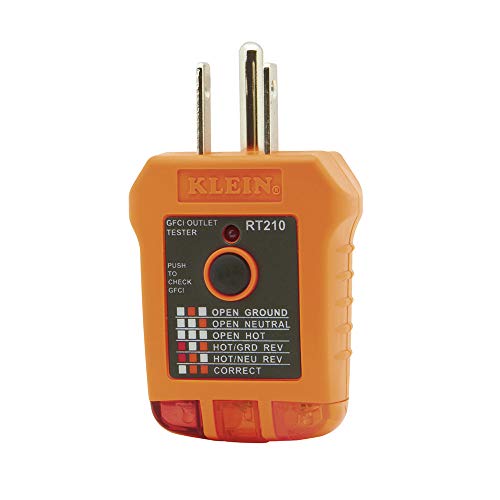
Klein Tools RT210 Review: A Fault Finder That Does Not List Its Faults
A three wire receptacle tester for standard and GFCI North American outlets, specified for 110 to 125 volts AC at 50 or 60 Hz, a 6.6 foot drop and an operating range of 32 to 140 degrees Fahrenheit.
Read More→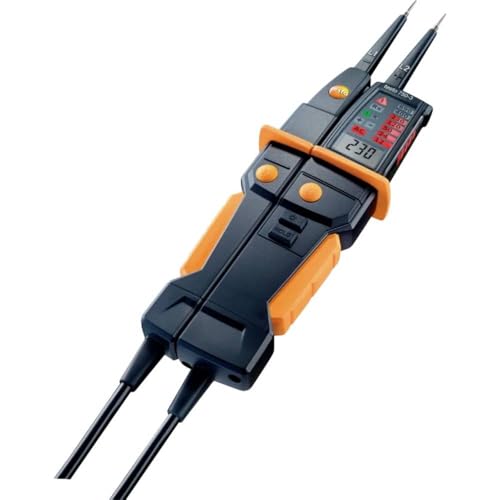
Testo 750-3 Review: Four Bullets, and No Published Category Rating
A two pole voltage tester with a three digit LCD showing measured voltage, a patented LED voltage bar viewable from any angle, polarity detection on DC and a GFCI test function for AC outlets.
Read More→