As an Amazon Associate, Akermin earns from qualifying purchases. Product links on this page are affiliate links.
Choose a clamp meter by deciding four things. AC or AC/DC: DC (Hall-effect) clamps are needed for automotive, solar and battery work; AC-only suits household and commercial mains. Jaw size: 25 to 30 mm for household cables, larger for feeders, or a flexible probe for bus bars. True-RMS and a CAT rating matched to the location (CAT III 600 V for panels). Then the functions: voltage and resistance through leads, inrush capture for motors, temperature for HVAC, low-current resolution for control circuits, and wireless logging for reports.
Step 1: AC or AC/DC
| AC clamp (transformer) | AC/DC clamp (Hall effect) | |
|---|---|---|
| Measures | AC current only | AC and DC current |
| Low-current accuracy | Slightly better | Needs a zero before each DC reading |
| Uses | Household, commercial, HVAC AC loads | Automotive, solar, batteries, DC drives, plus all AC uses |
| Examples | Fluke 323, Fluke 302+ | Fluke 325, Klein CL390, Extech EX655 |
Step 2: Range and resolution
400 A covers household and light commercial; 600 to 1000 A for feeders and industrial; 2000 A with flex probes for large plant. Resolution at the low end matters for control circuits and standby loads: a 400 A clamp with 0.1 A resolution cannot see a 50 mA drain; mini clamps (Extech 380942 class) resolve 1 mA or better. Leakage clamps go to microamps for earth-leakage work.
Step 3: Jaw and probe
- Jaw opening: measure the largest conductor you will clamp; add margin.
- Jaw shape: slim jaws reach into crowded panels.
- Flexible current probes (Fluke iFlex and equivalents): wrap around bus bars and bundles the jaw cannot.
- A line splitter separates the conductors of a plug-in appliance cord and often includes a ×10 loop for small currents.
Step 4: True-RMS and safety
Motor loads, drives and electronics distort current waveforms far more than voltage; True-RMS is essential on a clamp. The CAT rating must suit the location: CAT III 600 V for panels, CAT IV 600 V for service entrance, CAT III 1500 V DC for solar strings. See what True RMS is and what a CAT rating is.
Step 5: Functions
| Function | Who uses it |
|---|---|
| AC/DC voltage, resistance, continuity via leads | Everyone; the clamp doubles as a basic multimeter |
| Inrush current | Motors, compressors, tripping breakers |
| Temperature (K-type) | HVAC |
| Capacitance | HVAC (run capacitors) |
| Frequency | Drives, generators |
| Non-contact voltage | Safety first check |
| Min/max/hold, backlight | Everyone |
| Wireless logging (Fluke Connect and similar) | Reports, remote reading from outside the arc-flash boundary |
| Power (kW, PF) | Energy audits; power clamps |
Picks by trade
- Homeowner and electrician, residential: AC True-RMS 400 A with NCV; see how to measure current with a clamp meter.
- HVAC: AC/DC with temperature, capacitance and inrush; see choosing a clamp meter for HVAC.
- Solar: DC clamp rated CAT III 1500 V with polarity indication; see choosing a clamp meter for solar PV.
- Automotive: AC/DC with mA resolution for parasitic drain.
- Industrial: 1000 A or flex probe, CAT IV, logging.
The general comparison with multimeters is in multimeter vs clamp meter; clamp meters are covered in the energy and electrical testing category.
Recommended Tools


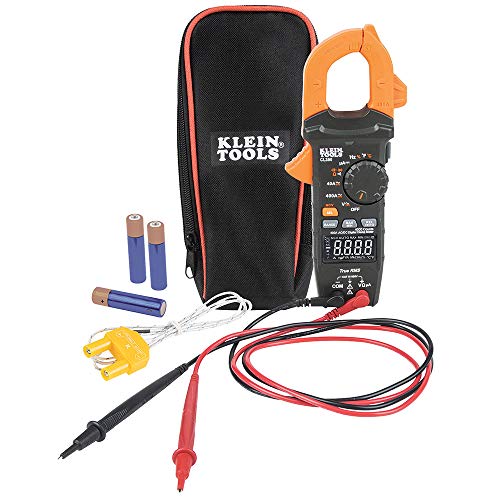

Products shown because their documented specifications fit this guide. Price and availability are on Amazon and can change.
Frequently Asked Questions
Do I need an AC/DC clamp meter?
For automotive, solar, battery and any DC circuit, yes. For household and commercial AC work, an AC-only clamp is cheaper and slightly more accurate at low currents.
What jaw size do I need?
25 to 30 mm covers household cables and most branch circuits; 35 to 40 mm for service entrance and larger feeders; a flexible current probe (iFlex type) for bus bars and bundles.
Why does the clamp read zero around a power cord?
Live and neutral in the cord carry equal and opposite currents that cancel. Clamp one conductor only, or use a line splitter.
Affiliate disclosure: Akermin earns a commission from qualifying Amazon purchases made through links on this page. Our editorial picks are based on documented specifications and owner feedback, not commissions.
Related Guides

Fluke 1AC II VoltAlert Review: Two Detection Thresholds in One Listing
A pocket sized non contact voltage tester whose tip glows red and beeper sounds when voltage is detected, with a continuous self test and a choice of audible or silent operation.
Read More→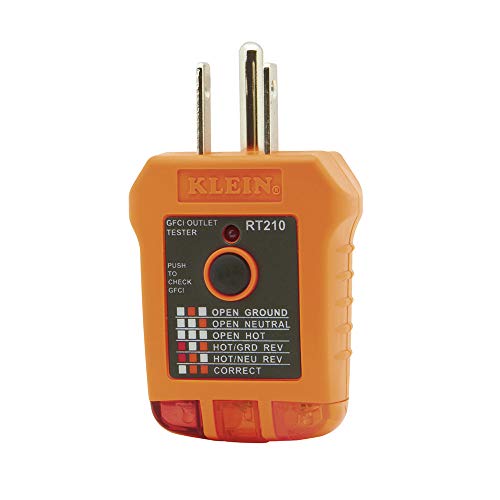
Klein Tools RT210 Review: A Fault Finder That Does Not List Its Faults
A three wire receptacle tester for standard and GFCI North American outlets, specified for 110 to 125 volts AC at 50 or 60 Hz, a 6.6 foot drop and an operating range of 32 to 140 degrees Fahrenheit.
Read More→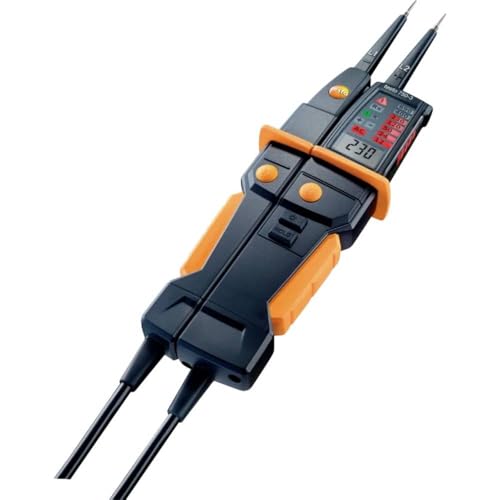
Testo 750-3 Review: Four Bullets, and No Published Category Rating
A two pole voltage tester with a three digit LCD showing measured voltage, a patented LED voltage bar viewable from any angle, polarity detection on DC and a GFCI test function for AC outlets.
Read More→