As an Amazon Associate, Akermin earns from qualifying purchases. Product links on this page are affiliate links.
Volts (V) measure electrical pressure, the push that drives current. Amps (A) measure current, the rate at which charge flows. Watts (W) measure power, the rate at which energy is delivered, and for DC and simple AC loads watts equal volts times amps. A 120 V circuit carrying 10 A delivers 1,200 W. Volts are set by the supply, amps by what the load demands, and watts is what you pay for over time as kilowatt-hours.
The water analogy
Think of a pipe. Voltage is the water pressure; current is the flow rate in liters per second; power is pressure times flow, the rate at which the water can do work. A narrow pipe (high resistance) passes less flow for the same pressure; a wide one passes more. Double the pressure through the same pipe and the flow doubles. The analogy breaks down eventually, but it carries the essential relationships.
The formulas
- Power: P = V × I (watts = volts × amps)
- Ohm’s law: V = I × R (volts = amps × ohms)
- Combined: P = I² × R and P = V² ÷ R
- AC with power factor: P = V × I × PF
The watts / volts / amps calculator solves any of these from two known values.
Worked examples
| Situation | Volts | Amps | Watts |
|---|---|---|---|
| Kettle on 230 V mains | 230 | 13 | 3,000 |
| Space heater on 120 V mains | 120 | 12.5 | 1,500 |
| Phone charger output | 5 | 2 | 10 |
| Car headlight bulb | 12 | 4.6 | 55 |
| Solar panel at maximum power | 36 | 11 | 400 |
| LED bulb | 230 | 0.04 | 9 |
Why each number matters
- Volts decide compatibility. A 120 V appliance on 230 V draws far too much current and fails; a 230 V appliance on 120 V underperforms. Battery systems are 12, 24 or 48 V and everything must match.
- Amps decide cable and fuse size. Cables heat in proportion to current squared, so the current rating, not the wattage, sizes the wire and the breaker. A 15 A circuit is a 15 A circuit whatever the voltage.
- Watts decide capacity and cost. An inverter is rated in watts; a generator in watts; the electricity bill in watt-hours. See what a kilowatt-hour is.
Power factor
For AC loads that are not purely resistive (motors, transformers, most electronics), current and voltage are out of step and volts times amps overstates the real power. The ratio is the power factor, typically 0.6 to 0.95. A motor drawing 5 A at 230 V with a power factor of 0.8 uses 920 W of real power but the circuit must carry the full 5 A. Cables and breakers are sized on amps; bills are charged on watts.
Measuring each
- Volts: a multimeter across the two points.
- Amps: a clamp meter around one conductor, or a multimeter in series for small currents. See multimeter vs clamp meter.
- Watts: a plug-in power meter, which measures both and multiplies them correctly with power factor. See plug-in vs whole-home energy monitors.
For how much a device costs to run, see how much electricity a 100-watt device uses.
Recommended Tools

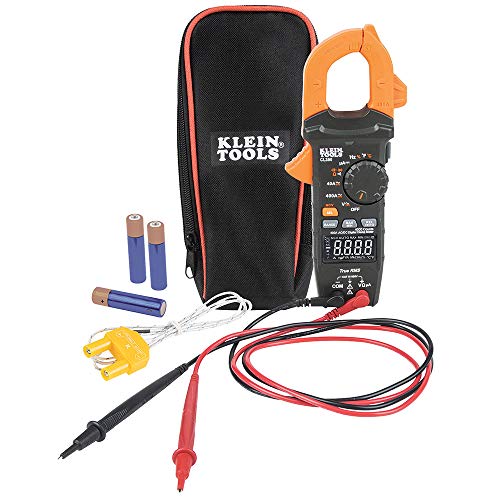
Products shown because their documented specifications fit this guide. Price and availability are on Amazon and can change.
Frequently Asked Questions
How do I convert amps to watts?
Multiply by the voltage: 10 A at 120 V is 1,200 W; 10 A at 230 V is 2,300 W. For AC loads with motors or electronics, multiply by the power factor as well.
How many amps does a 1,500 W heater draw?
About 12.5 A at 120 V or 6.5 A at 230 V. On a 15 A circuit at 120 V that leaves little margin for anything else.
What is a kilowatt-hour then?
Energy: power multiplied by time. A 1,000 W device running for one hour uses 1 kWh, which is what the electricity meter counts.
Affiliate disclosure: Akermin earns a commission from qualifying Amazon purchases made through links on this page. Our editorial picks are based on documented specifications and owner feedback, not commissions.
Related Guides

Fluke 1AC II VoltAlert Review: Two Detection Thresholds in One Listing
A pocket sized non contact voltage tester whose tip glows red and beeper sounds when voltage is detected, with a continuous self test and a choice of audible or silent operation.
Read More→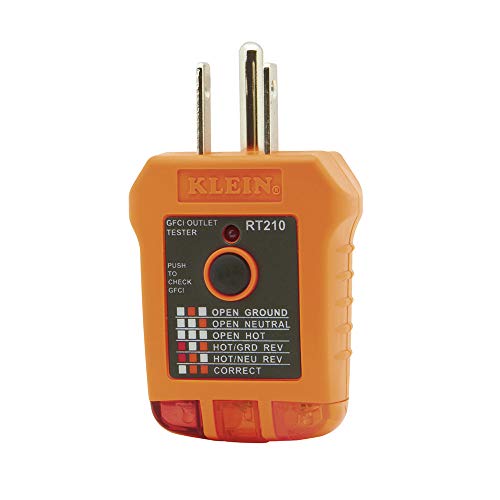
Klein Tools RT210 Review: A Fault Finder That Does Not List Its Faults
A three wire receptacle tester for standard and GFCI North American outlets, specified for 110 to 125 volts AC at 50 or 60 Hz, a 6.6 foot drop and an operating range of 32 to 140 degrees Fahrenheit.
Read More→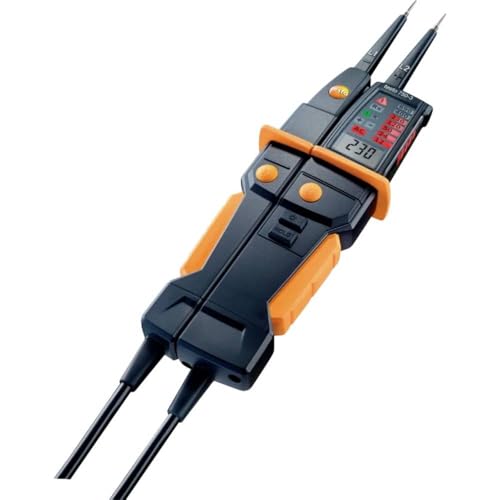
Testo 750-3 Review: Four Bullets, and No Published Category Rating
A two pole voltage tester with a three digit LCD showing measured voltage, a patented LED voltage bar viewable from any angle, polarity detection on DC and a GFCI test function for AC outlets.
Read More→