As an Amazon Associate, Akermin earns from qualifying purchases. Product links on this page are affiliate links.
Choose by what the battery does. For starter batteries (cars, boats, generators), a conductance tester (TOPDON BT100, ANCEL BA101 class) gives state of health, cold-cranking amps and a charging-system check in seconds without stressing the battery. For deep-cycle, solar, RV and lithium batteries, where amp-hours matter, choose a discharge capacity tester that draws a set current to a cutoff voltage and totals the amp-hours; it takes hours and gives the true figure. Check chemistry support, voltage range (6, 12, 24, 48 V) and current capability before buying.
Tester types
| Type | Measures | Time | Best for | Limits |
|---|---|---|---|---|
| Conductance / internal resistance | Health (%), CCA estimate, internal resistance; alternator and starter tests | Seconds | Starter batteries: flooded, AGM, gel, EFB | Estimates, not capacity; unreliable on lithium |
| Carbon-pile or electronic load tester | Voltage under a heavy fixed load | Seconds | Starter batteries; workshop use | Stresses the battery; crude pass/fail |
| Discharge capacity tester | Amp-hours and watt-hours to cutoff | Hours | Deep-cycle, solar, RV, lithium packs, cells | Slow; battery must be recharged after |
| Battery analyzer (charge-discharge) | Capacity with automatic recharge; cycles | Hours | Small packs, cells, drone and tool batteries | Current limits; cost |
| Coulomb-counting monitor (installed) | Ongoing state of charge and capacity trend | Continuous | Off-grid and marine systems | Needs a shunt install; see battery monitors |
What to check
- Chemistry: flooded, AGM, gel, EFB, LiFePO4, lithium-ion; conductance testers need the correct selection.
- Voltage range: 12 V only, or 6/12/24/48 V.
- Current: discharge testers are rated in amps and watts; a 100 Ah battery at a 0.1C test needs 10 A for 10 hours.
- Cutoff voltage: adjustable, to match chemistry (10.5 V lead-acid, 10 to 11 V LiFePO4 at 12 V nominal).
- Cranking amps standards: CCA, CA, MCA, EN, DIN, JIS on conductance testers.
- Extras: alternator ripple, starter voltage drop, printing or app export, reverse-polarity protection.
Picks by use
| Use | Choose |
|---|---|
| Car, motorcycle, boat starter batteries | Conductance tester with CCA standards and charging-system test |
| Workshop with many vehicles | Conductance tester with printer or app; a load tester for confirmation |
| RV, boat house bank, solar storage | Discharge capacity tester sized for the bank, or an installed shunt monitor |
| Lithium packs and cells | Discharge tester or charge-discharge analyzer with the right cutoffs |
| Small cells (AA, 18650) | Cell analyzer or a small discharge tester (HiLetgo class) |
Running a discharge test
- Charge fully and rest.
- Set the discharge current (0.05C to 0.2C is typical: 5 to 20 A for a 100 Ah battery) and the cutoff voltage for the chemistry.
- Run to cutoff; record amp-hours and time.
- Compare with the rated capacity at that rate; below 80 percent is generally end of life for lead-acid, and many lithium makers use the same threshold.
- Recharge immediately; lead-acid left discharged sulfates.
A multimeter covers the quick checks that precede any of this; see how to test a 12 V battery with a multimeter. The complete kit is in how to build a basic solar testing toolkit.
Recommended Tools

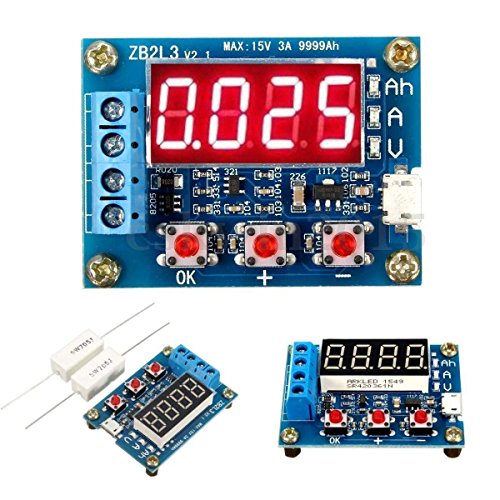
Products shown because their documented specifications fit this guide. Price and availability are on Amazon and can change.
Frequently Asked Questions
What is the difference between a conductance tester and a load tester?
A conductance tester sends a small AC signal and infers internal resistance and health; it is fast and safe. A load tester draws a heavy current and watches voltage sag; it is direct but stresses the battery. Both judge starter batteries; neither measures amp-hours.
How do I measure the real capacity of a deep-cycle battery?
Charge it fully, then discharge through a capacity tester or a known load at a set current until the cutoff voltage, recording amp-hours. It takes hours and is the only true measurement.
Do these testers work on lithium batteries?
Conductance testers give unreliable results on lithium. Discharge testers work on any chemistry within their voltage and current range, provided the cutoff voltage is set correctly.
Affiliate disclosure: Akermin earns a commission from qualifying Amazon purchases made through links on this page. Our editorial picks are based on documented specifications and owner feedback, not commissions.
Related Guides

UNI-T UT503PV Review: A DC 1000 V Headline on a CAT III 600 V Body
A solar insulation resistance tester that works on energised PV strings up to DC 1000 V, with test voltages of 125, 250, 500 and 1000 V, a range to 4000 megohms, automatic discharge, 1000 stored result sets and USB or Bluetooth transfer.
Read More→
ANCEL BA101 Review: The Exclusion List Is the Most Useful Bullet
A 12 volt battery, cranking and charging system tester covering 100 to 2000 CCA that reports state of health, state of charge, voltage, current and CCA, drawing its own power from the battery under test.
Read More→
Tenmars Solar Power Meter Review: One Accuracy Figure, Two Very Different Jobs
A handheld solar irradiance meter reading 0 to 1999 watts per square metre or 0 to 634 BTU per square foot per hour, with a selectable 199.9 or 1999 scale, maximum and minimum tracking, data hold and manual zeroing.
Read More→