As an Amazon Associate, Akermin earns from qualifying purchases. Product links on this page are affiliate links.
Measure operating current with a DC clamp meter around one panel or string conductor while the system runs; zero the clamp first and note polarity. Measure short-circuit current (Isc) only on a single panel whose Isc is below the multimeter’s fused range: isolate the panel, set the meter to 10 A DC with the lead in the amp jack, connect across the panel leads briefly in sunlight, read, and disconnect. Never do this on a string. In both cases read irradiance at the same moment; current scales with it, and a panel at half sun giving half its rated current is healthy.
Operating current with a clamp
- Select DC amps; zero the clamp with the jaws closed on nothing.
- Clamp one conductor: the positive or negative lead of a panel, a string at the combiner, or a battery cable.
- Read; the sign shows direction relative to the jaw arrow.
- Read irradiance at the same time.
- Compare strings against each other and against the expectation: Imp × (irradiance ÷ 1,000).
See how to measure current with a clamp meter and choosing a clamp meter for solar PV.
Short-circuit current with a multimeter (small panels only)
- Confirm the panel’s Isc from the label is below the meter’s fused rating (usually 10 A).
- Isolate the panel from everything else.
- Set DC amps, 10 A range; move the red lead to the 10 A jack.
- In full sun, connect the meter across the panel leads: the meter is now the short circuit. Read within a few seconds.
- Disconnect. Move the lead back to the volt jack before any voltage measurement.
Isc is almost exactly proportional to irradiance and barely affected by temperature, so Isc ÷ (irradiance ÷ 1,000) should match the label within about 5 percent. A low Isc at known irradiance means soiling, shading, a damaged cell or, on bifacial panels, different rear illumination.
Interpreting current
| Observation | Meaning |
|---|---|
| Current proportional to irradiance, near label at 1,000 W/m² | Healthy |
| Current low at known irradiance, Voc normal | Soiling, uniform shading, degraded cells |
| One string well below others under the same sun | Shading, a failed panel or a bad connection in that string |
| Operating current normal but power low | Voltage side: a bypassed sub-string or mismatch; check Vmp |
| Current fluctuating with clouds | Normal; pair readings with irradiance moment by moment |
| Zero current with normal Voc | Open circuit under load: a failed connector or an inverter not tracking |
Safety
- Never break a DC circuit under load; the arc sustains. Isolate at the disconnect before touching connectors.
- Never put a multimeter in series with a string; the current and voltage exceed its protection and opening the circuit arcs.
- Clamp meters read through insulation and avoid both hazards; they are the correct tool for anything beyond a single small panel.
- Use meters, leads and clamps rated CAT III at the working voltage.
Combine current with voltage and irradiance for the full picture; see how to measure solar panel output and solar irradiance vs panel output. MPPT testers do the current and voltage sweep in one step; see best solar panel testers.
Recommended Tools
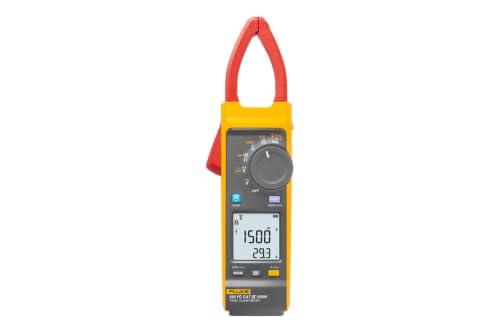
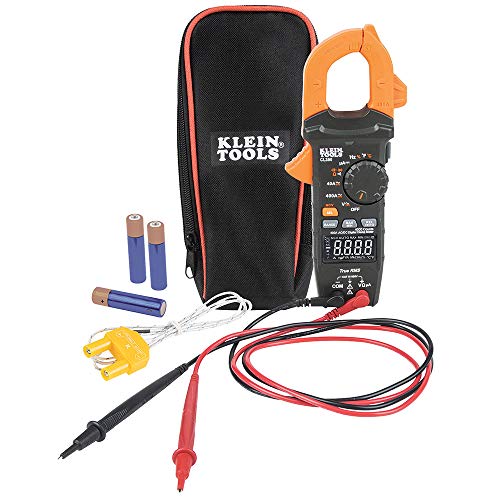
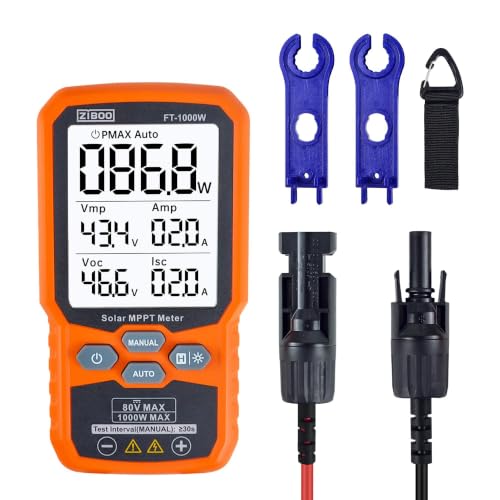
Products shown because their documented specifications fit this guide. Price and availability are on Amazon and can change.
Frequently Asked Questions
Is it safe to short a solar panel to measure Isc?
A single module is designed to tolerate its own short-circuit current, and measuring Isc through a fused 10 A multimeter is standard practice for panels under that current. Do not do it on strings or on panels above the meter's fuse rating; use a clamp.
Why is my current far below the label?
Current is proportional to irradiance. A panel rated 10 A Isc at 1,000 W/m² gives 5 A at 500 W/m². Measure irradiance at the same time before judging the panel.
Which clamp meter do I need?
A Hall-effect AC/DC clamp. For strings above 600 V, a solar-rated clamp with a CAT III 1000 or 1500 V rating; for 12 to 48 V systems, any AC/DC clamp with the right range.
Affiliate disclosure: Akermin earns a commission from qualifying Amazon purchases made through links on this page. Our editorial picks are based on documented specifications and owner feedback, not commissions.
Related Guides

UNI-T UT503PV Review: A DC 1000 V Headline on a CAT III 600 V Body
A solar insulation resistance tester that works on energised PV strings up to DC 1000 V, with test voltages of 125, 250, 500 and 1000 V, a range to 4000 megohms, automatic discharge, 1000 stored result sets and USB or Bluetooth transfer.
Read More→
ANCEL BA101 Review: The Exclusion List Is the Most Useful Bullet
A 12 volt battery, cranking and charging system tester covering 100 to 2000 CCA that reports state of health, state of charge, voltage, current and CCA, drawing its own power from the battery under test.
Read More→
Tenmars Solar Power Meter Review: One Accuracy Figure, Two Very Different Jobs
A handheld solar irradiance meter reading 0 to 1999 watts per square metre or 0 to 634 BTU per square foot per hour, with a selectable 199.9 or 1999 scale, maximum and minimum tracking, data hold and manual zeroing.
Read More→