As an Amazon Associate, Akermin earns from qualifying purchases. Product links on this page are affiliate links.
Solar panel output rises almost in proportion to irradiance: halve the sunlight and the power roughly halves. The panel’s rated power is its output at 1,000 W/m² and 25 °C cell temperature. In the field the irradiance is usually lower, the cells are usually hotter (each degree above 25 °C costs about 0.3 to 0.4 percent), and soiling, shading, angle and wiring take a few percent more. Expected output is therefore rating × (irradiance ÷ 1,000) × temperature factor × system losses, and a healthy panel lands within about 10 percent of that.
The conversion
A panel converts a fraction of the irradiance on its area into electricity; that fraction is its efficiency, 19 to 23 percent for current crystalline modules. A 2 m² panel at 20 percent efficiency under 1,000 W/m² produces 400 W, which is its rating. See what solar irradiance is.
How output tracks irradiance
- Current is nearly exactly proportional to irradiance. Half the light, half the amps.
- Voltage is almost independent of irradiance above a few hundred W/m²; it depends mainly on temperature.
- Power is therefore close to proportional, with a slight efficiency loss below about 200 W/m².
What reduces it
| Factor | Typical effect |
|---|---|
| Cell temperature above 25 °C | −0.3 to −0.4% per °C; −10 to −15% on a hot roof |
| Soiling (dust, pollen, bird droppings) | −2 to −5% typical; far more in dusty or dry regions |
| Shading, even partial | −10 to −50%; one shaded cell can drop a whole string |
| Angle of incidence and reflection | −2 to −5% away from noon; more at low sun |
| Mismatch between panels in a string | −1 to −3% |
| Wiring and connector resistance | −1 to −3% |
| Inverter conversion | −2 to −4% |
| Age (degradation) | −0.3 to −0.7% per year |
Worked example
A 400 W panel, irradiance measured at 780 W/m² in the plane of the array, panel back temperature 48 °C (cell about 51 °C), temperature coefficient −0.35 %/°C.
- Irradiance scaling: 400 × 0.78 = 312 W.
- Temperature: 26 °C above 25 °C × 0.35% = 9.1% loss → 312 × 0.909 = 284 W.
- Allow 3 to 5% for soiling and wiring → about 270 to 275 W expected.
A tester reading 265 W is healthy; 220 W suggests soiling, shading or a fault worth investigating. See how to measure solar panel output.
Over a day and a year
Because output tracks irradiance, daily energy tracks insolation. Multiply system size by peak sun hours and a loss factor (commonly 0.75 to 0.85) for daily kWh. The solar output estimator does this. Why the curve rises and falls through the day is covered in why solar panel output changes during the day. Instruments for both sides of the comparison are in best solar panel testers.
Recommended Tools

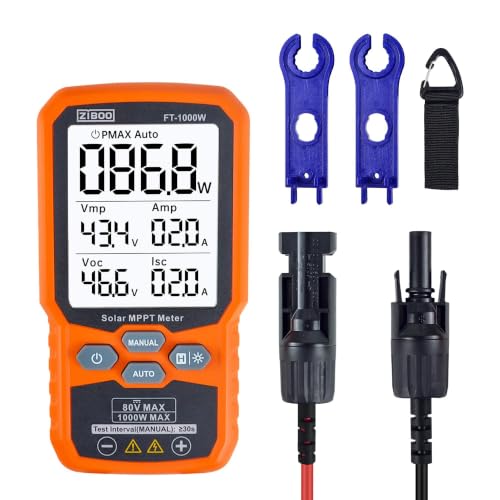
Products shown because their documented specifications fit this guide. Price and availability are on Amazon and can change.
Frequently Asked Questions
Is panel output proportional to irradiance?
Current is nearly proportional; voltage changes little. So power is close to proportional, with a small efficiency drop at very low light and a temperature penalty when the panel is hot.
Why does my 400 W panel only produce 300 W in full sun?
At 1,000 W/m² a panel on a summer roof runs at 50 to 65 °C, losing 10 to 15 percent to temperature. Add a few percent for soiling and wiring and 300 to 340 W is normal.
What efficiency do panels have?
Modern crystalline silicon modules are 19 to 23 percent efficient at standard test conditions. A 2 m² panel at 20 percent captures 400 W from 1,000 W/m².
Affiliate disclosure: Akermin earns a commission from qualifying Amazon purchases made through links on this page. Our editorial picks are based on documented specifications and owner feedback, not commissions.
Related Guides

UNI-T UT503PV Review: A DC 1000 V Headline on a CAT III 600 V Body
A solar insulation resistance tester that works on energised PV strings up to DC 1000 V, with test voltages of 125, 250, 500 and 1000 V, a range to 4000 megohms, automatic discharge, 1000 stored result sets and USB or Bluetooth transfer.
Read More→
ANCEL BA101 Review: The Exclusion List Is the Most Useful Bullet
A 12 volt battery, cranking and charging system tester covering 100 to 2000 CCA that reports state of health, state of charge, voltage, current and CCA, drawing its own power from the battery under test.
Read More→
Tenmars Solar Power Meter Review: One Accuracy Figure, Two Very Different Jobs
A handheld solar irradiance meter reading 0 to 1999 watts per square metre or 0 to 634 BTU per square foot per hour, with a selectable 199.9 or 1999 scale, maximum and minimum tracking, data hold and manual zeroing.
Read More→